Juniperus scopulorum
Sarg.
Rocky Mountain Juniper, Weeping Rocky Mountian Juniper, Colorado Red Cedar
iNaturalist· cc-by-nc
(c) Christopher J. Earle, some rights reserved (CC BY-NC), uploaded by Christopher J. Earle
iNaturalist· cc-by-nc
(c) Dakota Duff, some rights reserved (CC BY-NC), uploaded by Dakota Duff
iNaturalist· cc-by-nc
(c) Judith Ellen Lopez, some rights reserved (CC BY-NC), uploaded by Judith Ellen Lopez
Description
Juniperus scopulorum is an evergreen Tree growing to 10 m (32ft) by 4 m (13ft) at a slow rate. See above for USDA hardiness. It is hardy to UK zone 3. It is in leaf all year, in flower from April to May, and the seeds ripen in October. The species is dioecious (individual flowers are either male or female, but only one sex is to be found on any one plant so both male and female plants must be grown if seed is required). and is pollinated by Wind. The plant is not self-fertile. Suitable for: light (sandy), medium (loamy) and heavy (clay) soils and prefers well-drained soil. Suitable pH: mildly acid, neutral and basic (mildly alkaline) soils and can grow in very alkaline soils. It cannot grow in the shade. It prefers dry or moist soil and can tolerate drought. The plant can tolerates strong winds but not maritime exposure.
Edible Uses
Tea. Fruit - raw or cooked. Sweet and fleshy, but strongly flavoured. Resinous. Often used as a flavouring, imparting a sage-like taste, for which purpose it is usually dried and ground into a powder. The fruit can also be dried and ground into a meal for making mush and cakes.The fruits are about 5 - 8mm in diameter. The roasted fruit is a coffee substitute. A tea is made from the fruits and young shoots.
Medicinal Uses
Antidandruff Appetizer Diaphoretic Disinfectant Diuretic Haemostatic Kidney Laxative Parasiticide Poultice Sedative Stomachic Tonic VDRocky Mountain juniper was widely employed medicinally by many native North American Indian tribes who used it in particular to treat problems connected with the chest and kidneys. It is little, if at all, used in modern herbalism. A tea made from the terminal shoots has been used in the treatment of VD by some N. American Indian tribes. The treatment has to be taken over a long period of time. The fruits are appetizer, diuretic and stomachic. An infusion has been used in the treatment of stomach, kidney and bladder problems. An infusion of the twigs has been used in the treatment of fevers, pneumonia, coughs and colds. A poultice of the mashed and dampened branches has been applied to skin sores. The leaves are diaphoretic, disinfectant, febrifuge, haemostatic, laxative, sedative and tonic. A decoction has been used in the treatment of internal bleeding, constipation and constant coughing. The leaves have been boiled, then mixed with turpentine and used as an external treatment on rheumatic joints. The leaves have been rubbed into the hair in order to treat dandruff.
Distribution
Western N. America - British Columbia to Mexico and California.
Where It Grows
NORTHERN AMERICA: Canada (Alberta, British Columbia), United States (Nebraska, North Dakota, Oklahoma, South Dakota, Colorado, Idaho, Montana, Oregon, Washington, Wyoming, New Mexico, Texas, Arizona, Nevada, Utah), Mexico (Chihuahua (north), Coahuila de Zaragoza)
Cultivation
Succeeds in most soils, including chalk, so long as they are well drained, preferring a neutral or slightly alkaline soil. A drought tolerant species once established, succeeding in hot dry positions. Plants are fairly wind-resistant. A long-lived but slow-growing tree in its native range, it is very slow growing in Britain where it only makes a shrub. Closely allied to J. virginiana and hybridising with it where the ranges meet. It differs mainly in the fruit, which takes two years to mature in this species instead of one. Plants are resistant to honey fungus. This tree is apparently resistant to the rust fungus that attacks the closely related J. virginiana. Dioecious. Male and female plants must be grown if seed is required. In garden design, as well as the above-ground architecture of a plant, root structure considerations help in choosing plants that work together for their optimal soil requirements including nutrients and water.
Propagation
The seed requires a period of cold stratification. The seed has a hard seedcoat and can be very slow to germinate, requiring a cold period followed by a warm period and then another cold spell, each of 2 - 3 months duration. Soaking the seed for 3 - 6 seconds in boiling water may speed up the germination process. The seed is best sown as soon as it is ripe in a cold frame. Some might germinate in the following spring, though most will take another year. Another possibility is to harvest the seed 'green' (when the embryo has fully formed but before the seedcoat has hardened). The seedlings can be potted up into individual pots when they are large enough to handle. Grow on in pots until large enough, then plant out in early summer. When stored dry, the seed can remain viable for several years. Cuttings of mature wood, 5 - 10cm with a heel, September/October in a cold frame. Plant out in the following autumn. Layering in September/October. Takes 12 months.
Other Uses
Beads Disinfectant Incense Parasiticide Repellent Shelterbelt Tinder Wax WoodA fragrant wax on the fruits can be obtained by boiling the fruit and skimming off the wax as it floats to the surface. It is used to make aromatic candles but is only present in small quantities. The boughs are used as an incense to fumigate houses and to drive off smells. The wood can be burnt or just hung in the room, or it can be boiled up in water and the water used to wash the walls, floor etc. The bark is employed as a tinder and is also made into a slow match. The dried seeds have been used as beads or as the 'rattle' in rattles. The fruits and the leaves are used as an insect repellent. A strong infusion of the cones is used to kill ticks. Plants can be grown as a ground cover, the cultivar 'Repens' is especially suitable. A fairly wind resistant tree, it can be grown as part of a shelterbelt planting. In N. America it is used to some extent in re-afforestation and shelterbelt plantings on the prairies. Wood - extremely tough, aromatic, close grained, light, fairly strong in endwise compression but moderately weak in bending, hard, durable in the soil. Used for interior finishes, bows, hoops, hafts, wheels etc.
Synonyms
More from Cupressaceae
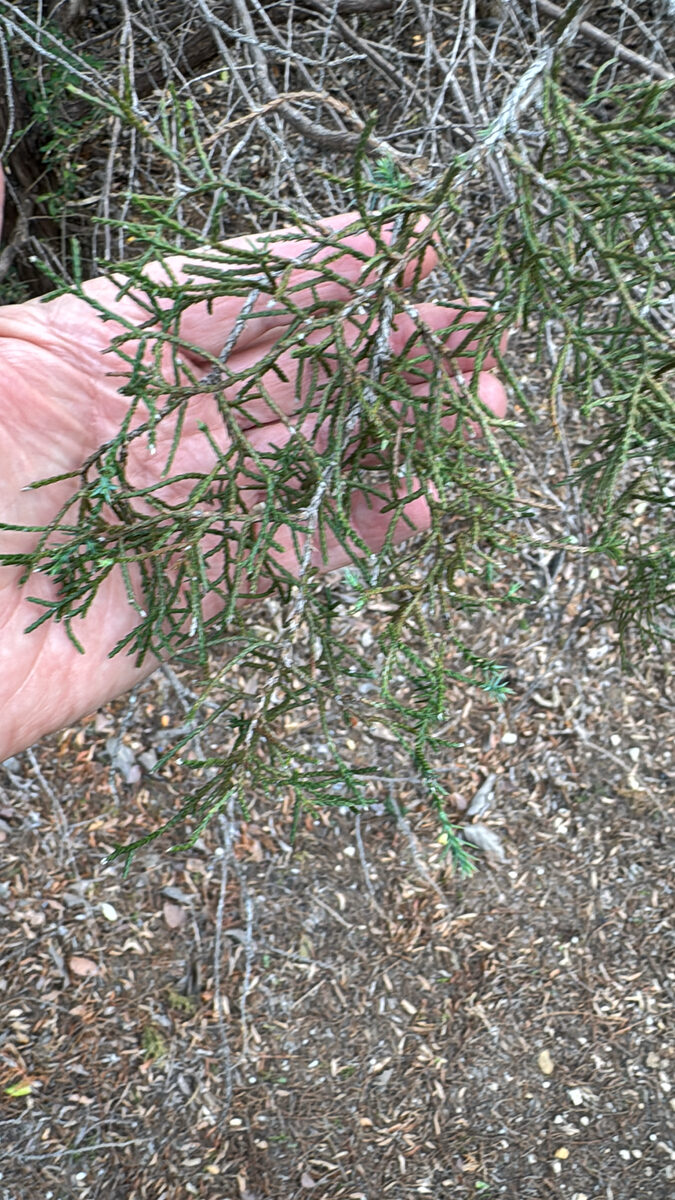
Juniperus tetragona
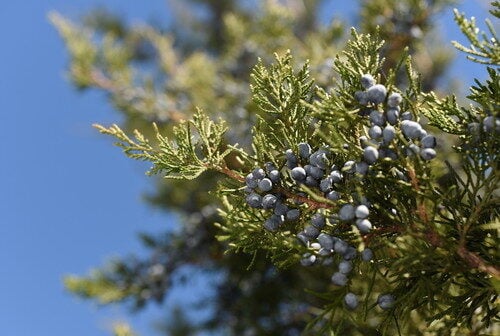
Juniperus virginiana
Pencil Cedar, Eastern redcedar, Southern redcedar, Silver Cedar, Burk Eastern Red Cedar, Silver East
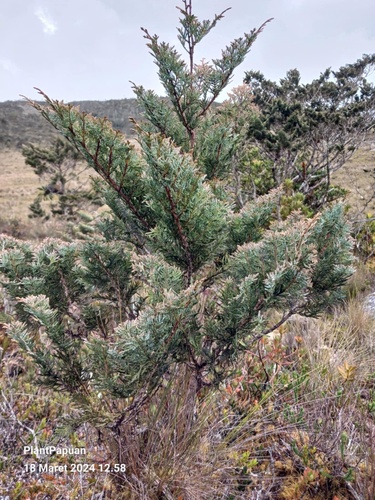
Papuacedrus papuana
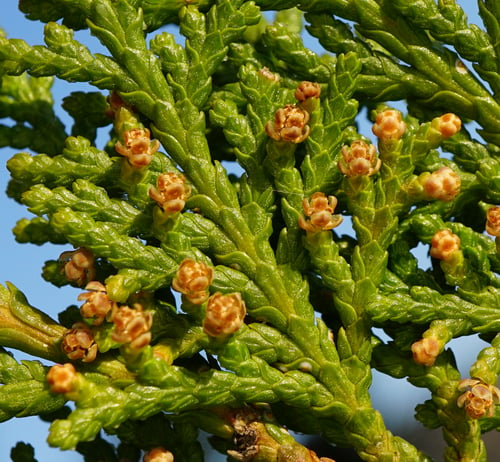
Platycladus orientalis
Oriental cedar
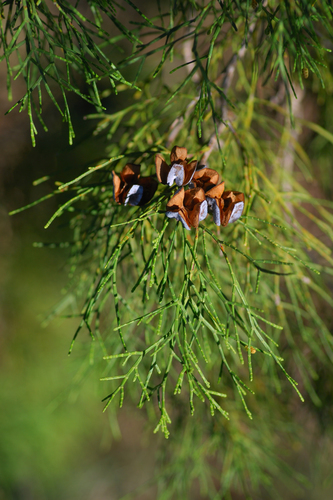
Tetraclinis articulata
Arartree
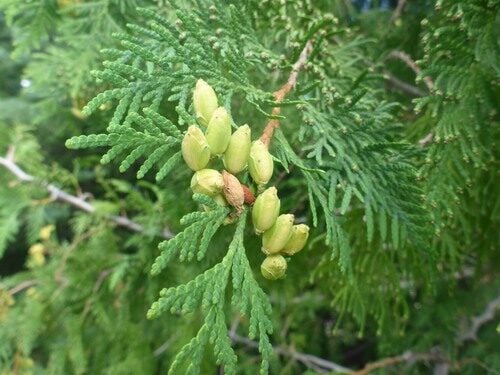
Thuja occidentalis
American Arbor-Vitae, Arborvitae, Eastern Arborvitae, Siberian Arborvitae, Northern White Cedar, Wh