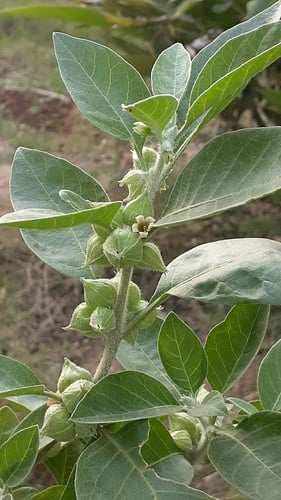
Capsicum annuum var. aviculare - (Dierb.) D'Arcy & Eschbaugh
(Dierb.) D'Arcy & Eschbaugh
Cayenne Pepper
gbif· cc-by-nc
Florida Museum of Natural History Herbarium - University of Florida
gbif· cc-by-nc
President and Fellows of Harvard College
Description
Capsicum annuum var. aviculare is a PERENNIAL growing to 0.6 m (2ft) by 0.6 m (2ft in) at a fast rate. See above for USDA hardiness. It is hardy to UK zone 6. The flowers are pollinated by Birds, Bees, Insects. It is noted for attracting wildlife. Suitable for: light (sandy), medium (loamy) and heavy (clay) soils, prefers well-drained soil and can grow in nutritionally poor soil. Suitable pH: mildly acid, neutral and basic (mildly alkaline) soils. It cannot grow in the shade. It prefers dry or moist soil and can tolerate drought.
Edible Uses
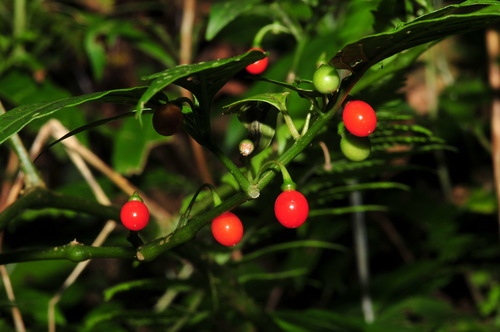
Edible Uses & Rating: The only edible portion is the fruit, which is exceptionally hot even in very small quantities. It is a seasoning rather than a staple food, providing heat for stews, beans, meats, and salsas. The fruits can be dried, ground into powder, or preserved in vinegar. Their culinary value is exceptionally high, but their caloric or nutritional contribution is minimal. Wild availability is limited and restricted to scattered populations, making their rating as a practical foraging resource low. Taste, Processing & Kitchen Notes: Fresh berries are fiery-hot, with a bright, sharp, clean heat that is far more intense than most cultivated jalapeño-type chiles. Their flavour is often described as searing and fruity with a slight citrus edge. Drying the berries concentrates heat and allows them to be crushed or powdered. Roasting lightly before grinding improves complexity and reduces grassy top notes. A single dried bird pepper can flavour an entire pot of beans or broth. The fruits can also be fermented for hot sauce, pickled green, or added whole to soups to infuse heat without contributing bitterness. Seasonality (Phenology): Plants flower in summer following monsoon rains, producing fruit from late summer through autumn. In warm frost-free regions, they may fruit intermittently throughout the year. Cool weather or drought markedly reduces flowering. Safety & Cautions (Food Use): Fruits are extremely hot and capable of causing skin, eye, and mucosal irritation. Handling should be done with care. No toxicity is present beyond capsaicin irritation. Harvest & Processing Workflow: Fruits are harvested when bright red and fully ripe. They can be dried whole in the sun or dehydrator, roasted lightly prior to grinding, or used fresh. Gathering wild fruits is tedious due to low density of shrubs and small fruit size. Cultivar / Selection Notes: Wild bird pepper is the ancestral stock of many modern Capsicum annuum cultivars. Some domesticated forms (e.g., chiltepin) have been selected for larger fruits or higher productivity. No named cultivars exist within the var. glabriusculum aside from ethnobotanically recognized regional forms. Look-Alikes & Confusion Risks: Confusion is unlikely: the small, upright, bright red berries and white five-petaled flowers are distinctive. Non-Capsicum Solanaceae species may have similar leaves but lack the characteristic pepper fruits. Traditional / Indigenous Use Summary: Indigenous peoples from Mexico to Texas used the fruits as seasoning, medicine, and food preservative. Chiles were often dried, powdered, or added to stews and corn preparations. Bird peppers were also valued as a trading commodity in pre-Columbian exchange networks.
Medicinal Uses
We have limited information on Capsicum annuum var. aviculare, but medical uses will be similar to the cultivated Capsicum annuum as follows: The fruit of the hot, pungent cultivars is antihaemorrhoidal when taken in small amounts, antirheumatic, antiseptic, diaphoretic, digestive, irritant, rubefacient, sialagogue, and tonic. It is taken internally in the treatment of the cold stage of fevers, debility in convalescence or old age, varicose veins, asthma, and digestive problems. Externally, it is used in the treatment of sprains, unbroken chilblains, neuralgia, pleurisy, etc. It is an effective sea-sickness preventative. The German Commission E Monographs, a therapeutic guide to herbal medicine, approve Capsicum for muscular tension, rheumatism (see for critics of commission E).
Known Hazards
Fruits are extremely hot and capable of causing skin, eye, and mucosal irritation. Handling should be done with care. No toxicity is present beyond capsaicin irritation.
Distribution
In the United States, the species occurs mainly in south Texas, southern Arizona (rarely), New Mexico’s southern deserts, the lower Rio Grande region, the Gulf Coast states, and Florida. It extends south through Mexico, Central America, and into South America.
Where It Grows
US. USA. Alabama, Arizona, Bahamas, Belize, Bolivia, Brazil North, Brazil Northeast, Cayman Is., Colombia, Costa Rica, Cuba, Dominican Republic, Ecuador, El Salvador, Florida, Guatemala, Guyana, Haiti, Honduras, Jamaica, Leeward Is., Louisiana, Mexico Central, Mexico Gulf, Mexico Northeast, Mexico Northwest, Mexico Southeast, Mexico Southwest, Netherlands Antilles, Nicaragua, Panamá, Peru, Puerto Rico, Southwest Caribbean, Suriname, Texas, Trinidad-Tobago, Turks-Caicos Is., Venezuela, Windward Is.
Cultivation
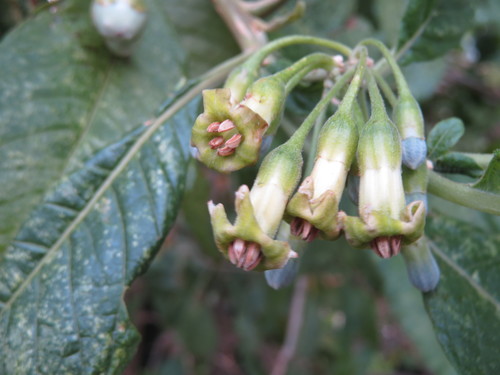
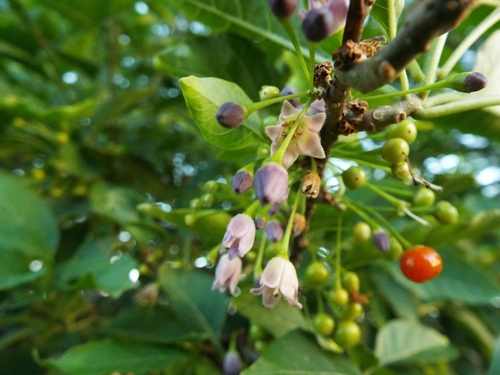
Growing Conditions: Cayenne pepper prefers warm temperatures, well-drained soils, and partial to full sun. It tolerates drought but fruits best under moderate moisture and seasonal rains. In the U.S., wild populations occur in USDA Zones 9–11, though cultivated plants may survive as annuals in Zones 6–8. Soil fertility has little effect on survival but influences fruit quantity. Habitat & Range: In the United States, the species occurs mainly in south Texas, southern Arizona (rarely), New Mexico’s southern deserts, the lower Rio Grande region, the Gulf Coast states, and Florida. It extends south through Mexico, Central America, and into South America. Typical habitats include canyon bottoms, limestone slopes, thornscrub, mesquite woodlands, subtropical thickets, and disturbed sites with partial shade. Size & Landscape Performance: Wild bird pepper forms compact shrubs 30–100 cm tall and 30–60 cm wide. In cultivation, plants may reach a meter or more. They are highly ornamental due to the profusion of bright red upright fruits, and they tolerate heat, drought, and poor soils well. Cultivation (Horticulture): Cayenne pepper is straightforward to cultivate like other chiles. Seeds germinate best with warmth (25–30°C) and consistent moisture. Plants thrive in sunny beds or containers and benefit from occasional pruning to maintain dense form. They are perennial in frost-free climates but grown as annuals elsewhere. The variety glabriusculum is slower-growing and less productive than modern cultivars but hardier and more pest-resistant. Pests & Problems: Plants are generally hardy, with occasional issues from aphids, flea beetles, whiteflies, or fungal leaf spots. In wild habitats these pressures are minimal. Cultivar / Selection Notes: Wild bird pepper is the ancestral stock of many modern Capsicum annuum cultivars. Some domesticated forms (e.g., chiltepin) have been selected for larger fruits or higher productivity. No named cultivars exist within the var. glabriusculum aside from ethnobotanically recognized regional forms. Identification & Habit: Cayenne pepper in its wild form grows as an unarmed, branched subshrub or herbaceous perennial with smooth stems. Plants may remain small—typically under a meter—or form compact shrubs in favourable conditions. Leaves are simple, alternate, and stalked, usually lance-shaped to broadly ovate with entire margins and a glossy to matte green surface. Flowers are borne singly or in pairs in leaf axils on pedicels noticeably longer than the flower itself. Each flower is white, five-lobed, wheel-shaped, and perfect, with five stamens and a superior ovary. After pollination, the plant forms small, upright, red, fleshy berries with thin walls and extremely hot pulp and seeds. The fruiting phase follows late-summer flowering triggered by rainfall or humid conditions.
Propagation
Propagation is almost exclusively by seed, though cuttings can root. Seeds remain viable for years if kept dry. Wild seed germination is enhanced by warm-day / cool-night cycles or small amounts of scarification.
Other Uses
Bird peppers were also valued as a trading commodity in pre-Columbian exchange networks. Ecology & Wildlife: Pollination is performed primarily by insects, especially bees attracted to the white, nectar-bearing flowers. Some self-pollination occurs. The fruits are eaten extensively by birds, which are not affected by capsaicin and disperse the seeds widely. Mammals generally avoid them.
Synonyms
Also Known As
Cayenne Pepper, Bird Pepper, Chilipiquin, Capsicum annuum var. glabriusculum, Chile Pequin, Chile Tepin, Turkey Pepper, Cayenne Pepper