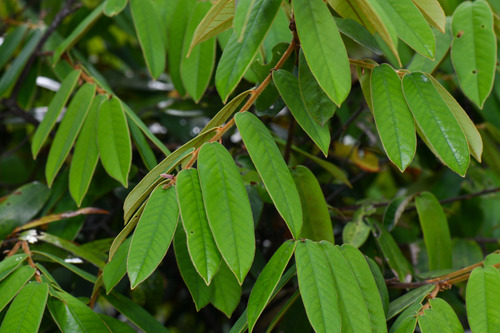
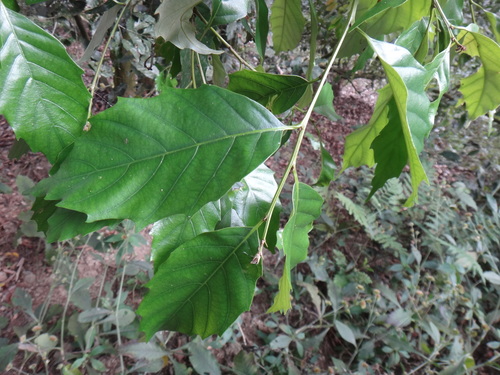
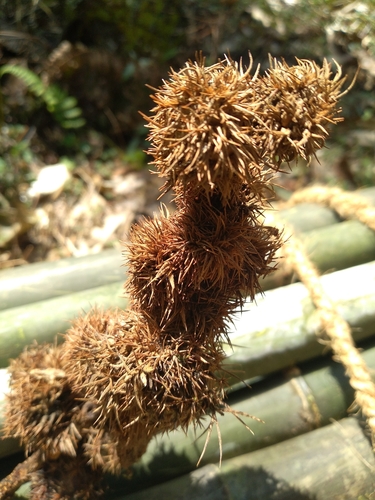
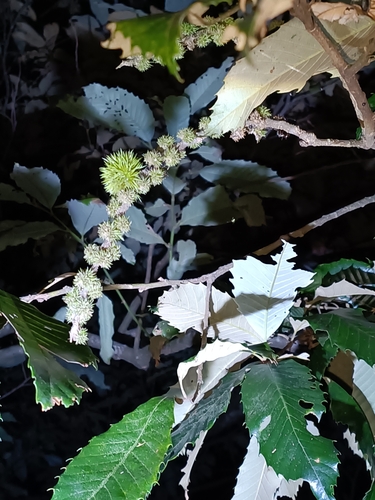
Quercus ithaburensis macrolepis - (Kotschy.)Hedge.&Yalt.
(Kotschy.)Hedge.&Yalt.
Valonia Oak
gbif· cc-by-nc
Nemo di Punta Grossa
gbif· cc-by-nc
Nemo di Punta Grossa
gbif· cc-by-nc
Felipe Castilla Lattke
Description
Quercus ithaburensis macrolepis is a deciduous Tree growing to 15 m (49ft) by 13 m (42ft) at a slow rate. See above for USDA hardiness. It is hardy to UK zone 7. The species is monoecious (individual flowers are either male or female, but both sexes can be found on the same plant) and is pollinated by Wind. The plant is not self-fertile. It is noted for attracting wildlife. Suitable for: medium (loamy) and heavy (clay) soils. Suitable pH: mildly acid, neutral and basic (mildly alkaline) soils. It can grow in semi-shade (light woodland) or no shade. It prefers dry or moist soil. The plant can tolerates strong winds but not maritime exposure.
Edible Uses
Coffee. Seed - raw or cooked. The seed is quite big, about 4cm x 3cm and is very low in tannin. Any bitter seeds can be leached by thoroughly washing the seed in running water though many minerals will also be lost. Either the whole seed can be used or the seed can be dried and ground it into a powder. It can take several days or even weeks to properly leach whole seeds, one method was to wrap them in a cloth bag and place them in a stream. Leaching the powder is quicker. A simple taste test can tell when the tannin has been leached. The traditional method of preparing the seed was to bury it in boggy ground overwinter. The germinating seed was dug up in the spring when it would have lost most of its astringency. Roasted seed is a coffee substitute. A manna is obtained from the tree. No further details.
Medicinal Uses
Astringent Dysentery. Any galls produced on the tree are strongly astringent and can be used in the treatment of haemorrhages, chronic diarrhoea, dysentery etc.
Distribution
S.E. Europe to W. Asia.
Where It Grows
TEMPERATE ASIA: Lebanon-Syria, Palestine,Turkey. EUROPE: Albania, Bulgaria, East Aegean Island, Greece, Italy, Kriti, Turkey, Slovenia, Croatia, Bosnia, Herzegovina, Serbia, Montenegro, North Macedonia, Kosovo,
Cultivation
Prefers a good deep fertile loam which can be on the stiff side. Lime tolerant. Young plants tolerate reasonable levels of side shade. Tolerates moderate exposure, surviving well but being somewhat stunted. Prefers warmer summers than are usually experienced in Britain, but trees usually grow well in Britain. The seed takes two years to ripen but is seldom produced in this country. Hybridizes freely with other members of the genus. This species is notably resistant to honey fungus. Intolerant of root disturbance, trees should be planted in their permanent positions whilst young. Acorns are harvested in Autumn, usually from September to November(Northern Hemisphere) , depending on the species and local climate. Oaks flower in Spring, with male flowers (catkins) appearing in April to June (Northern Hemisphere). Oaks generally have a slow to moderate growth rate, often taking several decades to reach full maturity. Some species may grow 1-2 feet per year under optimal conditions. Oaks are generally not self-fertile; they require cross-pollination between different trees for acorn production.
Propagation
Seed - it quickly loses viability if it is allowed to dry out. It can be stored moist and cool overwinter but is best sown as soon as it is ripe in an outdoor seed bed, though it must be protected from mice, squirrels etc. Small quantities of seed can be sown in deep pots in a cold frame. Plants produce a deep taproot and need to be planted out into their permanent positions as soon as possible, in fact seed sown in situ will produce the best trees. Trees should not be left in a nursery bed for more than 2 growing seasons without being moved or they will transplant very badly.
Other Uses
Dye Ink Repellent Tannin Wood Agroforestry uses: Oaks are valuable in agroforestry for providing shade, timber, and wildlife habitat. They can also help with soil improvement and erosion control. A mulch of the leaves repels slugs, grubs etc, though fresh leaves should not be used as these can inhibit plant growth. The acorn cups contain about 45% tannin. A black dye can be obtained from them and it can be used as an ink. Gall-like excretions on the plant are caused by damage from the insect Cynips calicis. These growths contain about 30% tannin.
Synonyms
Also Known As
Valonia Oak (Q. ithaburensis subsp. macrolepis or Q. macrolepis)