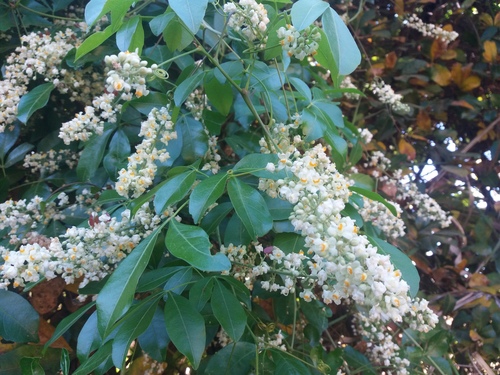
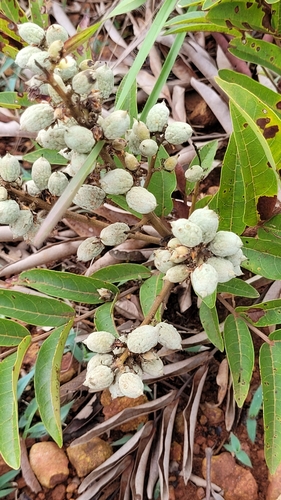
Melicoccus bijugatus
Jacq.
Mamoncillo, Spanish Lime, Guayo
iNaturalist· cc-by-nc
(c) Susan J. Hewitt, some rights reserved (CC BY-NC), uploaded by Susan J. Hewitt
iNaturalist· cc-by-nc-sa
(c) Karen, some rights reserved (CC BY-NC-SA)
iNaturalist· cc-by-nc-sa
(c) BIODAA I E Diogenes A. Arrieta, some rights reserved (CC BY-NC-SA)
Description
Melicoccus bijugatus is an evergreen Tree growing to 18 m (59ft) by 18 m (59ft) at a slow rate. See above for USDA hardiness. It is hardy to UK zone 10 and is frost tender. The flowers are pollinated by Bees. It is noted for attracting wildlife. Suitable for: light (sandy), medium (loamy) and heavy (clay) soils, prefers well-drained soil and can grow in nutritionally poor soil. Suitable pH: neutral and basic (mildly alkaline) soils and can grow in very alkaline and saline soils. It can grow in semi-shade (light woodland) or no shade. It prefers dry or moist soil and can tolerate drought. The plant can tolerates strong winds but not maritime exposure.
Edible Uses
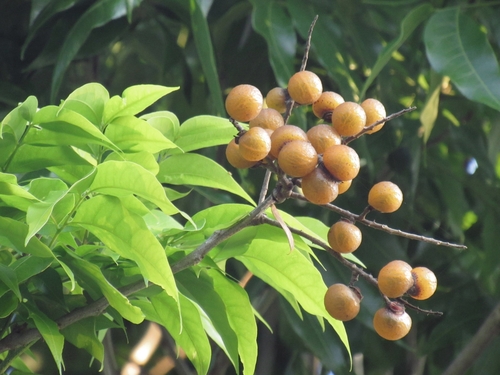
Drink. Fruit - raw or cooked. The fruit is juicy, aromatic and somewhat sweet with a pleasant, acid flavour. A sweet and gelatinous pulp with a grape-like flavour. Usually eaten out of hand, they can also be cooked in pies, jams and jellies etc. They make a cooling drink. The fruit is up to 3cm in diameter, containing a single, occasionally two, large seed. The large, starchy seeds are roasted and used as a substitute for cassava. The elliptic seeds can be up to 28mm long.
Medicinal Uses
Antidiarrhoeal Antihydrotic DysenteryA decoction of the bark is widely used by local people to treat dysentery. An infusion of the leaves is used to decrease or retard perspiration.
Distribution
Northern and western S. America - Colombia and Venezuela.
Where It Grows
SOUTHERN AMERICA: Venezuela, Brazil, Colombia,
Cultivation
A plant of the moist, lowland tropics, where it is found at elevations up to 600 metres. It grows best in areas where annual daytime temperatures are within the range 22 - 30°c, but can tolerate 13 - 34°c. When dormant, the plant can survive temperatures down to about -3°c, but young growth can be severely damaged at -1°c. It prefers a mean annual rainfall in the range 800 - 1,600mm, but tolerates 500 - 2,700mm. Prefers a fertile, well-drained soil in a sunny position, though it can also succeed in poor soils. Prefers a pH in the range 5.5 - 7, tolerating 5 - 8.7. Established plants are very drought tolerant. Plants can withstand the strongest salt-laden winds. Seedling plants take 7 - 10 years to begin fruiting. Cuttings can fruit in 4 - 5 years. The flowers are pleasantly scented and attract bees. There are some named varieties. Trees are intolerant of pruning. Some members of this species are hermaphrodite, whilst others can be dioecious. Most forms are dioecious, in which case it is necessary to grow both male and female forms if fruit and seed are required. Flowering Time: Late Winter/Early Spring Mid SSpring. Bloom Color: White/Near White. Spacing: 20-30 ft. (6-9 m).
Propagation
Seed - seedlings often do not fruit as well as their parent. Air layering. Greenwood cuttings. Grafting.
Other Uses
Furniture Wood. Seaside and Shade tree. Street tree. Specimen. Xerophytic. Other Uses The heartwood is light brown to pale yellow-gray; the sapwood light brown. The wood is of medium weight, fairly hard but does not resist decay. It is sometimes used for cabinet work, construction and interior works.
Synonyms
Also Known As
Mamoncillo, Spanish Lime, Guayo, Honeyberry, Limoncillo, Genipe, Ginep, Ginip, Grosella de miel, Guayo, Guenepa, Guinep, Honey-berry, Kanappy, Kenep, Kinep, Limoncillo, Mamon, Mamoncilho, Pitomba-das-guianas, Quenep, ackee, genip, guinep, honeyberry, mamoncillo, quenepa, spanish lime