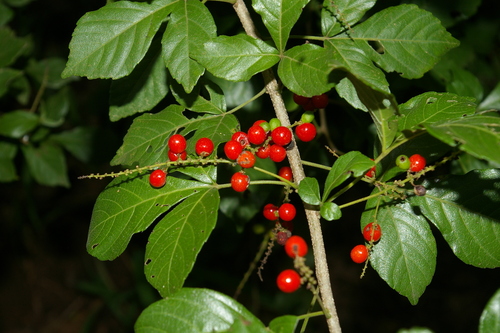
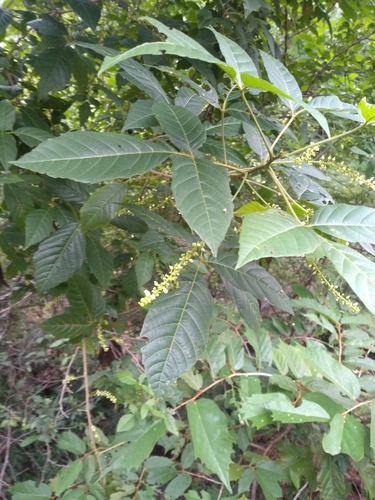
Aesculus hippocastanum
L.
European horse chestnut
iNaturalist· cc-by-nc
(c) Valeria Pismerova, some rights reserved (CC BY-NC), uploaded by Valeria Pismerova
iNaturalist· cc0
no rights reserved, uploaded by Onondaga Earth Corps
iNaturalist· cc-by-nc-sa
(c) Kingsbrae Garden, some rights reserved (CC BY-NC-SA)
Summary
Source: WikipediaAesculus hippocastanum, the horse chestnut, is a species of flowering plant in the maple, soapberry and lychee family Sapindaceae. It is a large, deciduous, synoecious (hermaphroditic-flowered) tree. It is also called horse-chestnut, European horsechestnut, buckeye, and conker tree. It is not to be confused with the sweet chestnut or Spanish chestnut, Castanea sativa, which is a tree in another family, Fagaceae.
Description
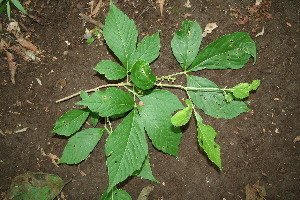
A rounded spreading deciduous tree. It grows to 25-30 m high and spreads to 5-20 m wide. The stem is erect. The bark is smooth and grey when young but becomes cracked and scaly with age. The leaves are like the fingers on a hand with 5-7 leaflets. The leaves are 30 cm long. The leaflets are wedge shaped and broadest towards the outer edge. There are fine teeth around the edge. The leaves have long leaf stalks. The flowers are white with yellow and in clusters 30 cm tall. They occur at the ends of branches. They have a sweet honey like perfume. The fruit is a spiny green chestnut capsule. Inside there is a brown nut with a shiny skin. It has 1-2 glossy brown seeds inside. The seeds are 5 cm across.
Edible Uses
The roasted seed can be used as a coffee substitute. It can also be cooked, dried, and ground into a powder for use as a gruel. Seeds are large — around 3cm in diameter — and typically produced in abundance. They contain up to 40% water, 8–11% protein, and 8–26% toxic saponins. These saponins must be removed before the seed is safe to eat, and doing so also strips out much of the mineral and vitamin content, leaving mostly starch. Based on practice recorded for A. californica, an effective method is to slow-roast the nuts (which neutralises the saponins), slice them thinly, place them in a cloth bag, and rinse in a running stream for 2–5 days.
Traditional Uses
The roasted seed is used as a coffee substitute. CAUTION: This plant contains saponins which although poisonous are not normally easily absorbed by the body. It is nevertheless probably not wise to eat large quantities. The seeds are eaten cooked. Before eating they are slowly roasted then often crushed and washed for 2-5 days in running water. They are then dried and ground into a powder.
Medicinal Uses
Horse chestnut is an astringent, anti-inflammatory herb that helps to tone vein walls, which when slack or distended can become varicose, haemorrhoidal, or otherwise problematic. It also reduces fluid retention by increasing capillary permeability and allowing excess fluid to be reabsorbed into the circulatory system. This plant is potentially toxic if ingested and should not be used internally without professional supervision. It has alterative, analgesic, haemostatic, and vulnerary properties. The bark is anti-inflammatory, astringent, diuretic, febrifuge, narcotic, tonic, and vasoconstrictive; it is harvested in spring and dried for later use. Taken internally in small doses, it is used for a wide range of venous diseases including hardening of the arteries, varicose veins, phlebitis, leg ulcers, haemorrhoids, and frostbite, and can also be made into a lotion or gel for external application. A tea from the bark treats malaria and dysentery internally, and lupus and skin ulcers externally. A leaf tea is tonic and used for fevers and whooping cough. The pericarp is peripherally vasoconstrictive. The seeds are decongestant, expectorant, and tonic, and have been used for rheumatism, neuralgia, and haemorrhoids; they are reported to be narcotic, with 10 grains said to be equivalent to 3 grains of opium. An oil from the seeds has been used externally for rheumatism. A compound of the powdered roots is analgesic and has been used for chest pains. The buds are used in Bach flower remedies — the prescribing keywords are 'Failure to learn by experience', 'Lack of observation in the lessons of life', and 'The need of repetition'. The flowers are also used in Bach flower remedies — the keywords are 'Persistent unwanted thoughts' and 'Mental arguments and conversations'. The German Commission E Monographs approve Aesculus hippocastanum for chronic venous insufficiency in the legs.
Known Hazards
There is risk of acute kidney injury, "when patients, who had undergone cardiac surgery were given high doses of horse chestnut extract i.v. for postoperative oedema. The phenomenon was dose dependent as no alteration in kidney function was recorded with 340 μg/kg, mild kidney function impairment developed with 360 μg/kg and acute kidney injury with 510 μg/kg". Raw horse chestnut seed, leaf, bark and flower are toxic due to the presence of aesculin and should not be ingested. Horse chestnut seed is classified by the FDA as an unsafe herb. The glycoside and saponin constituents are considered toxic.
Distribution
It is a temperate plant. It requires rich sandy loam. It is drought and frost resistant. It needs a protected sunny position. It can grow on poorer soils and in exposed positions. Trees are very hardy when dormant. In Melbourne Botanical Gardens. It suits hardiness zones 6-9. At Anvers Chocolate factory. Arboretum Tasmania. National Arboretum Canberra.
Where It Grows
Albania, Asia, Australia, Austria, Balkans, Belgium, Britain, Bulgaria, Canada, Central America, China, Czech Republic, Estonia, Europe*, France, Germany, Greece*, Himalayas, Hungary, India, Iran, Ireland, Italy, Kazakhstan, Latvia, Lithuania, Macedonia, Mediterranean, Mexico, Netherlands, Northeastern India, North America, Poland, Portugal, Romania, Spain, Switzerland, Tasmania, Turkey, Türkiye, Turkmenistan, USA, Uzbekistan, Yugoslavia,
Cultivation
Prefers a deep loamy well-drained soil but is not too fussy tolerating poorer drier soils. Tolerates exposed positions and atmospheric pollution. A very ornamental and fast-growing tree, it succeeds in most areas of Britain but grows best in eastern and south-eastern England. Trees are very hardy when dormant, but the young growth in spring can be damaged by late frosts. The flowers have a delicate honey-like perfume. Trees are tolerant of drastic cutting back and can be severely lopped. They are prone to suddenly losing old heavy branches. The tree comes into bearing within 20 years from seed. Most members of this genus transplant easily, even when fairly large.
Propagation
Seed is best sown outdoors or in a cold frame as soon as it is ripe, as it germinates almost immediately and has very limited viability — it must not be allowed to dry out. Young seedlings need protection from severe weather. Stored seed should be soaked for 24 hours before sowing, though even then germination is not guaranteed. Sow with the scar facing downwards. When sowing in a cold frame, pot seedlings up in early spring and transplant to their permanent positions during summer.
Other Uses
Saponins in the seed act as a soap substitute and can be extracted by chopping the seed into small pieces and infusing them in hot water. The liquid can wash the body or clothes, though it leaves a persistent smell of horse chestnuts. The seed contains saponins up to a maximum of 10%. A starch obtained from the seed is used in laundering. The bark and other plant parts contain tannin. A yellow dye is obtained from the bark, and the flowers yield the dyestuff quercetin. The wood is soft, light, and not durable; it has little commercial value but is used for furniture, boxes, and charcoal.
Production
A fast growing tree. The tree comes into bearing within 20 years from seed. Trees live for 100 years.
Other Information
It is cultivated.
Notes
The seed contains up to 40% water, 8 - 11% protein and 8 - 26% toxic saponins. Esculin is contained in the leaves and fruit. There are 15 Aesculus species. Also put in the family Hippocastanaceae.
Synonyms
Also Known As
Buckeye, Common Horse-chestnut, Horse chestnut, Kastan, Kastani, Kastanos, Segah, Spanish chestnut, Vadesztenye, Wilde kastanje
References (38)
- Ambasta S.P. (Ed.), 2000, The Useful Plants of India. CSIR India. p 18
- Bircher, A. G. & Bircher, W. H., 2000, Encyclopedia of Fruit Trees and Edible Flowering Plants in Egypt and the Subtropics. AUC Press. p 11
- Bodkin, F., 1991, Encyclopedia Botanica. Cornstalk publishing, p 54
- Bremness, L., 1994, Herbs. Collins Eyewitness Handbooks. Harper Collins. p 34
- Brickell, C. (Ed.), 1999, The Royal Horticultural Society A-Z Encyclopedia of Garden Plants. Convent Garden Books. p 84
Show all 38 references Hide references
- Brouk, B., 1975, Plants Consumed by Man. Academic Press, London. p 214
- Brown, D., 2002, The Royal Horticultural Society encyclopedia of Herbs and their uses. DK Books. p 104
- Chen, B. & Qiu, Z., Consumer's Attitudes towards Edible Wild Plants, Ishikawa Prefecture, Japan. p 22 www.hindawi.com/journals/ijfr/aip/872413.pdf
- Coombes, A.J., 2000, Trees. Dorling Kindersley Handbooks. p 179
- Cundall, P., (ed.), 2004, Gardening Australia: flora: the gardener's bible. ABC Books. p 107
- Denes, A., et al, 2012, Wild plants used for food by Hungarian ethnic groups living inthe Carpathian Basin. Acta Societatis Botanicorum Poloniae 81 (4): 381-396
- Etherington, K., & Imwold, D., (Eds), 2001, Botanica's Trees & Shrubs. The illustrated A-Z of over 8500 trees and shrubs. Random House, Australia. p 79
- Farrar, J.L., 1995, Trees of the Northern United States and Canada. Iowa State University press/Ames p 158
- Guite, C., 2016, A study of wild edible plants associated with the Paite tribe of Manipur, India, International Journal of Current Research. Vol. 8, Issue, 11, pp. 40927-40932
- Harris, B.C., 1975, Eat the Weeds. Barre. p 93
- Harris, E & J., 1983, Field Guide to the Trees and Shrubs of Britain. Reader's Digest. p 158
- Heywood, V.H., Brummitt, R.K., Culham, A., and Seberg, O., 2007, Flowering Plant Families of the World. Royal Botanical Gardens, Kew. p 294
- Huxley, A. (Ed.), 1977, The Encyclopedia of the Plant Kingdom. Chartweil Books. p 138
- Joyce, D., 1998, The Garden Plant Selector. Ryland, Peters and Small. p 106
- Kalle, R. & Soukand, R., 2012, Historical ethnobotanical review of wild edible plants of Estonia (1770s-1960s) Acta Societatis Botanicorum Poloniae 81(4):271-281
- Kew Plants of the World Online
- Krochmal, A. & Krochmal, C., 1982, Uncultivated Nuts of The United States. United States Department of Agriculture Forest Service. p 31
- Little, E.L., 1980, National Audubon Society Field Guide to North American Trees. Alfred A. Knopf. p 585
- Lord, E.E., & Willis, J.H., 1999, Shrubs and Trees for Australian gardens. Lothian. p 46
- Menninger, E.A., 1977, Edible Nuts of the World. Horticultural Books. Florida p 113
- Morley, B. & Everard, B., 1970, Wild Flowers of the World. Ebury press. Plate 19
- Plants for a Future database, The Field, Penpol, Lostwithiel, Cornwall, PL22 0NG, UK. http://www.scs.leeds.ac.uk/pfaf/
- Prakofjewa, J., et al, 2023, Boundaries Are Blurred: Wild Food Plant Knowledge Circulation across the Polish-Lithuanian-Belarusian Borderland. Biology 2023, 12, 571.
- Pruse, B., et al, 2021, Active Wild Food Practices among Culturally Diverse Groups in the 21st Century across Latgale, Latvia. Biology 2021, 10, 551.
- Ryan, S., 2008, Dicksonia. Rare Plants Manual. Hyland House. p 6
- Sfikas, G., 1984, Trees and shrubs of Greece. Efstathiadis Group. Athens. p 118
- Simkova, K. et al, 2014, Ethnobotanical review of wild edible plants used in the Czech Republic. Journal of Applied Botany and Food Quality 88, 49-67
- Sp. pl. 1:344. 1753
- Vermeulen, N, 1998, The Complete Encyclopedia of Herbs. Rebo Publishers. p 26
- Vorstenbosch, T., et al, 2017, Famine food of vegetal origin consumed in the Netherlands during World War II. Journal of Ethnobiology and Ethnomedicine (2017) 13:63
- Wickens, G.E., 1995, Edible Nuts. FAO Non-wood forest products. FAO, Rome. p 132
- Young, J., (Ed.), 2001, Botanica's Pocket Trees and Shrubs. Random House. p 72
- Zeven, A. C. & de West, J. M. J., 1982, Dictionary of cultivated plants and their regions of diversity. Wageningen. p 83, 112