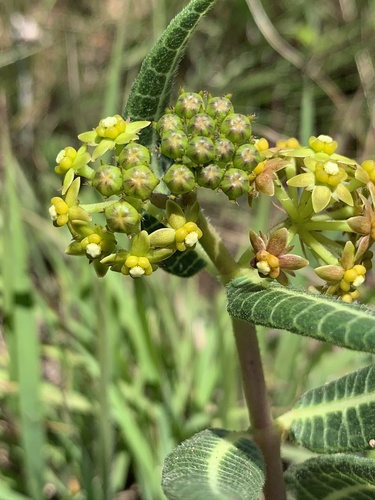
Leptadenia hastata - (Pers.) Decne.
(Pers.) Decne.
Akamongot, Anvara
No photos yet for Leptadenia hastata - (Pers.) Decne.
Sign in to contribute a photoDescription
Leptadenia hastata is an evergreen Perennial Climber growing to 1.5 m (5ft) by 0.2 m (0ft 8in) at a medium rate. See above for USDA hardiness. It is hardy to UK zone 10. The plant is self-fertile. It is noted for attracting wildlife. Suitable for: light (sandy), medium (loamy) and heavy (clay) soils, prefers well-drained soil and can grow in nutritionally poor soil. Suitable pH: mildly acid and neutral soils. It cannot grow in the shade. It prefers dry or moist soil and can tolerate drought.
Edible Uses
Young leaves and young shoots - cooked and added to soups. The young shoot-tips are sometimes eaten raw. The chopped and boiled leaves are mixed with beans, pigeon peas or cowpeas. The leaves of plants grown at Dakar have been analysed as containing: carbohydrates 46%, protein 18%, ash 14%, oil 6% by weight. Calcium was present at 2.06%, potassium 1.74%, with magnesium, sodium, phosphorous and numerous minor elements, the principal one being iron, and amino-acids. Flowers - cooked and added to soups. In a survey on the preference for 14 wild herbaceous vegetables that was held in Burkina Faso in 1999, this species ranked 3rd; its taste was considered good, and its tolerance of drought, insects and poor soil conditions as very good.
Medicinal Uses
Antidiarrhoeal Antihaemorrhoidal Antiinflammatory Diuretic Laxative Leprosy Ophthalmic Stomachic. The plant contains a milky sap and this has lead, by allusion, to it being used in the treatment of a wide range of ailments symptomized by discharges, or a lack of them. The plant is very strongly diuretic and generally strongly stimulates the flow of urine. In it also often used with a range of other plants to treat various conditions, including treating suckling babies who have green diarrhoea; for all vein troubles such as varicose veins, bleeding and painful haemorrhoids; poisonings; anuria; syphilis; leprosy; trypanosomiasis, etc. In short, it is used as a general panacea. Combined with the root of Smilax spp., it is used to treat for tertiary syphilis. The latex contains the triterpene lupeol and derivatives of it, which possess anti-inflammatory activity. The sap, or the whole leaf-petiole rolled up into a spill, is put in the nose as a treatment for head-colds and head pains. The latex is put on wounds. The sap, or the root in decoction, is used for treating ophthalmia. A root macerate is taken to treat anuria or constipation.The powdered roots in water are taken as a stomachic. A macerate or decoction of the whole plant is used to treat urethral discharge, abdominal complaints. A macerate or decoction of the leaves is used to remedy a lack of breast-milk, impotence, gonorrhoea and stomach-ache in children.
Distribution
Tropical Africa - Senegal to Ethiopia, Uganda and Kenya.
Where It Grows
Algeria, Benin, Burkina, Cameroon, Central African Republic, Chad, Ethiopia, Gambia, Ghana, Guinea, Guinea-Bissau, Ivory Coast, Kenya, Libya, Mali, Mauritania, Niger, Nigeria, Senegal, Sudan, Tanzania, Uganda.
Cultivation
A plant of semi-arid areas in the tropics. Succeeds in poor soil conditions. Established plants are drought-tolerant. Leptadenia hastata is generally considered to be self-fertile. The leaves and young shoots can be harvested throughout the growing season, the best time being spring to early summer. It usually flowers from late spring to early summer, depending on the local climate.
Propagation
Seed -
Other Uses
Fibre Tinder Agroforestry uses: Leptadenia hastata can be used as a forage plant for livestock, and its deep roots help in soil stabilization and erosion control. A fibre, without recorded use, can be obtained from the stem. The dried fruits are used as a tinder.
Synonyms
Also Known As
Akamongot, Anvara, Akamongot, Anvara, Be-thacare, Bissacra, Cheila, Chesakisyon, Cibode, Kayilla, Lelogo, M'bafecabuduco, Meta, Metsa, Moroh, Ndedeweck, N'rocde, Njera, Safaro, Safarodje, Sapate, Xeyla, Ya'diya, akamongot, anvara, chesakisyon, ekamong'o, lélogo, moroh.