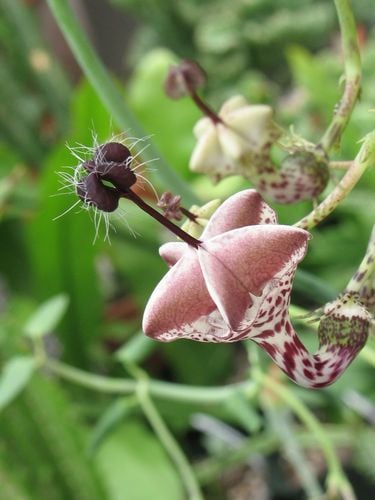
Marsdenia roylei
Wight
iNaturalist· cc-by-nc
(c) Suresh Ghimire, some rights reserved (CC BY-NC), uploaded by Suresh Ghimire
iNaturalist· cc-by-nc
(c) Suresh Ghimire, some rights reserved (CC BY-NC), uploaded by Suresh Ghimire
Summary
Marsdenia roylei is a climbing vine with hermaphroditic flowers. It grows in light sandy, loamy, or heavy clay soils suitable to mildly acidic or alkaline pH. Tolerates semi-shade in light woodland or full sun and prefers moist soil conditions.
Description
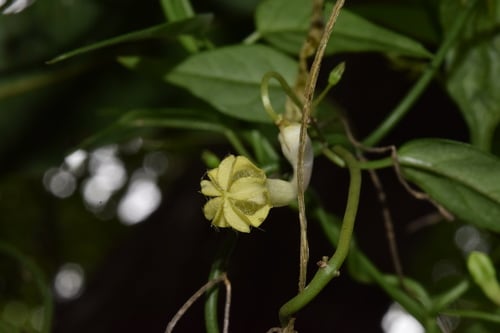
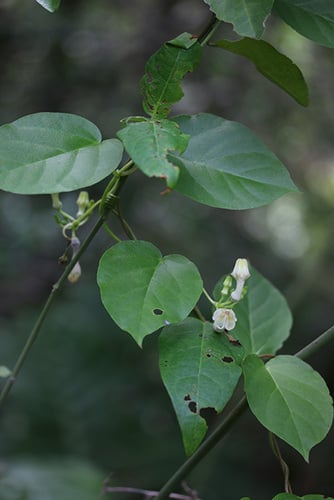
A twining shrub or climber. The juice is milky. The branches are woody and has raised lenticels. The leaves are 8-13 cm long by 4-8 cm wide. They are oval with a heart shaped base. They are hairy on both surfaces. The fruit are dry with several seeds. The fruit are 7.5 cm long by 2.5 cm wide. The seeds are oval and have a beak and with a thin wing along the edge.
Edible Uses
No edible uses are known for this plant.
Traditional Uses
The fruit are eaten raw.
This uses section is brief — help expand it
Medicinal Uses
The juice of the stem is used to treat gastric troubles and peptic ulcers.
Distribution
A tropical plant. It grows in the Himalayas between 1,000-2,300 m altitude.
Where It Grows
Asia, Himalayas, India, Malaysia, Myanmar, Nepal, Northeastern India, Pakistan, SE Asia, Sikkim,
Cultivation
We have very little information on this species and do not know if it will be hardy in Britain. However, judging by its native range, it could possibly succeed outdoors in the milder areas of the country. The plant is likely to require a very warm, sheltered position that gives some protection from winter cold.
Propagation
Sow seed in early spring in a greenhouse. Prick out seedlings into individual pots as soon as they are large enough to handle and grow them on for at least their first winter under glass. Plant out in early summer, providing some protection from winter cold for at least the first winter outdoors. Can also be propagated by cuttings or layering.
Other Uses
A silky-white, strong fibre obtained from the stems is used for making ropes and similar products.
Also Known As
Dhungmo nyung, Dudhe laharaa, Khorokse
References (4)
- Ambasta, S.P. (Ed.), 2000, The Useful Plants of India. CSIR India. p 357
- Flora of Pakistan.
- Ghimire, S. K., et al, 2008, Non-Timber Forest Products of Nepal Himalaya. WWF Nepal p 27
- Savita, et al, 2006, Studies on wild edible plants of ethnic people in east Sikkim. Asian J. of Bio Sci. (2006) Vol. 1 No. 2 : 117-125