Irvingia wombolu
Vermoesen
Bitter bush-mango
gbif· cc-by
Royal Botanic Gardens, Kew
Description
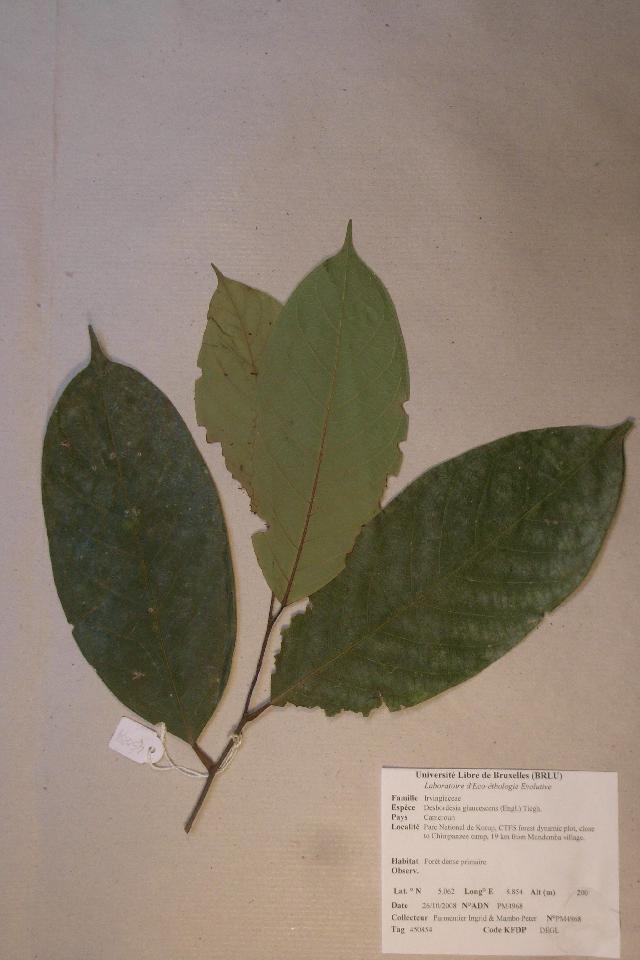
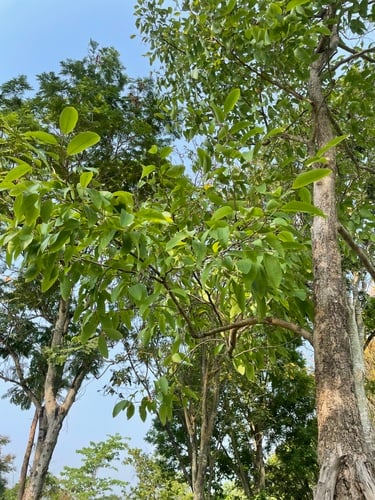
Irvingia wombolu is a TREE growing to 20 m (65ft) by 20 m (65ft) at a slow rate. See above for USDA hardiness. It is hardy to UK zone 10. The flowers are pollinated by Insects. Suitable for: light (sandy), medium (loamy) and heavy (clay) soils and prefers well-drained soil. Suitable pH: mildly acid, neutral and basic (mildly alkaline) soils and can grow in very acid soils. It can grow in semi-shade (light woodland) or no shade. It prefers moist soil.
Edible Uses
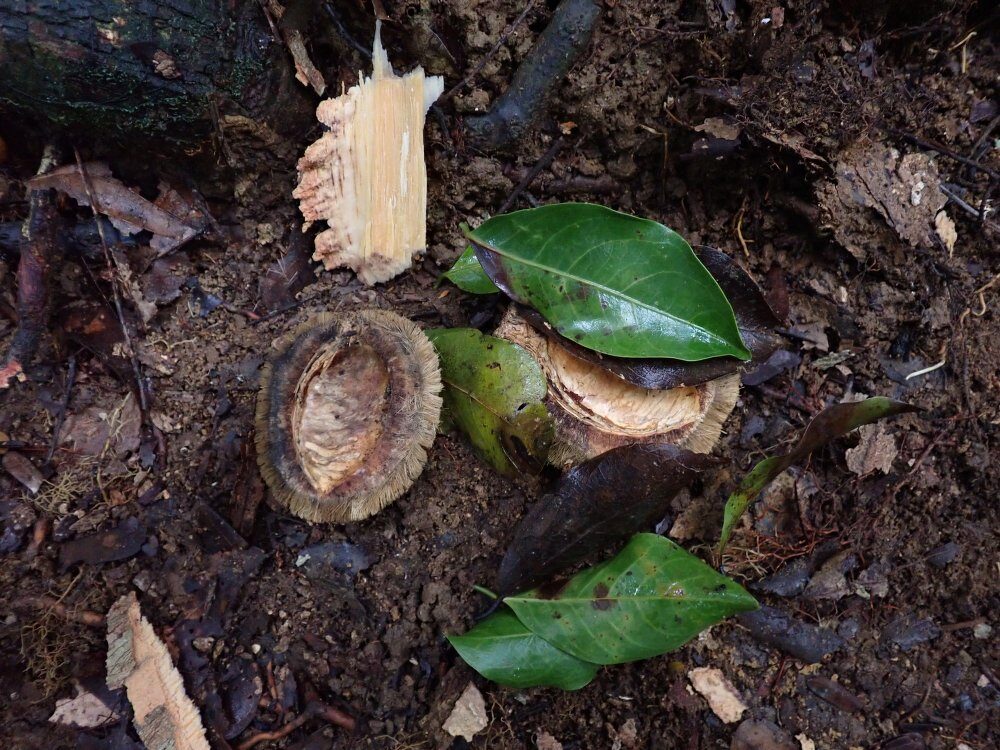
Oil. The seeds are used for making a mucilaginous sauce in cooking. The seeds are 35 - 50 mm long, 17 - 26 mm wide, 8 - 10 mm thick; with an endosperm that is almost non-existent. The kernels from the fruit are an important ingredient in cooking and are generally preferred over those of other Irvingia spp. They are processed by grinding and crushing, and are then used to thicken soups and stews. The kernels are also made into a cake called 'dika bread' or 'odika bread' for year-round preservation and easy use. The preparation of 'dika bread' consists of drying, roasting and grinding the kernels. The paste obtained is put in a container or 'cake tin' and left to cool for a few hours. Once solid, the cake is removed from the container and is ready for use. If well dried, it can be stored for more than a year. Sometimes women place a tin below the grid on which the dika cake is stored, to collect the oil that drips from it. An edible oil is extracted from the seed and used in cooking. As it is solid at ambient temperatures it has been used as a substitute for cocoa butter. The oil is extracted by boiling the ground kernels and then scooping off the oil from the top of the water. The pulp of the fruit is very bitter and slimy, but it is occasionally added to soups as thickener. The yellow pulp is soft, juicy and very bitter, with fairly numerous fibres. The bright yellow then black fruit is an ellipsoid drupe, slightly laterally compressed, 45 - 80mm long and 45 - 50mm wide. The nutritive value of the kernels per 100g edible portion is: water 4 g, energy 2918 kJ (697 kcal), protein 8.5 g, fat 67 g, carbohydrate 15 g, Ca 120 mg, Fe 3.4 mg, thiamin 0.22 mg, riboflavin 0.08 mg, niacin 0.5 mg (Platt, 1962). Drawability (sliminess) and viscosity of soups imparted by the kernels varies between kernels from different trees. The kernels of Irvingia wombolu are considered better than those of other Irvingia spp. Fat content of kernels also varies between trees and is about 37.5 - 75 g/100 g; the approximate fatty acid composition is: lauric acid 20 - 59%, myristic acid 33 - 70%, palmitic acid 2%, stearic acid 1% and oleic acid 1 - 11%. The residue obtained after separation from the fat is suitable for processing in the food industry.
Medicinal Uses
Antidiarrhoeal Antidote Febrifuge Odontalgic Skin. The medicinal uses of the various Irvingia species are many, but can hardly be assigned to an individual species. The bark is used in the treatment of diarrhoea. Preparations mainly from the bark are used to treat hernia and yellow fever, and also as an antidote for poisoning. Preparations from the bark are rubbed on to the body in order to relieve pains; they are applied to sores and wounds and are also used against toothache. A leaf extract is used as a febrifuge. The kernels are used to treat diabetes.
Distribution
Tropical Africa - Senegal to southern Sudan, south to Angola, DR Congo and Uganda.
Where It Grows
AFRICA: Sudan, Uganda, Central African Republic, Cameroon, Democratic Republic of the Congo, Congo, Côte D Ivoire, Ghana, Guinea, Guinea-Bissau, Liberia, Nigeria, Senegal, Sierra Leone, Angola.
Cultivation
A plant of the moist tropics, growing in areas where the mean annual rainfall exceeds 1,500mm. The tree starts flowering when 6 - 10 years old. It does not have a clearly demarcated flowering season, but flowering peaks at the end of the rainy season or beginning of the dry season, while fruiting peaks at the end of the dry season. The fruits are mostly gathered from the ground around the tree. The next step consists of extracting the kernel from the seed, which is split in halves with a cutlass, after which the kernel is removed with the help of a knife. The kernels are then dried in the sun or on bamboo drying racks over the fireplace in the kitchen. Good yields of kernels have been estimated at 100 kilos per tree per year. The tree is intolerant of fire.
Propagation
Seed - it has a very short viability of around 1 month and so should be sown as soon as it is ripe.
Other Uses
Fuel Oil Soap making Wood. Agroforestry Uses: The tree is commonly preserved when clearing land for agriculture so that, as well as being harvested for its seeds, it can provide shade for various crops, especially cocoa and coffee but also for annual crops. The tree has a high agroforestry potential. In its native range it is found cultivated with other crops in farm systems. Other Uses: An oil is extracted from the seed. Solid at ambient temperatures, it has been used for soap-making. The heartwood is pale greenish brown or orange-yellow fading to greyish brown; the sapwood is lighter, but not always clearly differentiated. The grain is straight or interlocked, texture fine to medium. The wood is fairly heavy, it is durable and fairly resistant to termites, but susceptible to powder-post beetles and marine borers. The timber is moderately difficult to saw or plane and tools should be kept sharp; it dresses to a smooth finish and glues well, though nailing is difficult. The wood, called 'andok' in Cameroon, is used locally for heavy construction work and for making ships' decks, paving blocks and planking. Young trees are used for making poles and stakes, while branches are made into walking sticks or thatched roof supports. Dead branches are used as firewood.
Synonyms
Also Known As
Bitter bush-mango, dry season bush-mango, chocolatier - French, dika - French, manguier sauvage - French, odika - French, ogbono - French. Madohu, Mobolou, Zokoso, chocolatier, dika, ogbono.