Irvingia gabonensis - (Aubrey
(Aubrey-Lecomte. ex O'Rorke.) Baill.
Dika Nut
gbif· cc-by-nc-nd
Christ Kombil, West & Central Africa programme
gbif· cc-by-nc-nd
Christ Kombil, West & Central Africa programme
gbif· cc-by-nc-nd
Christ Kombil, West & Central Africa programme
Description
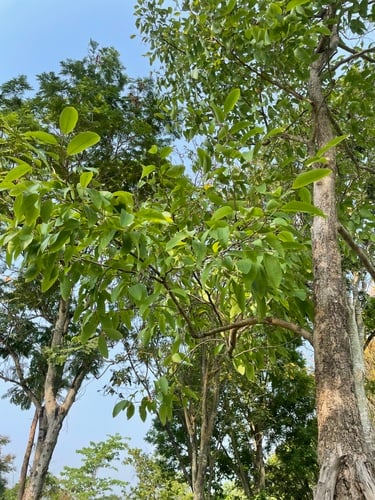
Irvingia gabonensis is an evergreen Tree growing to 30 m (98ft) by 30 m (98ft) at a slow rate. See above for USDA hardiness. It is hardy to UK zone 10. The flowers are pollinated by Insects. Suitable for: light (sandy), medium (loamy) and heavy (clay) soils and prefers well-drained soil. Suitable pH: mildly acid, neutral and basic (mildly alkaline) soils and can grow in very acid soils. It can grow in semi-shade (light woodland) or no shade. It prefers moist soil.
Edible Uses
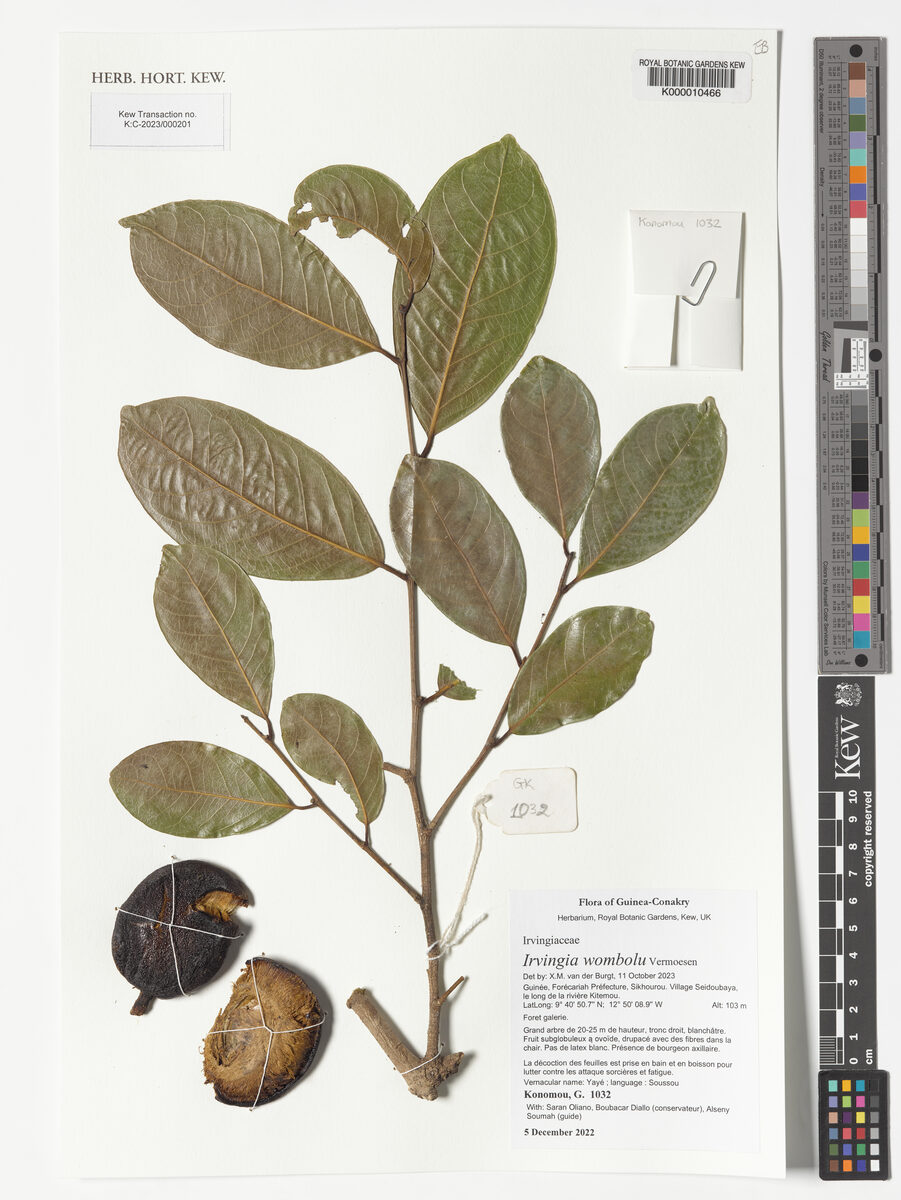
Chocolate Condiment Drink Oil. Edible portion: Seeds, Fruit, Kernels, Leaves, Bark - drink. Seed - cooked. In season, the fallen fruits are collected in the forest and stacked till the pulp has rotted away. The nuts are opened and the cotyledons removed and dried. These cotyledons are a common item of market produce and are used in soups and as a food flavouring. They are said to have a pleasant taste with a lingering slight bitterness. The seeds are 25 - 38 mm long, 17 - 27 mm wide, 8 - 12 mm thick; the endosperm is almost non-existent. The principal domestic use of the seed is for the preparation of odika, or dika bread, also known as Gabon chocolate. For this the cotyledons are ground and heated in a pot that is lined with banana leaves in order to melt the fat, and then left to cool. The resultant grey-brown greasy mass is dika bread. It has a slightly bitter and astringent taste with a more or less aromatic odour. Pepper and other spices may be added, and it may perhaps be subjected to wood smoke. The end product may be made up into cylindrical packets wrapped in a basket-like or leaf-wrapping. It can be kept for a long time without going off and it is used as a food-seasoner. An alternative method of preparation, more akin to the making of vegetable butters, is to take the fresh or stored cotyledons and pound them into a paste. A third preparation, known in Gabon as ov?ke, is to soak the kernels for 15 - 20 days till soft and then to knead them by hand into a cheese-like paste. A fourth practice is known in Sierra Leone, in which the cotyledons are dried and ground to a brown 'flour' in which form it can be stored for use as an additive to food as and when required. The kernel is an important source of vegetable oil. There is a wide variation in quantity and composition of the oil; even so the seeds are considered a suitable source of industrial and edible oils. Total fat content has been recorded as 54 - 68%. The crude dika paste yields on heating or boiling 70 - 80% of a pale yellow or nearly white solid fat, dika butter, which has qualities comparable with cacao-butter, and is, in fact, a possible adulterant or substitute for the latter in chocolate manufacture. Freed from its slight odour it can also be regarded as suitable for margarine manufacture. The yellow, fibrous fruit looks somewhat like a small mango and has a similar flavour. The fruit pulp is palatable and can be used for a fruit drink and for jam production. The fruit is variable, with special forms. The pulp of some trees is edible with a turpentine flavour, and of others inedible, bitter and acrid. The edible ones are a good source of vitamins. The ellipsoidal to cylindrical fruit is 40 - 65mm long, 42 - 64mm wide, 34 - 60mm thick, smooth, green at maturity; mesocarp bright orange, soft and juicy with few weak fibres.
Medicinal Uses
Aphrodisiac Bitter Dysentery Mouthwash Poultice Purgative Skin. The bark has a bitter taste and has the usual usages of bitter barks in Africa. It is used as a purgative for treating gastro-intestinal and liver conditions; sterility; hernias; and urethral discharge. It is considered by some to be a powerful aphrodisiac and to be beneficial in cases of senility. It is used in an enema, or added to a baked banana in order to relieve diarrhoea and dysentery. Applied externally, it is ground up with water for rubbing on to the body for easing pains. It is used in mouth-washes for relieving toothache, made into a poultice and applied to sores and wounds. Tannin has been reported present in both the bark and the roots, also a strong presence of alkaloid in the bark, though none in the roots.
Distribution
Tropical Africa - Nigeria to Central African Republic, south to Congo, DR Congo and Angola.
Where It Grows
AFRICA: Sudan, Uganda, Central African Republic, Cameroon, Congo, Gabon, Benin, Côte D Ivoire, Ghana, Guinea, Guinea-Bissau, Liberia, Senegal, Sierra Leone, Angola.
Cultivation
It grows best in areas where annual daytime temperatures are within the range 25 - 32c, but can tolerate 20 - 38c. It prefers a mean annual rainfall in the range 1,500 - 3,000mm, but tolerates 1,200 - 3,300mm. Prefers a sunny position, tolerating light shade. It does not have any particular soil preference, though it grows well in well-drained, acidic soils. The plant is restricted in the wild to fairly wet, well-drained loamy to clayey soils. Prefers a pH in the range 5 - 7, tolerating 4.5 - 7.5. Growth in young plants is very slow; later it becomes moderately fast. The fruits are mostly gathered from the ground around each tree, or are harvested by climbing when the tree is not too tall. The next step consists of extracting kernels from seed, which is split in halves with a cutlass, and the kernel is removed with the help of a knife. The kernels are then dried in the sun or on bamboo drying racks over the fireplace in the kitchen. Twelve year-old trees in Nigeria have yielded 1060 fruits (180 kilos) per tree, but in drier areas yields are much lower. Good kernel yields are about 100 kilos per tree per year. Trees are not resistant to fire. A number of different forms are recognised in Africa. These differences are not always recognized by botanists:- In Liberia there are two: one is small-leaved with inedible seeds, and the other larger-leafed with edible seeds. In Nigeria: var. Gabonensis has sweet edible fruit-pulp, whilst var. Excelsa has bitter inedible pulp but is slimy and is added to soup for this quality. Modern treatments distinguish these two forms as distinct species, var excelsa being separated as Irvingia excelsa Mildbr.. In Lower Dahomey a variety with a thick edible pulp is cultivated. In Ivory Coast large-leaved and small-leaved forms are given separate vernacular names, the former being considered inedible.
Propagation
Seed - it has a short period of viability and so should be sown as soon as it is ripe. Germination takes more than 14 days and the seed should first be extracted from the fruit and then dried for at least 2 days prior to sowing. A germination rate of 80% can be reached in this way. Can be grown from stem cuttings under mist. Plants can be budded.
Other Uses
Dye Oil Paper Tannin Teeth Wax Wood. Agroforestry Uses: The tree is commonly preserved on farms when woodland is cleared in order to provide shade for crops, especially cocoa and coffee. Other Uses: A wax has been extracted from the plant which has been found useful as an adjunct in making medicinal tablets. Both the bark and the roots contain tannins. The fruit pulp is used to prepare a black dye for cloth The fat extracted from the seed is suitable for soap-making and other industrial uses. The sap-wood is light brown, the heart-wood a slightly darker or greenish-brown. The wood is tough, very heavy, very hard, durable, immune to termite attack but rather difficult to split. It has a fine moderately close grain and a good polished finish can be achieved. It is not easy to cut, which limits its usefulness for native people who often only have simple implements. Its weight is said to preclude it from all but the most rugged construction-work, e.g., for railway-ties, house building, etc. It is used for street paving. Canoes can be made from the trunk, and pestles for yam-mortars. Tests for paper manufacture have shown cellulose content 48 .8%, fibre length 1.5 mm, and the resultant dark brown paper to be inferior, rather weak and soft, and not bleachable.
Synonyms
Also Known As
Dika Nut, Abesebuo, Andok, Boborou, Bush mango, Dika, Duika, Ebi, Eniok, Esele, Mango-bravo, Mopae, N'corobaque, Ntwa, Ogbono, Ogwe, Oro, Pekie, Ugiri, Uncorobaque, Upupa, Uyo, Synonyms Irvingia barteri Hook. f.; Mangifera gabonensis Aubry-Lecomte ex O'Rorke; Irvingia tenuifolia Hook.f.; african wild mango, chocolatier, dika du gabon, dika nut tree, dikabread-tree, dikanut, dikanut-tree, dikanuß, irvingia, manguier sauvage, odika, rainy season bush-mango, sweet bush-mango, árbol chocolate.