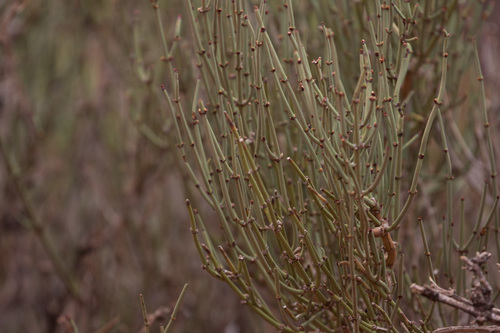
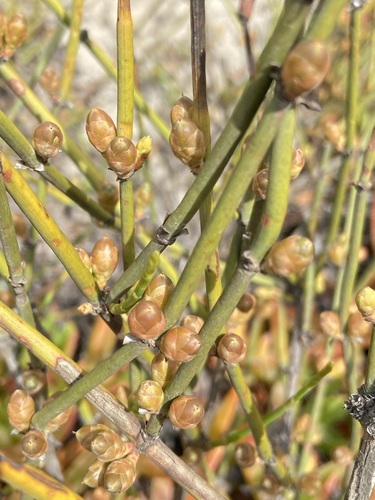
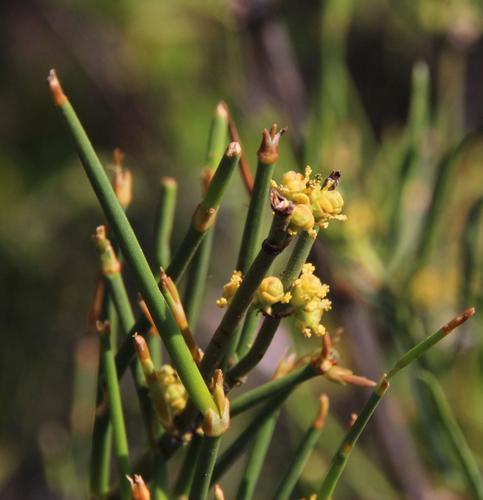
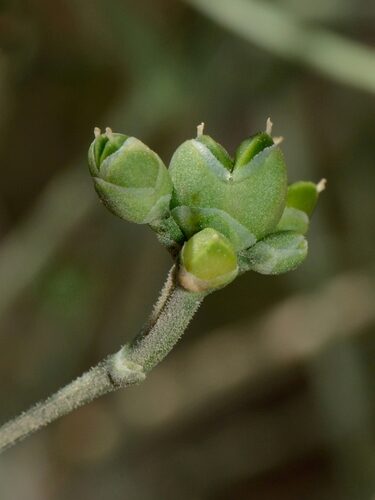
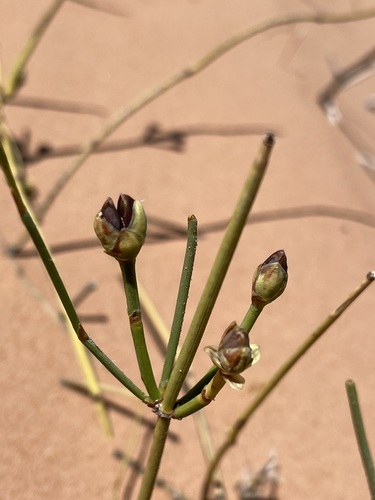
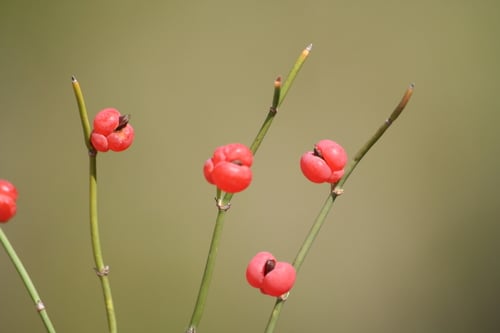
Ephedra pachyclada
Boiss.
iNaturalist· cc-by
(c) Jacky Judas, some rights reserved (CC BY)
iNaturalist· cc-by
(c) Jacky Judas, some rights reserved (CC BY)
iNaturalist· cc-by-nc
(c) Jerome Viard, some rights reserved (CC BY-NC)
Summary
Evergreen shrub with year-round foliage. Dioecious flowers (separate male and female plants required for seed production). Not self-fertile. Grows in light sandy and medium loamy soils with good drainage. Tolerates mildly acidic to mildly alkaline pH. Requires full sun and can handle both dry and moist conditions with good drought tolerance.
Description
Evergreen shrub with year-round foliage. Dioecious flowers (separate male and female plants required for seed production). Not self-fertile. Grows in light sandy and medium loamy soils with good drainage. Tolerates mildly acidic to mildly alkaline pH. Requires full sun and can handle both dry and moist conditions with good drought tolerance.
Edible Uses
The fruit can be eaten raw or cooked.
Medicinal Uses
The stems of most members of this genus contain the alkaloid ephedrine and are valuable in treating asthma and many other respiratory complaints. Using the whole plant at much lower concentrations than isolated ephedrine rarely causes side-effects. Ephedra does not cure asthma but is often very effective at managing symptoms. Stems can be used fresh or dried, usually prepared as a tea, though they can also be eaten raw. Young stems are best eaten raw, while older stems are more suited to making tea. Stems can be harvested at any time of year and dried for later use.
Distribution
It is a temperate plant. In Pakistan it grows in the Himalayas between 2,300-5,200 m above sea level.
Where It Grows
Asia, Himalayas, Iran, Middle East, Nepal, Pakistan,
Cultivation
We have very little information on this species and do not know if it will be hardy in Britain, though judging by its native range it could succeed outdoors in parts of this country. The following notes are based on the general needs of the genus. Requires a well-drained loamy soil and a sunny position. Established plants are drought resistant and are also lime tolerant. Dioecious, male and female plants must be grown in fruit and seed are required.
Propagation
Sow seed as soon as it is ripe in autumn in a greenhouse, or in spring in a greenhouse using a sandy compost. Prick out seedlings into individual pots once large enough to handle and grow on for at least their first winter under glass. Plant out in spring or early summer after the last expected frosts, with some protection during their first winter. Can also be propagated by division in spring or autumn, or by layering.
Other Uses
None known.
Notes
There are about 40 Ephedra species.
References (4)
- Anonymous, 2000, Selected edible wild plants of Pakistan north of Lahore, Including Pakistan-held Jammu-Kashmir. Central Intelligence Agency.
- Fl. orient. 5:713. 1884
- Flora of Pakistan. www.eFloras.org
- Plants for a Future database, The Field, Penpol, Lostwithiel, Cornwall, PL22 0NG, UK. http://www.scs.leeds.ac.uk/pfaf/