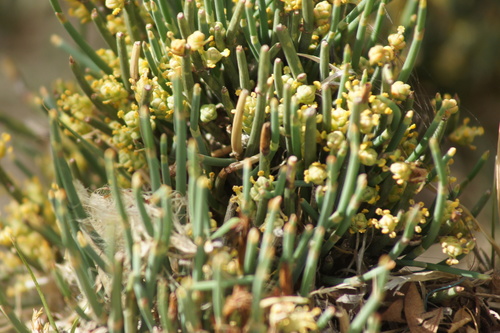
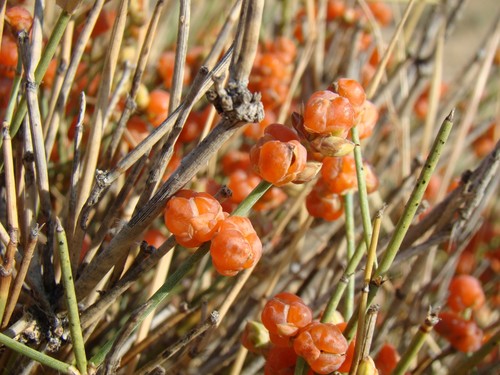
Ephedra nevadensis
S. Watson
Mormon tea, Mexican tea
iNaturalist· cc-by
(c) Steve Matson, some rights reserved (CC BY), uploaded by Steve Matson
iNaturalist· cc-by-nc
(c) Dayne Galash, some rights reserved (CC BY-NC)
iNaturalist· cc-by-nc
(c) Curren Frasch, some rights reserved (CC BY-NC), uploaded by Curren Frasch
Summary
Source: WikipediaEphedra nevadensis, commonly known as Nevada ephedra, gray ephedra, Mormon tea and Nevada jointfir, is a species of gymnosperm native to dry areas of western North America. Its range extends west to California, east to Colorado, north to Oregon, and south to Baja California, including areas of the Great Basin, Colorado Plateau and desert Southwest. It is found in rocky and sandy soils, generally in areas without trees. It can be found in a variety of environments but predominately grows in desert climates. It serves as a non toxic grazing source to both wild and domestic livestock. It posses a various amount of medicinal properties that can be used in a domestic setting. Historically, it is known for its usage in Mormon communities as tea.
Description
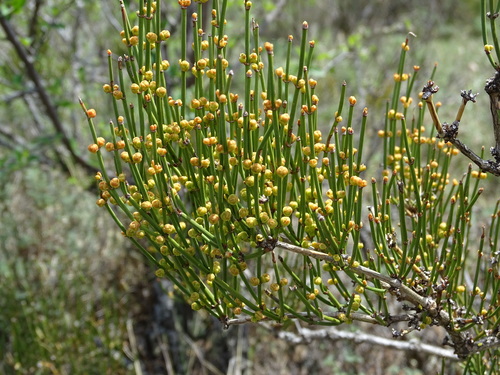
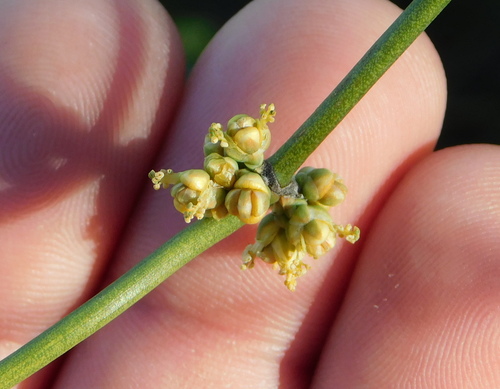
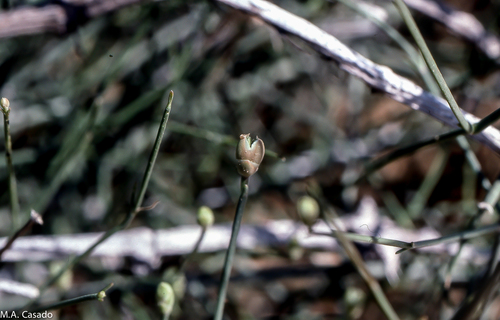
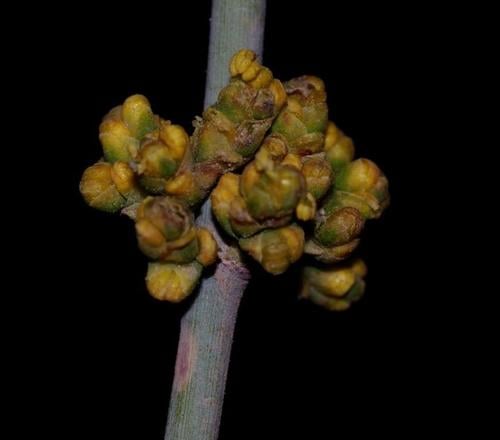
An evergreen shrub. It grows 1 m tall and spreads 1 m wide. The stems are green and leafless. The flowers are small and green. Plants are separately male and female. The fruit are red berries.
Edible Uses
The fruit is eaten raw and has a sweet but very mild flavour. The seeds can be cooked — they taste bitter but can be roasted and ground into a powder for use in bread or mush. A delicious tea is made by steeping the green or dried twigs in boiling water until the liquid turns amber or pink.
Traditional Uses
The green or dried twigs are used to make a tea. The seeds are ground into flour to make a bitter bread.
This uses section is brief — help expand it
Medicinal Uses
The stems are a blood purifier, diuretic, febrifuge, and tonic, and are beneficial for urogenital complaints. An infusion has been used to treat kidney problems, gonorrhoea, and the early stages of syphilis. A poultice of powdered stems has been applied to sores. Most members of this genus contain the alkaloid ephedrine and are valuable in treating asthma and many other respiratory complaints. Using the whole plant at much lower concentrations than isolated ephedrine rarely causes side-effects. Ephedra does not cure asthma but is often very effective at easing symptoms. Stems can be used fresh or dried, usually as a tea, though they can also be eaten raw — young stems are best raw, while older stems are more suited to tea. Stems can be harvested at any time of year and dried for later use.
Known Hazards
A study was conducted to determine a better understanding of the nutritional potency of Ephedra nevadensis compared Ephedra with orchardgrass hay (Dactylis glomerata) and cheatgrass (Bromus tectorum). It was determined that Ephedra scored second in terms of having the most ammoniacal nitrogen, while also scoring highest in ruminal pH. Results produced that Ephedra could be used as a grazing alternative but cannot be determined as exceptional in terms of nutrition or toxicity. In another study conducted to determine the toxicity of two different varieties of Ephedra (viridis, nevadensis) focusing on maternal and fetal toxicity in livestock, it was concluded that Ephedra nevadensis showed no dietary abnormalities or signs of ailment or toxicity in both the material party and offspring.
Distribution
It is a temperate plant. It grows in arid regions.
Where It Grows
Australia, Britain, Central America, Europe, Mexico, North America, Tasmania, USA,
Cultivation
Requires a well-drained loamy soil and a sunny position. Established plants are drought resistant and are also lime tolerant. Dioecious. Male and female plants must be grown if seed is required.
Propagation
Sow seed as soon as it is ripe in autumn in a greenhouse, or in spring in a greenhouse using a sandy compost. Prick out seedlings into individual pots once large enough to handle and grow on for at least their first winter under glass. Plant out in spring or early summer after the last expected frosts, with some protection during their first winter. Can also be propagated by division in spring or autumn, or by layering.
Other Uses
None known.
Notes
There are about 40 Ephedra species. It is used in medicine.
Synonyms
Also Known As
Canatillo, Desert tea, Nevada jointfir, Popatillo, Squaw tea
References (10)
- Beckstrom-Sternberg, Stephen M., and James A. Duke. "The Foodplant Database." http://probe.nalusda.gov:8300/cgi-bin/browse/foodplantdb.(ACEDB version 4.0 - data version July 1994)
- Brown, D., 2002, The Royal Horticultural Society encyclopedia of Herbs and their uses. DK Books. p 202
- Facciola, S., 1998, Cornucopia 2: a Source Book of Edible Plants. Kampong Publications, p 94
- Hibbert, M., 2002, The Aussie Plant Finder 2002, Florilegium. p 92
- Kermath, B. M., et al, 2014, Food Plants in the Americas: A survey of the domesticated, cultivated and wild plants used for Human food in North, Central and South America and the Caribbean. On line draft. p 337
Show all 10 references Hide references
- Kiple, K.F. & Ornelas, K.C., (eds), 2000, The Cambridge World History of Food. CUP p 1816
- Moerman, D. F., 2010, Native American Ethnobotany. Timber Press. p 210
- Plants for a Future database, The Field, Penpol, Lostwithiel, Cornwall, PL22 0NG, UK. http://www.scs.leeds.ac.uk/pfaf/
- Proc. Amer. Acad. Arts 14:298. 1879
- World Checklist of Useful Plant Species 2020. Royal Botanic Gardens, Kew