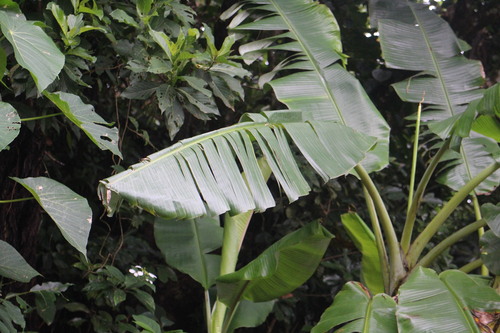
Musa x paradisiaca
L.
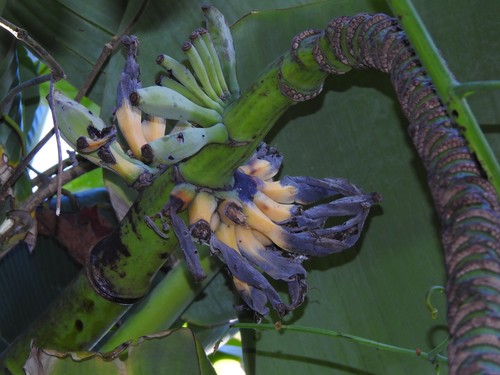
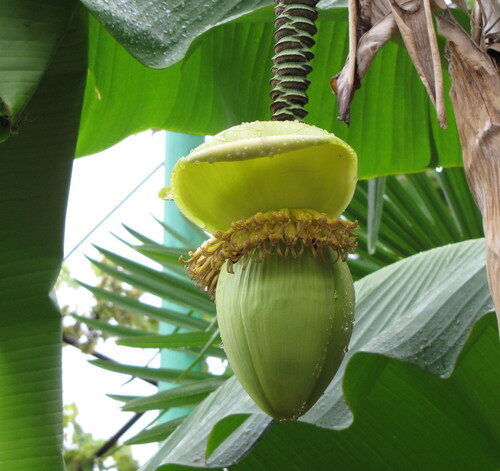
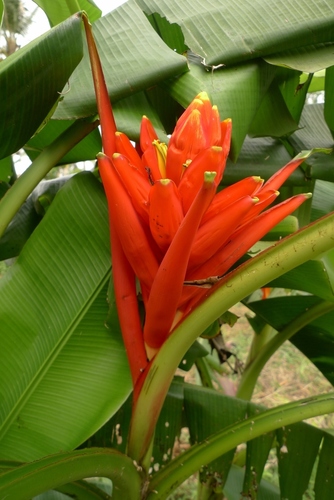
Plantain Banana
gbif· cc-by-nc
Nelly Hernández
gbif· cc-by-nc
Nelly Hernández
gbif· cc-by-nc
Nelly Hernández
Description
Musa x paradisiaca is an evergreen Perennial growing to 8 m (26ft) by 4 m (13ft) at a fast rate. See above for USDA hardiness. It is hardy to UK zone 10. The flowers are pollinated by Birds, Bats. It is noted for attracting wildlife. Suitable for: light (sandy), medium (loamy) and heavy (clay) soils and prefers well-drained soil. Suitable pH: mildly acid and neutral soils and can grow in very acid soils. It cannot grow in the shade. It prefers moist soil. The plant is not wind tolerant.
Edible Uses
Salt. Fruit - raw or cooked. Dessert forms are sweet and succulent when fully ripe and are widely eaten out of hand, though they are very versatile and are used in a wide variety of other ways. For example, they are commonly used with other juicier fruits to make smoothies, they can be baked, cooked in cakes, dried for later use etc. Plantains are richer in starch and contain less sugars. Whilst these are more commonly cooked as a vegetable, when fully ripe they make a very acceptable raw fruit. Male inflorescences are eaten in curries or cooked with coconut milk. The inner stem can be boiled and eaten, or can be dried and made into a flour and starch. Blanched shoots that sprout from the base can be roasted and eaten. The leaves are commonly used for wrapping foods that are to be cooked - especially glutinous rice dishes. They impart a distinctive flavour and a greenish colour. Nectar of the flowers is consumed. The ashes of the plant can be used as a salt substitute.
Medicinal Uses
Antidiarrhoeal Antitussive Astringent Dysentery Epilepsy Haemostatic Skin Vesicant. The unripe fruits and their sap are astringent and haemostatic. They are eaten, often roasted, as a treatment for diarrhoea. The fruit is used to treat epilepsy. The peeled and sliced fruit is placed on the forehead to relieve the heat of a headache. The peel of the fruit is considered an abortive. The leaves, dried and made into a syrup, are used to treat coughs and chest conditions such as bronchitis. An infusion of the banana leaf, combined with sugarcane roots, is used to hasten childbirth. The leaves are applied as a vesicant on blistering. It is tied onto the forehead to relieve a headache. The pulp of the trunk is made into an infusion to soothe dysentery. A liquid collected at a cut stem is an antiseptic that is applied to furuncles and wounds. The root is strongly astringent and has been used to arrest the coughing up of blood. Applied externally, the juice of the root is used to treat carbuncles and swellings. The flowers are astringent. The fruit contains two vasoconstrictors: norepinephrine (a chemical used to raise blood pressure) and dopamine. Norepinephrine is good for a weak heart. The fruit is also rich in vitamin A. Sap of the fruit contains serothine, which has an action on the long muscles.
Distribution
Only known as a cultivated plant, it is a hybrid of M. Acuminata × M. Balbisiana.
Where It Grows
Malaya, Philippines
Cultivation
The optimal temperature for fruit production is about 27°c, and night time temperatures should not fall much below 18°c when the fruit is ripening or flavour can be impaired. Requires a sunny sheltered position in a well-drained fertile soil with a pH between 6 and 7.5. There are very many named varieties, but two main types can be distinguished:- Dessert bananas which become very sweet when fully ripe. Plantains, which contain more carbohydrate and are more commonly cooked.
Propagation
Seed - sow the large seed in individual pots in the spring in a warm greenhouse at about 20°c. Grow the seedlings on in a rich soil, giving occasional liquid feeds. Keep the plants in the greenhouse for at least three years before trying them outdoors. Division of suckers in late spring. Dig up the suckers with care, trying to cause the least disturbance to the main plant. Pot them up and grow them on in a lightly shaded position in a greenhouse until they are well established.
Other Uses
Containers Fibre Hair String. Other Uses The large leaves are used as plates for eating food. The leaf sheath is used as a temporary binding. The juice of the roots is used as a hair tonic.
Synonyms
Also Known As
Banana, Amenvu, Cheek nam' vaa, Chuoi, Guineo, Hakua, Hopa, It'ath, Jaina, Kawadar, Keepran, Kele, Kera, Kluai, Kwayz, Leka, Maika, Meika, Mgomba, Moni, Ndizi, Nget pyo thee, Peint, Pinana, Pisang, Platano, Saging, Sou, Te banana, Te bunti, Te oraora, Uchu, Uht, Usr, Vudi, bananenbaum, bananier, ess-banane, paradise banana, plantain, plátano.