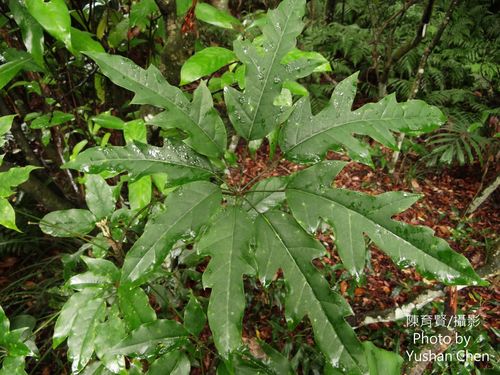
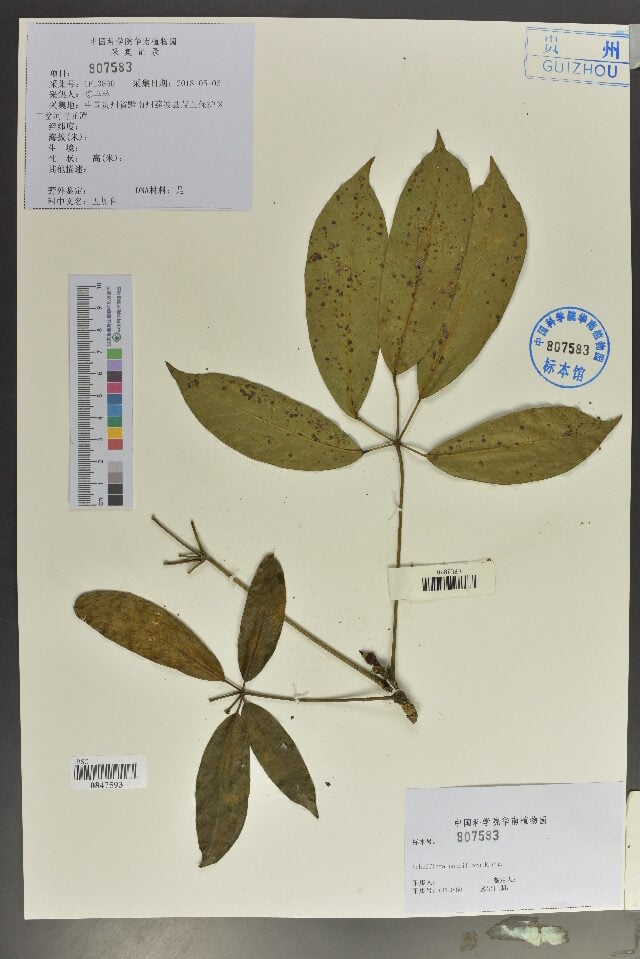
Eleutherococcus sessiliflorus
(Rupr. & Maxim.) S.Y.Hu
Wangrangkura
iNaturalist· cc-by-nc
(c) V.S. Volkotrub, some rights reserved (CC BY-NC), uploaded by V.S. Volkotrub
iNaturalist· cc-by
(c) Mathew* Zappa, some rights reserved (CC BY), uploaded by Mathew* Zappa
iNaturalist· cc-by-nc
(c) vladimir_korotkov, some rights reserved (CC BY-NC), uploaded by vladimir_korotkov
Summary
A deciduous shrub reaching 4.5 m tall, hardy to UK zone 4. Flowers July-August with hermaphrodite blooms. Grows in sandy, loamy, or clay soils including poor soil. Tolerates mildly acidic to basic pH, semi-shade to full sun, and prefers moist conditions. Pollution-tolerant.
Description
A shrub. It grows 4.5 m high. It spreads 3.5 m wide. There are 3-5 teeth around the edge. The leaves are 15 cm long. The leaf stalks are sometimes prickly. The flowers are purple. The flowers are often in clustered heads. The fruit are fleshy and black. They are 12 mm long.
Edible Uses
Young leaves can be eaten raw or cooked as a vegetable. Older leaves are dried and used as a tea substitute. A wine made from the bark is highly regarded by the Chinese, though it is likely consumed primarily for its medicinal properties.
Traditional Uses
The young leaves are boiled as a vegetable. They are also used in salads and preserved in soy sauce. The older leaves and stems are used as a tea substitute. The bark is used to make a wine. The fruit are used in brewing.
Medicinal Uses
The root bark contains saponins, acanthosides, cardiac glycosides, and polysaccharides. It is adaptogenic, analgesic, anti-inflammatory, antipyretic, and diuretic. In Korea it is used to treat lumbago, neuralgia, arthritis, and oedema.
Distribution
It grows in temperate places. It grows in forests and on mountain slopes between 200-1,000 m above sea level in northern China. It suits hardiness zones 4-9.
Where It Grows
Asia, Australia, China, Korea, Manchuria,
Propagation
Seed is best sown as soon as it is ripe in autumn in a cold frame, though germination can be slow. Stored seed requires 6 months of warm stratification followed by 3 months of cold stratification, and may also be very slow to germinate. Prick seedlings out into individual pots when large enough to handle, then grow on in light shade in a cold frame or greenhouse for at least the first winter before planting out in late spring or early summer. Other options include half-ripe wood cuttings in July/August in a frame, ripe wood cuttings of the current season's growth at 15–30cm long in a cold frame, root cuttings in late winter, or division of suckers during the dormant season.
Other Uses
None known
Synonyms
Also Known As
Ogalpinamu
References (8)
- Chon, S. et al., 2009, Total Phenolics Level, Antioxidants Activity and Cytotoxicity of Young Sprouts of Some Traditional Korean Salad Plants. Plant Foods for Human Nutrition. 64:25-31
- Cundall, P., (ed.), 2004, Gardening Australia: flora: the gardener's bible. ABC Books. p 534
- Etherington, K., & Imwold, D., (Eds), 2001, Botanica's Trees & Shrubs. The illustrated A-Z of over 8500 trees and shrubs. Random House, Australia. p 277
- Facciola, S., 1998, Cornucopia 2: a Source Book of Edible Plants. Kampong Publications, p 25 (As Acanthopanax sessiliflorus)
- J. Arnold Arbor. 61:109. 1980
Show all 8 references Hide references
- Plants for a Future database, The Field, Penpol, Lostwithiel, Cornwall, PL22 0NG, UK. http://www.scs.leeds.ac.uk/pfaf/
- Song, M., et al, 2013, Traditional knowledge of wild edible plants in Jeju Island, Korea. Indian Journal of Traditional Knowledge. 12(2) pp 177-194
- Tanaka,