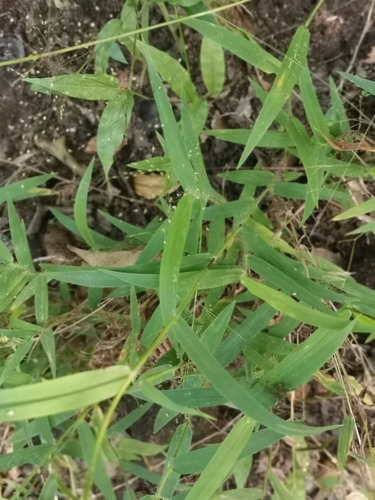
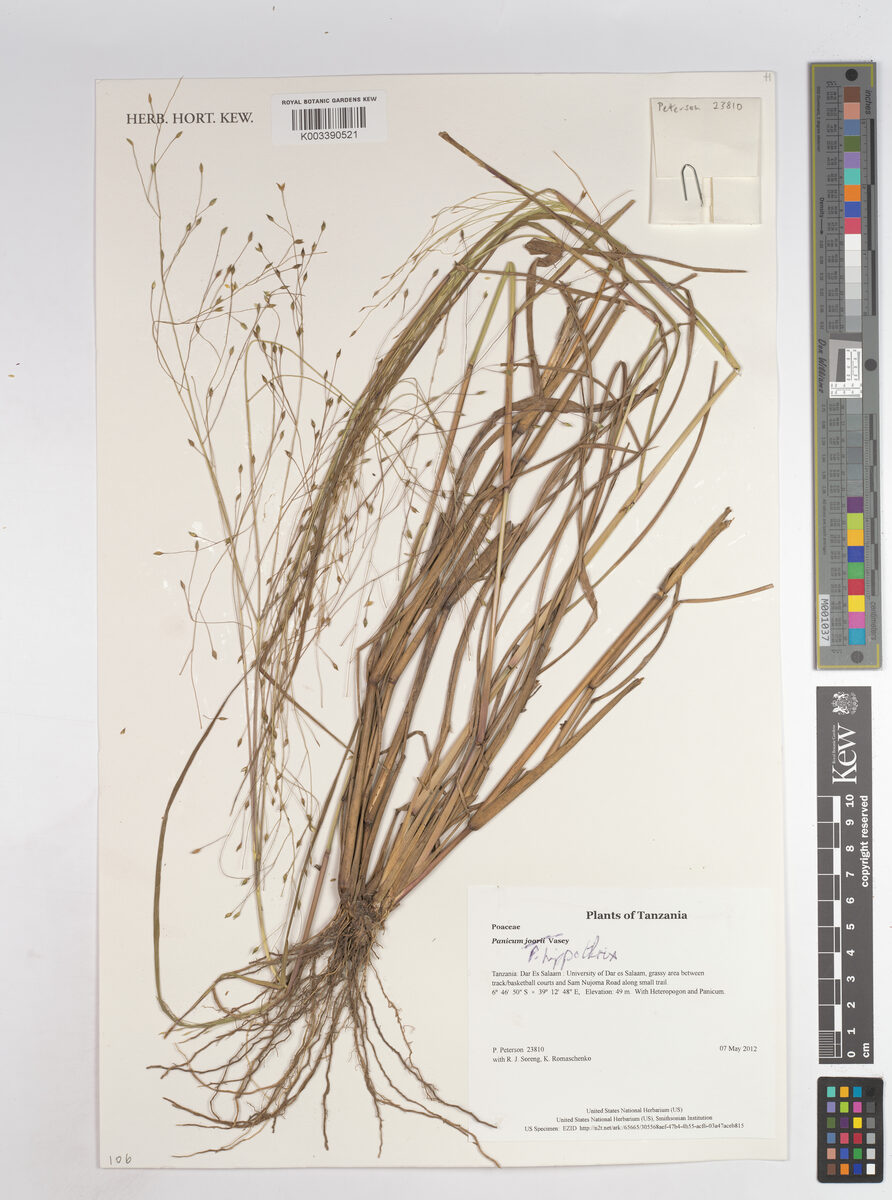
Eleusine indica
(L.) Gaertn.
Bermuda grass, Indian goosegrass
iNaturalist· cc0
no rights reserved, uploaded by 葉子
iNaturalist· cc-by-nc
(c) Gabrielle Dunham, some rights reserved (CC BY-NC)
iNaturalist· cc-by-nc
(c) Gabrielle Dunham, some rights reserved (CC BY-NC)
Summary
Source: WikipediaEleusine indica, the Indian goosegrass, yard-grass, goosegrass, wiregrass, or crowfootgrass, is a species of grass in the family Poaceae. It is a small annual grass distributed throughout the warmer areas of the world to about 50 degrees latitude. It is an invasive species in some areas. Eleusine indica is closely related to Eleusine coracana (finger millet or African finger millet), and the diploid E. indica is likely an ancestor of the allotetraploid E. coracana. Seeds of E. indica are edible and are sometimes used as a famine food, but yields are low. It is an important weed of cultivated crops, lawns, and golf courses. It thrives in disturbed areas with compacted soils in full sun. Both tillage and herbicides are used in its control. This low-growing grass is capable of setting seed even when closely mown. Some populations have evolved resistance to certain herbicides, including glyphosate. Eleusine indica performs C4 photosynthesis and therefore can grow in hot climates and in the hotter months of the temperate zone. Its seeds germinate later in spring than most other temperate zone weeds, such as crabgrasses. Though usually considered an annual, it may survive for more than a year in climates not subject to frost.
Description
A tufted annual grass. It grows up to 0.6 m tall. It has many branches from the base and tough wiry stems. The stems are slender and flattened. The leaves are 17 cm long and 3-8 mm wide. The leaves are covered with a bluish-green bloom. They are folded. The flower spikes are divided like fingers on a hand except for one which is single and below. The flowers do not have stalks and the flower spikes are 4-15 cm long. The seed heads shatter at maturity dropping their seed.
Edible Uses
The seed, though rather small, can be cooked whole or ground into a flour for cakes and gruels, and is sometimes used as a famine food. Young seedlings can be eaten raw or cooked and used as a side dish with rice. The root is edible raw.
Traditional Uses
The seeds are used as food in times of food shortage. They are parched and ground into flour for cakes, porridge or gruel. It is used in kreb a grain mixture eaten in Chad. They are also used for alcoholic drinks. Caution: Alcohol is a cause of cancer. The young shoots are eaten. They can be eaten raw or steamed and eaten with rice.
Medicinal Uses
The whole plant, particularly the root, is depurative, diuretic, febrifuge, laxative, and sudorific. It is used in treating liver complaints. In Vietnamese traditional medicine it forms part of the 'basic remedy' and is also used for influenza, hypertension, oliguria, and retention of urine. The plant can be used fresh or dried.
Known Hazards
The plant often contains prussic acid (Cyanogenetic glucoside), the main concentration being in the seeds, where it can vary from 0.015 to 0.019%, which is just below the theoretical potential danger level.
Distribution
It is mainly a tropical and subtropical plant. In the tropics it grows from sea level to 1800 m altitude. It tends to grow in places high in nitrogen. It grows on clayey soil. It can grow in arid places. In Argentina it grows below 500 m above sea level. Tasmanian Herbarium. In Sichuan and Yunnan.
Where It Grows
Africa, American Samoa, Angola, Antigua-Barbuda, Argentina, Asia*, Australia, Azores, Bahamas, Bangladesh, Belize, Benin, Bermuda, Bolivia, Botswana, Brazil, Britain, British Indian Ocean Terr., BIOT, Burkina Faso, Burundi, Cambodia, Cameroon, Canary Island, Caroline Islands, Central Africa, Central America, Chad, Chile, China, Colombia, Comoros, Congo DR, Costa Rica, Côte d'Ivoire, Chad, Chuuk, Cuba, Dominica, Dominican Republic, East Africa, East Timor, Easter Island, Ecuador, Egypt, El Salvador, Equatorial-Guinea, Eswatini, Ethiopia, Europe, Fiji, France, French Guiana, FSM, Gabon, Gambia, Ghana, Greece, Grenada, Guadeloupe, Guam, Guatemala, Guianas, Guinea, Guinée, Guinea-Bissau, Guyana, Haiti, Hawaii, Himalayas, Honduras, India, Indochina, Indonesia, Iran, Italy, Ivory Coast, Jamaica, Japan, Kenya, Kiribati, Korea, Laos, Liberia, Libya, Madagascar, Malawi, Malaysia, Maldives, Mali, Marquesas, Marshall Islands, Martinique, Mauritius, Mediterranean, Mexico, Micronesia, Middle East, Montserrat, Mozambique, Myanmar, Namibia, Nepal, New Zealand, Nicaragua, Niger, Nigeria, Niue, North Africa, North America, Northeastern India, Pacific, Pakistan, Palau, Panama, Papua New Guinea, PNG, Paraguay, Peru, Philippines, Puerto Rico, Rotuma, Rwanda, Sahel, Samoa, Sao Tome and Principe, Saudi Arabia, SE Asia, Senegal, Seychelles, Sierra Leone, Socotra, Solomon Islands, South Africa, Southern Africa, South America, Spain, St Helena, St. Kitts and Nevis, St Lucia, Sudan, Suriname, Swaziland, Taiwan, Tanzania, Tasmania, Thailand, Tibet, Timor-Leste, Togo, Tokelau, Tonga, Trinidad-Tobago, Turkey, Türkiye, Tuvalu, Uganda, Uruguay, USA, Vanuatu, Venezuela, Vietnam, Wallis & Futuna, West Africa, West Indies, West Timor, Yemen, Zambia, Zimbabwe,
Cultivation
It is mostly self sown from seed. Seed are spread in animal manure.
Propagation
Sow seed in early spring in a greenhouse, only just covering it. Germination should occur within 2 weeks. Prick seedlings out into individual pots as soon as they are large enough to handle and plant out in late spring after the last expected frosts. Seed can also be sown in mid to late spring in situ, though it may not ripen if the summer is cool.
Other Uses
The stems are used to make mats and baskets. The plant is also suitable for paper manufacture.
Production
It Australia plants flower and fruit in April.
Other Information
It is a famine food. It is sold in local markets in China.
Notes
It commonly becomes self sown and considered a problem in some situations. It has 2 sets of chromosomes compared to 4 in finger millet but it can cross with finger millet. It is used in Chinese medicine. There are 9 Eleusine species. They are mostly in tropical Africa.
Synonyms
Also Known As
Albali, Bticatchor, Butchuque, Caa pii, Capi, Capim-da-cidade, Capimde-pomar, Crowsfoot grass, Dande, Dulu, Fahitalo, Fatao, Fowl-foot grass, Godong ula, Goose grass, Grama carraspe ra, Grama de caballo, Gramillon, Huibinbi, Huk you, I puva, Jukut jampang, Kalassindra, Kalolo, Khai futun bobibia, Kinsali, Kodo ghans, Licoro, Lukata, Makar nachni, Mandla, Myet-thakwa, Nandia, Nin jin cao, Niu dun cao, Nya phak khuaai, Oxgrass, Pata de gallo, Pie de gallina, Rumput belulang, Rumput sambau, Rumput welulang, Sambau, Sarut, Se-gwa, Sikwaluku, Sin-myet, Sinngo-myet, Suket lulangan, Ta'ata'a, Thippa ragi, Wire grass, Ya tin ka
References (65)
- Abbiw, D.K., 1990, Useful Plants of Ghana. West African uses of wild and cultivated plants. Intermediate Technology Publications and the Royal Botanic Gardens, Kew. p 25
- Ambasta, S.P. (Ed.), 2000, The Useful Plants of India. CSIR India. p 193
- Bandyopadhyay, S. et al, 2009, Wild edible plants of Koch Bihar district, West Bengal. Natural Products Radiance 8(1) 64-72
- Borrell, O.W., 1989, An Annotated Checklist of the Flora of Kairiru Island, New Guinea. Marcellin College, Victoria Australia. p 23, 159
- Burkill, H. M., 1985, The useful plants of west tropical Africa, Vol. 2. Kew.
Show all 65 references Hide references
- Burkill, I.H., 1966, A Dictionary of the Economic Products of the Malay Peninsula. Ministry of Agriculture and Cooperatives, Kuala Lumpur, Malaysia. Vol 1 (A-H) p 932
- Cabalion, P. and Morat, P., 1983, Introduction le vegetation, la flore et aux noms vernaculaires de l'ile de Pentcoste (Vanuatu), In: Journal d'agriculture traditionnelle et de botanique appliquee JATBA Vol. 30, 3-4
- Chen Shouliang, Lu Shenglian, Wu Zhenlan, et al Poaceae Tribe 19 Eragrostidae Flora of China
- Cowie, I, 2006, A Survey of Flora and vegetation of the proposed Jaco-Tutuala-Lore National Park. Timor-Lests (East Timor) www.territorystories.nt/gov.au p 52
- CRÉAC'H,
- Cribb, A.B. & J.W., 1976, Wild Food in Australia, Fontana. p 103
- Dalziel, J. M., 1937, The Useful plants of west tropical Africa. Crown Agents for the Colonies London.
- Ekman Herbarium records Haiti
- Facciola, S., 1998, Cornucopia 2: a Source Book of Edible Plants. Kampong Publications, p 175
- Flora of Pakistan. www.eFloras.org
- Flora of Solomon Islands
- Fowler, D. G., 2007, Zambian Plants: Their Vernacular Names and Uses. Kew. p 70
- Franklin, J., Keppel, G., & Whistler, W., 2008, The vegetation and flora of Lakeba, Nayau and Aiwa Islands, Central Lau Group, Fiji. Micronesica 40(1/2): 169–225, 2008
- Fruct. sem. pl. 1:8. 1788
- Gallagher, D. E., 2010, Farming beyond the escarpment: Society, Environment, and Mobility in Precolonial Southeastern Burkina Faso. PhD University of Michigan.
- Grivetti, L. E., 1980, Agricultural development: present and potential role of edible wild plants. Part 2: Sub-Saharan Africa, Report to the Department of State Agency for International Development. p 32
- Hanif, U., et al, 2013, Ethnobotanical studies on some wild plants of head Qadirabad and adjoining areas, Pakistan. International Journal of Phytomedicine 5:373-377
- Henty, E.E., & Pritchard, G.S., 1973, Weeds of New Guinea and their control. Botany Bulletin No 7, Division of Botany, Lae, PNG. p 44
- Hussey, B.M.J., Keighery, G.J., Cousens, R.D., Dodd, J., Lloyd, S.G., 1997, Western Weeds. A guide to the weeds of Western Australia. Plant Protection Society of Western Australia. p 54
- Henty, E.E., 1980, Harmful Plants in Papua New Guinea. Botany Bulletin No 12. Division Botany, Lae, Papua New Guinea. p 66, 67
- Jackes, B. R., 2010, Plants of Magnetic Island. 3rd Edition. James Cook University, Australia. p 33
- Jardin, C., 1970, List of Foods Used In Africa, FAO Nutrition Information Document Series No 2.p 2
- Kenneally, K.E., Edinger, D. C., and Willing T., 1996, Broome and Beyond, Plants and People of the Dampier Peninsula, Kimberley, Western Australia. Department of Conservation and Land Management. p 219
- Kumar, R. & Saikia, P., 2020, Wild edible plants of Jharkhand and their utilitarian perspectives. Indian Journal of Traditional Knowledge Vol 19 (2), April 2020, pp 237-250
- Lazarides, M. & Hince, B., 1993, Handbook of Economic Plants of Australia, CSIRO. p 89
- Li, D. et al, 2017, Ethnobotanical survey of herbal tea plants from the traditional markets in Chaoshan, China. Journal of Ethnopharmacology. 205 (2017) 195-206
- Lim, T. K., 2015, Edible Medicinal and Non Medicinal Plants. Volume 9, Modified Stems, Roots, Bulbs. Springer p 40
- Long, C., 2005, Swaziland's Flora - siSwati names and Uses http://www.sntc.org.sz/flora/
- Low, T., 1992, Bush Tucker. Australia’s Wild Food Harvest. Angus & Robertson. p 88
- Luczaj, L., et al, 2021, Wild food plants and fungi sold in the markets of Luang Prabang, Lao PDR. Journal of Ethnobiology and Ethnomedicine (2021) 17:6
- Macmillan, H.F. (Revised Barlow, H.S., et al), 1991, Tropical Planting and Gardening. Sixth edition. Malayan Nature Society. Kuala Lumpur. p 353
- Malezas Comestibles del Cono Sur, INTA, 2009, Buernos Aires
- Martin, F.W. & Ruberte, R.M., 1979, Edible Leaves of the Tropics. Antillian College Press, Mayaguez, Puerto Rico. p 79, 194
- Ochse, J.J. et al, 1931, Vegetables of the Dutch East Indies. Asher reprint. p 313
- Paczkowska, G. & Chapman, A.R., 2000, The Western Australian Flora. A Descriptive Catalogue. Western Australian Herbarium. p 103
- Parham, B. E. V., 1971, The Vegetation of the Tokelau Islands with special reference to the Plants of Nukunonu Atoll. New Zealand Journal of Botany. 9:4, 576-609
- Peters, C. R., O'Brien, E. M., and Drummond, R.B., 1992, Edible Wild plants of Sub-saharan Africa. Kew. p 22
- Plants for a Future database, The Field, Penpol, Lostwithiel, Cornwall, PL22 0NG, UK. http://www.scs.leeds.ac.uk/pfaf/
- Plants of Haiti Smithsonian Institute http://botany.si.edu/antilles/West Indies
- Purseglove, J.W., 1972, Tropical Crops. Monocotyledons. Longmans p 146
- Purseglove, J.W., 1979, Millets, in Simmonds N.W.,(ed), Crop Plant Evolution. Longmans. London. p 91
- Royal Botanic Gardens, Kew (1999). Survey of Economic Plants for Arid and Semi-Arid Lands (SEPASAL) database. Published on the Internet; http://www.rbgkew.org.uk/ceb/sepasal/internet [Accessed 3rd June 2011]
- Smith, A.C., 1979, Flora Vitiensis Nova, Lawaii, Kuai, Hawaii, Volume 1 p 304
- Sujanapal, P., & Sankaran, K. V., 2016, Common Plants of Maldives. FAO & Kerala FRI, p 118
- Swaziland's Flora Database http://www.sntc.org.sz/flora
- Tasmanian Herbarium Vascular Plants list p 84
- Terashima, H., et al, 1992, Ethnobotany of the Lega in the Tropical Rainforest of Eastern Zaire (Congo): Part Two, Zone de Walikale, African Study Monographs, Suppl. 19:1-60
- Terra, G.J.A., 1973, Tropical Vegetables. Communication 54e Royal Tropical Institute, Amsterdam, p 45
- Thaman, R. R., 1987, Plants of Kiribati: A listing and analysis of vernacular names. Atoll Research Bulletin No. 296
- Topp, J. M. W., 1988, An Annotated Check List of the Flora of Diego Garcia, British Ocean Territory. Atoll Research Bulletin No. 313
- Trimanto, & Hapsari L., 2016, Botanical survey in thirteen montane forests of Bawean Island Nature Reserve, East Java Indonesia: Conservation status, bioprospecting and potential tourism. Biodiversitas 17: 832-846.
- Vernon, R., 1983, Field Guide to Important Arable Weeds of Zambia. Dept of Agriculture, Chilanga, Zambia. p 116
- Welcome, A. K. & Van Wyk, B.-E., 2019, An inventory and analysis of the food plants of southern Africa. South African Journal of Botany 122 (2019) 136–179
- Westerway, J., et al, 2018, Preliminary checklist of the naturalised and pest plants of Timor-Leste. Blumea 63:157-163
- Wheeler, J.R.(ed.), 1992, Flora of the Kimberley Region. CALM, Western Australian Herbarium, p 1156, 1178. (Drawing)
- Wiersema, J. H. & Leon, B., 2013, World Economic Plants. A Standard Reference CRC Press. 2nd Ed. p 268
- World Checklist of Useful Plant Species 2020. Royal Botanic Gardens, Kew
- Youssef, R. S. A., 2013, Medicinal and non-medicinal uses of some plants found in the middle region of Saudi Arabia. Journal of Medicinal Plants Research. Vol. 7(34), pp. 2501-2517
- Yuncker, T.G., 1959, Plants of Tonga, Bernice P. Bishop Museum, Hawaii, Bulletin 220. p 55
- Zizka, G., 1991, Flowering Plants of Easter Island. Palmarum Hortus Francofurtensis