Eleocharis sphacelata
R. Br.
Tall spike rush
iNaturalist· cc-by-nc
(c) Vik Dunis, some rights reserved (CC BY-NC)
iNaturalist· cc-by-nc
(c) Vik Dunis, some rights reserved (CC BY-NC)
iNaturalist· cc-by-nc
(c) Vik Dunis, some rights reserved (CC BY-NC)
Summary
Source: WikipediaEleocharis sphacelata, commonly known as tall spikerush, is a sedge of the family Cyperaceae that is native to Australia and New Zealand. The erect rhizomatous perennial herb to grass-like sedge typically grows to a height of 1 to 2 metres (3.3 to 6.6 ft). It blooms between February and October producing white flowers. It is found in and around lagoons and in and swampy areas in coastal parts of the Kimberley, South West, Great Southern and Goldfields-Esperance regions of Western Australia where it grows in black muddy soils.
Description
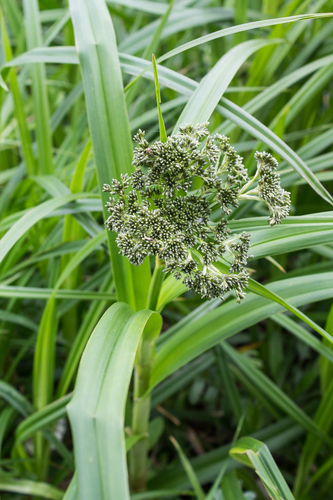
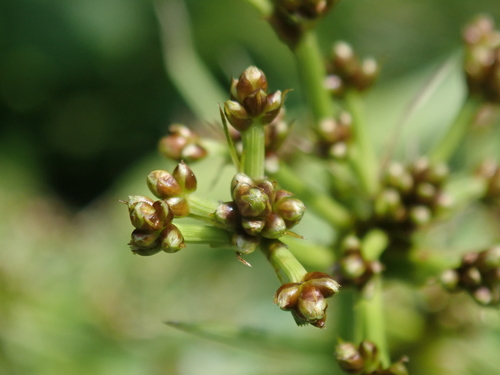
A sedge. These grow in clumps and have grass like leaves and solid stalks. It is a robust plant which grows in water. It sticks up above the water. It grows to 1.5 m high and spreads to 1 m across. The rhizome roots in the mud. The underground stem or rhizome is 5-6 mm across. The rhizome is thick and woody and produces 2 rows of stems. These stems are 0.5-2 m long by 0.5-1.1 cm wide. They are long narrow stalks which are hollow. The end is blunt. They are leafless. They can produce sterile scales or a flower arrangement. The flower spike is 3-6.5 cm long by 0.4-1.3 cm wide. The fruit is a nut about 0.2 cm long. It is yellow and hard.
Edible Uses
The starch from the underground stems is eaten. The rhizome can be cooked and eaten.
Traditional Uses
The starch from the underground stems is eaten. The rhizome can be cooked and eaten.
This uses section is brief — help expand it
Medicinal Uses
None mentioned in provided data.
Known Hazards
None mentioned in provided data.
Distribution
It is a tropical plant. It grows in clumps in fresh water. The water can be flowing or still. It can grow in shallow water or water 2 m deep. It is frost resistant but drought tender. It prefers a sunny position. Tasmanian Herbarium.
Where It Grows
Australia*, New Zealand, Pacific, Papua New Guinea, PNG, Tasmania*,
Cultivation
Plamts are normally grown by dividing the rootstock.
Other Uses
The culms are used by local people for making rush skirts.
Notes
Plants can spread rapidly and become a problem. There are about 160 Eleocharis species.
Also Known As
Djabren
References (17)
- Bailey, F. M., 1913, Comprehensive Catalogue of Queensland Plants. Queensland Government. p 591
- Bodkin, F., 1991, Encyclopedia Botanica. Cornstalk publishing, p 378
- Cancilla, D., 2018, Ethnobotanical and Ethnozoological Values Desktop Assessment - Eliwana Project. p 39
- Crawford, I. M., 1982, Traditional Aboriginal Plant Resources in the Kalumburu Area: Aspects in Ethno-economics. Records of the Western Australian Museum Supplement No. 15
- Cronin, L., 1989, The Concise Australian Flora. Reed. p 57
Show all 17 references Hide references
- Elliot, W.R., & Jones, D.L., 1984, Encyclopedia of Australian Plants suitable for cultivation. Vol 3. Lothian. p 395 (including photo & drawing)
- Hibbert, M., 2002, The Aussie Plant Finder 2002, Florilegium. p 92
- Lazarides, M. & Hince, B., 1993, Handbook of Economic Plants of Australia, CSIRO. p 89
- Leach, G.J., & Osborne, P.L., 1985, Freshwater Plants of Papua New Guinea. UPNG Press, p 115
- Low, T., 1991, Wild Food Plants of Australia. Australian Nature FieldGuide, Angus & Robertson. p 53
- Paczkowska, G. & Chapman, A.R., 2000, The Western Australian Flora. A Descriptive Calatogue. Western Australian Herbarium. p 46
- Sainty, G.R. & Jacobs, S.W.L., 1981, Waterplants of New South Wales. Water Resources Commission. NSW p 135
- Simpson, D. A. & Inglis, C. A., 2001, Cyperaceae of Economic, Ethnobotanical and Horticultural Importance: A checklist. Kew Bulletin Vol. 56, No. 2 (2001), pp. 257-360
- Stephens, K.M., & Dowling, R.M., 2002, Wetland Plants of Queensland. A field guide. CSIRO p 27
- Tasmanian Herbarium Vascular Plants list p 62
- Wheeler, J.R.(ed.), 1992, Flora of the Kimberley Region. CALM, Western Australian Herbarium, p 1063
- Woolmore, E et al, 2002, King Island Flora: A Field Guide. p 82