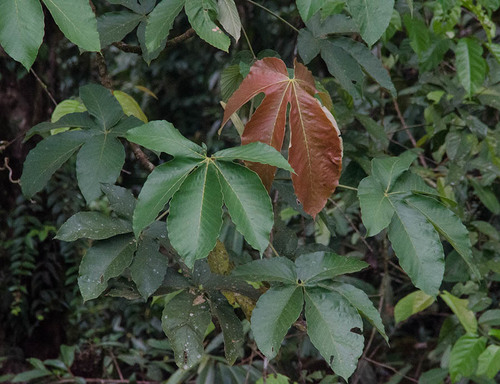
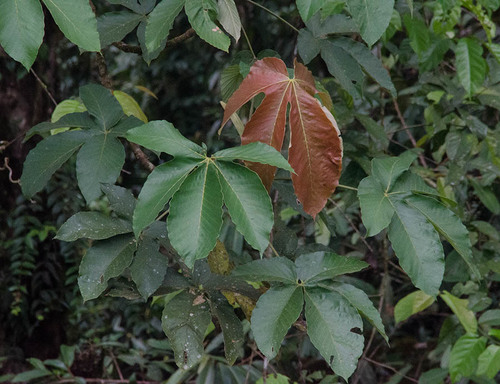
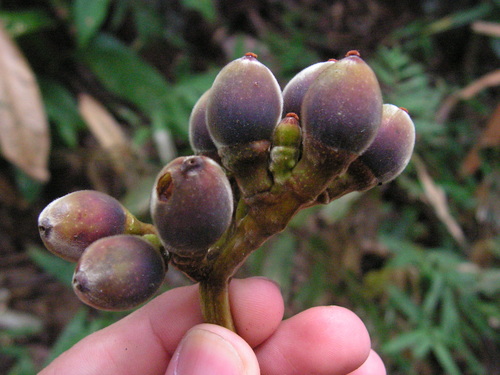
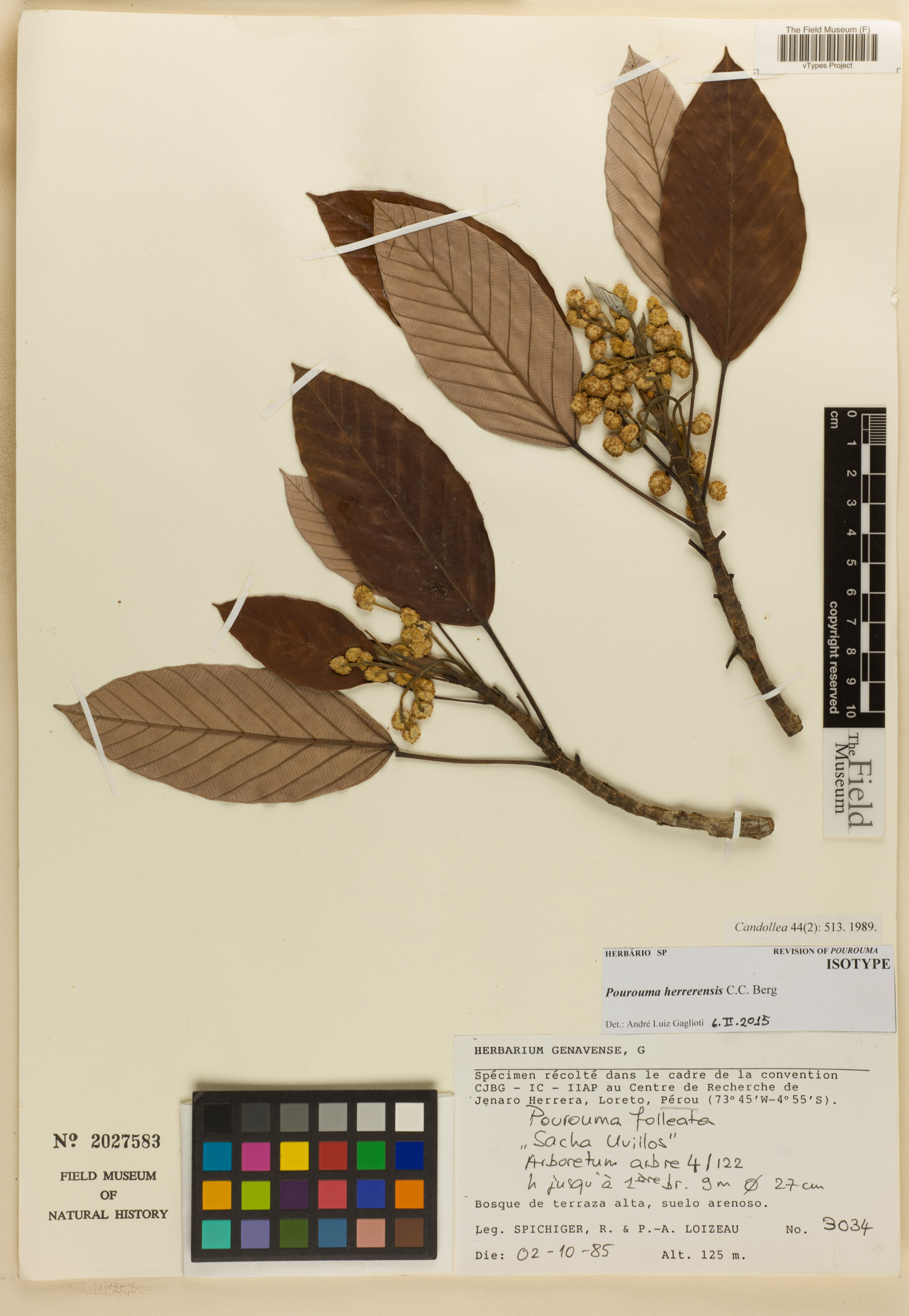
Elatostema reticulatum
Wedd.
Rainforest Spinach, Soft Nettle
iNaturalist· cc-by-nc
(c) Pete Woodall, some rights reserved (CC BY-NC), uploaded by Pete Woodall
iNaturalist· cc-by-nc-sa
(c) Nick Lambert, some rights reserved (CC BY-NC-SA)
Summary
Source: WikipediaElatostema reticulatum, commonly known as rainforest spinach, is a plant in the nettle family Urticaceae endemic to eastern areas of Queensland and New South Wales. It is a course straggly herb growing to 50–100 cm (20–39 in) high, and may form dense mats on the forest floor. It prefers wet shaded areas in rainforest and wet sclerophyll forest, and is often found in and beside streams as well as on wet rock faces. The natural range of the plant is from near Batemans Bay in the south to the ranges and tablelands near Cairns in the north. This species was first described in 1854 by the English-French botanist Hugh Algernon Weddell, who published his paper in the journal Annales des Sciences Naturelles. The specific epithet reticulatum is a reference to the prominent reticulate venation of the leaves. Joan Cribb suggests the stems and young leaves are edible, and taste better than spinach.
Description
A fleshy herb. It keeps growing from year to year. It grows 30-60 cm high and spreads 30-45 cm wide. It forms coarse clumps. The stems are 30-60 cm long and bright green. The are fleshy and root at the base. The leaves are 7-15 cm long by 3.5-6 cm wide. The leaves are scattered up the stem. The leaves are soft and bright green. They have teeth along the edge. The leaves are edible. The male flower heads are 1-2.5 cm across and flattened and green. The female flower heads are 0.6-0.8 cm across and rounded and green. The flowers are about 0.2 cm across. The fruit are nuts 0.1 cm long.
Edible Uses
The young stems and leaves are eaten raw or cooked.
Traditional Uses
The young stems and leaves are eaten raw or cooked.
This uses section is brief — help expand it
Known Hazards
Unlike many other plants in the nettle family (Urticaceae), plants in this genus do not have stinging hairs.
Distribution
A subtropical plant. It can grow with low light levels. It needs to be kept moist. It benefits from adequate fertiliser. It grows from tropical to warm temperate locations. It is damaged by frost or drought.
Where It Grows
Australia,
Cultivation
It is easily grown from cuttings. They can also be grown from seeds. Plants can be cut back and allowed to regrow.
Propagation
Seed - Cuttings of the stems root easily. Division
Notes
There are about 200 Elatostema species.
Nutrition
| Part | Moisture | kJ | kcal | Protein | Vit A | Vit C | Iron | Zinc |
|---|---|---|---|---|---|---|---|---|
| Stem | 89.3 | 151 | 36 | 1 | — | — | — | 2.2 |
References (11)
- Bodkin, F., 1991, Encyclopedia Botanica. Cornstalk publishing, p 377
- Caton, J.M. & Hardwick, R. J., 2016, Field Guide to Useful Native Plants from Temperate Australia. Harbour Publishing House. p 222
- Cherikoff V. & Isaacs, J., The Bush Food Handbook. How to gather, grow, process and cook Australian Wild Foods. Ti Tree Press, Australia p 195, 199
- Cribb, A.B. & J.W., 1976, Wild Food in Australia, Fontana. p 121
- Elliot, W.R., & Jones, D.L., 1984, Encyclopedia of Australian Plants suitable for cultivation. Vol 3. Lothian. p 392
Show all 11 references Hide references
- Flora of Australia, Volume 3, Hamamelidales to Casuarinales, Australian Government Publishing Service, Canberra (1989) p 80, 81
- Lazarides, M. & Hince, B., 1993, Handbook of Economic Plants of Australia, CSIRO. p 88
- Nicholson, N & H., 1996, Australian Rainforest Plants, Terania Rainforest Publishing. NSW. p 28
- Pearson, S. & A., 1992, Rainforest Plants of Eastern Australia. Kangaroo Press p 101
- Ratcliffe D & P., 1987, Australian Native Plants for Indoors. Little Hills press. p 86
- Williams, K.A.W., 1999, Native Plants of Queensland Volume 4. Keith A.W. Williams North Ipswich, Australia. p 172