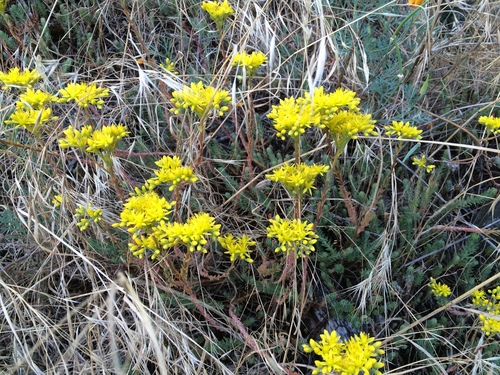
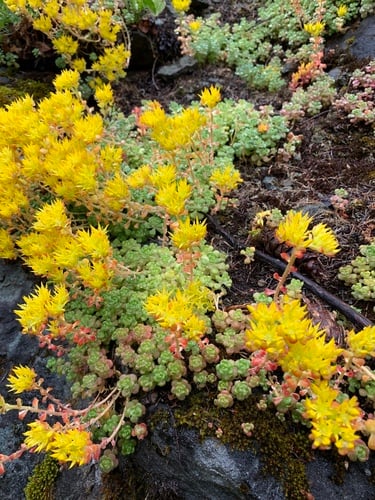
Dudleya edulis
(Nutt.) Moran
Mission lettuce
iNaturalist· cc-by-nc
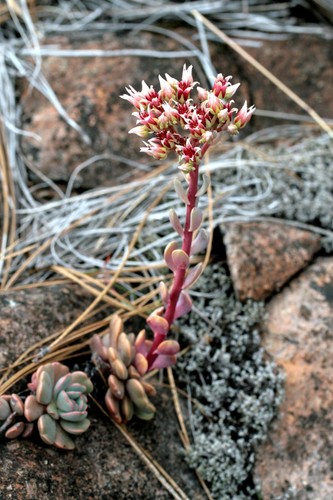
(c) Bonnie Nickel, some rights reserved (CC BY-NC), uploaded by Bonnie Nickel
iNaturalist· cc-by-nc
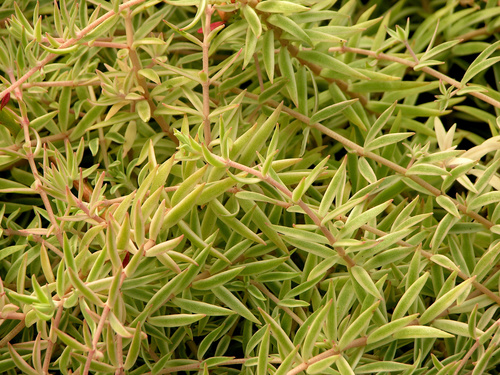
(c) R.J. Adams, some rights reserved (CC BY-NC)
Summary
Source: WikipediaDudleya edulis is a species of perennial, succulent flowering plant of the Crassulaceae, known by the common names fingertips, lady-fingers, mission lettuce, or simply the San Diego dudleya. The common name "fingertips" denotes the finger-like shape of the leaves; the specific epithet edulis (meaning "edible") refers to the Kumeyaay people's traditional foraging and consumption of the plant's young scapes. Dudleya edulis is native to the dry, coastal cliffs and chaparral hills of Southern California and northern Baja California, where it has adapted to absorb as much moisture as possible from the nightly fog and marine layer which forms over the Pacific Ocean and gradually moves slightly inland, typically covering all plants and stationary objects in dew. In addition to its inherent drought-tolerance and xeric qualities, this species is also highly salt-tolerant, as it grows almost exclusively facing the ocean, often in exposed settings where it is subjected to regular periods of extreme wind and weather. The species may be found growing on rocky hillsides, sandstone sea cliffs, chaparral habitat, arid canyons, or rooted between exposed, bare rock crevices.
Description
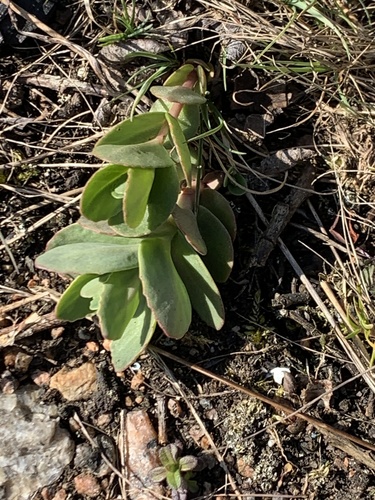
A bushy succulent. It grows 40 cm high and spreads 40 cm wide. The leaves are in rings often arranged in spirals. They are fleshy and like fingers. They often have a floury coating of wax. The flower stalks have arrow shaped bracts. The flowers are bell shaped. They are white.
Edible Uses
The fleshy leaves can be eaten raw and are considered a delicacy. The stems are slightly sweet and refreshing to chew, though they leave a chalky taste in the mouth.
Traditional Uses
The fleshy leaves are eaten raw. The stems are chewed.
This uses section is brief — help expand it
Medicinal Uses
None known
Distribution
It is a Mediterranean climate plant. They need warmth and light. It is best in a rich, well-drained soil. It needs an open, sunny position. It is resistant to drought but damaged by frost.
Where It Grows
Australia, North America, Mexico*, USA,
Cultivation
It can be grown from seeds or by divisions of offsets.
Propagation
Sow seed in spring in a greenhouse. Prick seedlings out into individual pots when large enough to handle and grow on under glass for at least their first winter. Plant out into permanent positions in late spring or early summer, after the last expected frosts. Side-shoot cuttings can be taken in summer — allow the stem to dry for 24 hours before planting in a very sandy soil mix. The main stem can also be used as a cutting, after which the parent plant will produce new plantlets at the cut edge.
Other Uses
None known Special Uses
Notes
There are (40) 84 Dudleya species.
Synonyms
References (5)
- Bodkin, F., 1991, Encyclopedia Botanica. Cornstalk publishing, p 365
- Cundall, P., (ed.), 2004, Gardening Australia: flora: the gardener's bible. ABC Books. p 517 (Genus)
- Facciola, S., 1998, Cornucopia 2: a Source Book of Edible Plants. Kampong Publications, p 83
- Kermath, B. M., et al, 2014, Food Plants in the Americas: A survey of the domesticated, cultivated and wild plants used for Human food in North, Central and South America and the Caribbean. On line draft. p 321
- Plants for a Future database, The Field, Penpol, Lostwithiel, Cornwall, PL22 0NG, UK. http://www.scs.leeds.ac.uk/pfaf/