Amphineurion marginatum
(Roxb.) D. J. Middleton
Common aganosma
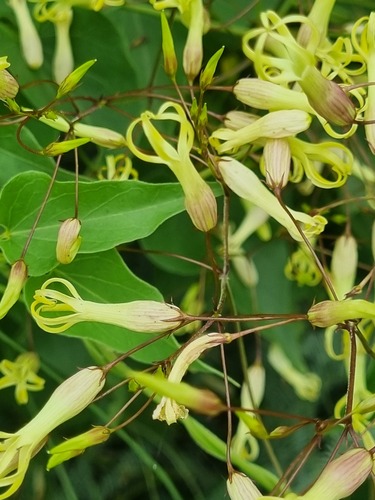
iNaturalist· cc-by-nc
(c) Wangworn Sankamethawee, some rights reserved (CC BY-NC), uploaded by Wangworn Sankamethawee
gbif· cc0
President and Fellows of Harvard College
gbif· cc0
President and Fellows of Harvard College
Description
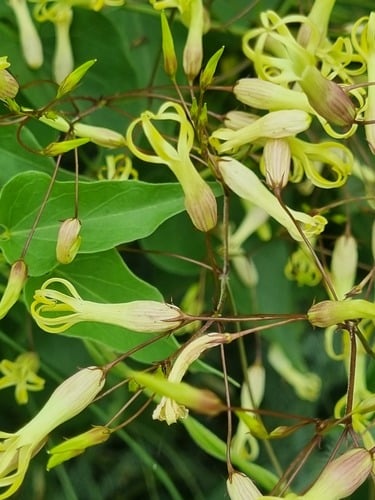
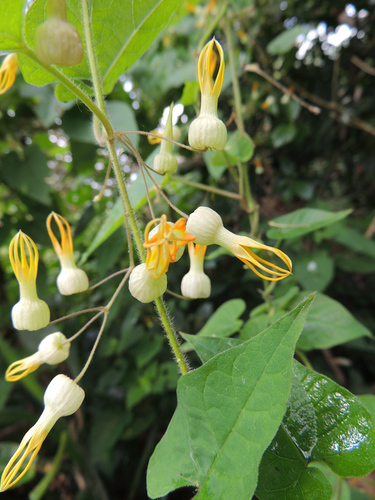
A woody climbing vine 8 m long. It has milky sap. The leaves are glossy and oval. The flowers are white tubes with lobes. They can be in the axils of leaves or at the ends of branches. They have a scent.
Edible Uses
The leaves, stems, flowers, and fruit are eaten, though the leaves and flowers are bitter. The leaves are used to make a drink and are sold in local markets.
Traditional Uses
The leaves and flowers have been eaten during times of food shortage. They are bitter. Leaves are used for a drink.
This uses section is brief — help expand it
Medicinal Uses
In times of famine, including during the Khmer Rouge regime years, the people of Cambodia eat the young leaves and stem of this climber, called krâllam' paè or trâllam' paè in Khmer language. Various parts of the plant are also used in traditional medicine to treat a number of ailments, including menstruation problems.
Distribution
A tropical plant. It grows in limestone areas. It can be in mountain forests or near the seashore.
Where It Grows
Asia, Brunei, Cambodia, China, India, Indochina, Indonesia, Laos, Malaysia, Myanmar, Pacific, Philippines, SE Asia, Thailand, Vietnam,
Cultivation
Plants can be grown from seeds or cuttings.
Other Information
It is sold in local markets.
Notes
There are 6-8 Aganosma species. It is used in medicine.
Synonyms
Also Known As
Aganosma biasa, Akar ara tanah, Akar gerit puteh, Kaung-nwe, Khaung-tan, Kro lan per, Kyetmauk-po, Kyet-paung-bo, Maduea-din, Mai pit, Mok khruea, Sai tan, Thow-wan
References (16)
- Altschul, S.V.R., 1973, Drugs and Foods from Little-known Plants. Notes in Harvard University Herbaria. Harvard Univ. Press. Massachusetts. no. 3384 (As Aganosma acuminata)
- Ambasta S.P. (Ed.), 2000, The Useful Plants of India. CSIR India. p 19 (As Aganosma marginata)
- Burkill, I.H., 1966, A Dictionary of the Economic Products of the Malay Peninsula. Ministry of Agriculture and Cooperatives, Kuala Lumpur, Malaysia. Vol 1 (A-H) p 61 (As Aganosma marginata)
- Cengel, D. J. & Dany, C., (Eds), 2016, Integrating Forest Biodiversity Resource Management and Sustainable Community Livelihood Development in the Preah Vihear Protected Forest. International Tropical Timber Organization p 123 (As Aganosma marginata)
- Eiadthong, W., et al, 2010, Management of the Emerald Triangle Protected Forests Complex. Botanical Consultant Technical Report. p 22 (As Aganosma marginata)
Show all 16 references Hide references
- Gen. hist. 4:77. 1837 (As Aganosma marginata)
- Gen. hist. 4:77. 1837 (As Aganosma acuminata)
- Kachenchart, B., et al, 2008, Phenology of Edible Plants at Sakaerat Forest. In Proceedings of the FORTROP II: Tropical Forestry Change in a Changing World. Bangkok, Thailand. (As Aganosma marginata)
- Khumgratok, S., Edible Plants in Cultural Forests of Northeastern Thailand. Mahasarakham University Thailand.
- Li Ping-tao; Antony J. M. Leeuwenberg, David J. Middleton, Apocynaceae, Flora of China (As Aganosma marginata)
- Martin, F.W. & Ruberte, R.M., 1979, Edible Leaves of the Tropics. Antillian College Press, Mayaguez, Puerto Rico. p 175 (As Agonosma marginata)
- McMakin, P.D., 2000, Flowering Plants of Thailand. A Field Guide. White Lotus. p 43 (As Aganosma marginata)
- Phon, P., 2000, Plants used in Cambodia. © Pauline Dy Phon, Phnom Penh, Cambodia. p 13 (As Aganosma marginata)
- Srichaiwong, P., et al, 2014, A Study of the Biodiversity of Natural Food Production to Support Community Upstream of Chi Basin, Thailand. Asian Social Science 10 (2): (As Aganosma marginata)
- Sukarya, D. G., (Ed.) 2013, 3,500 Plant Species of the Botanic Gardens of Indonesia. LIPI p 889 (As Aganosma marginata)
- Thitiprasert, W., et al, 2007, Country report on the State of Plant Genetic Resources for Food and Agriculture in Thailand (1997-2004). FAO p 106 (As Aganosma marginata)