Dovyalis rotundifolia
(Thunb.) Thunb. & Harv.
Wild apricot, Dune dovyalis
iNaturalist· cc-by
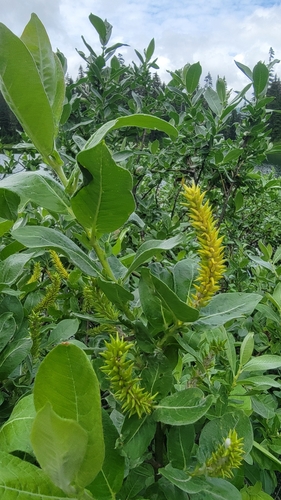
(c) Andrew Gillespie, some rights reserved (CC BY), uploaded by Andrew Gillespie
iNaturalist· cc-by
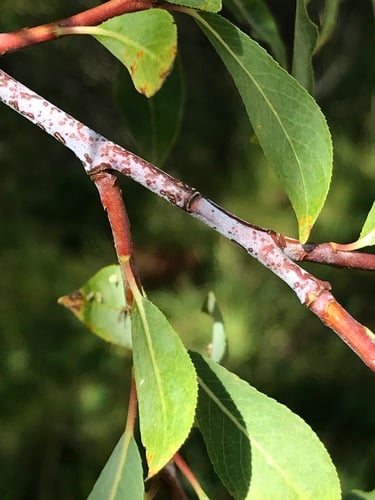
(c) Henry de Lange, some rights reserved (CC BY)
Description
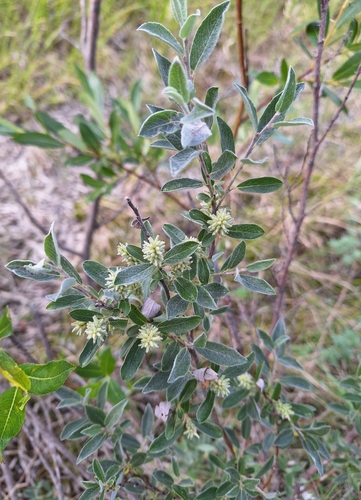
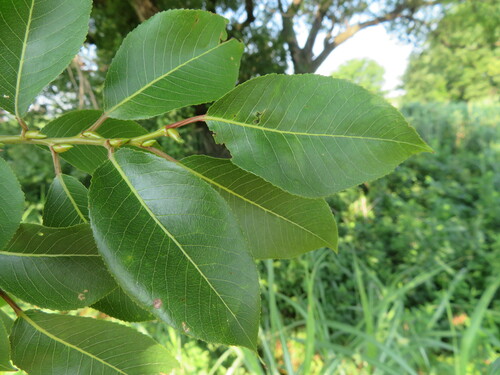
A shrub or small tree 3-6 m high. The stem can be 30 cm across. The leaves are dark glossy green. The leaves are simple and alternate. They have short stalks. Leaves are 1.3-4 cm long and 0.8-2.5 cm wide. There are spines up to 5 cm long in the axils of leaves. The flowers are male and female on separate plants. They are small and pale yellow. A few flowers occur in a cluster. Flowers often grow on old wood. The fruit is oval and has a small point at the tip. They are 1.3 cm long and fleshy. They are bright red. There are usually 2 seeds. The fruit are edible.
Edible Uses
The bright red fruit are eaten fresh or used to make preserves.
Traditional Uses
The fruit can be eaten or used for preserves.
This uses section is brief — help expand it
Distribution
It is a subtropical plant. It grows near the coast often nears dunes.
Where It Grows
Africa, South Africa*, Southern Africa,
Other Information
The fruit have a good flavour.
Notes
There are about 22 Dovyalis species. Also put in the Flacourtiaceae family.
Synonyms
References (9)
- Fox, F. W. & Young, M. E. N., 1982, Food from the Veld. Delta Books. p 230
- Jardin, C., 1970, List of Foods Used In Africa, FAO Nutrition Information Document Series No 2.p 133 (As Dovyalis celastroides)
- Palgrave, K.C., 1996, Trees of Southern Africa. Struik Publishers. p 640
- Palmer, E and Pitman, N., 1972, Trees of Southern Africa. Vol. 3. A.A. Balkema, Cape Town p 1566
- Peters, C. R., O'Brien, E. M., and Drummond, R.B., 1992, Edible Wild plants of Sub-saharan Africa. Kew. p 114
Show all 9 references Hide references
- Plowes, N. J. & Taylor, F. W., 1997, The Processing of Indigenous Fruits and other Wildfoods of Southern Africa. in Smartt, L. & Haq. (Eds) Domestication, Production and Utilization of New Crops. ICUC p 190
- Ruiters-Welcome, A. K., 2019, Food plants of southern Africa. Ph.D. thesis. Univ. of Johannesburg p 99
- Welcome, A. K. & Van Wyk, B.-E., 2019, An inventory and analysis of the food plants of southern Africa. South African Journal of Botany 122 (2019) 136–179
- World Checklist of Useful Plant Species 2020. Royal Botanic Gardens, Kew