Docynia delavayi
(Franch.) C. K. Schneid.
King haw
iNaturalist· cc-by
(c) Eugene Popov, some rights reserved (CC BY), uploaded by Eugene Popov
iNaturalist· cc-by-nc
(c) hilyshao, some rights reserved (CC BY-NC), uploaded by hilyshao
iNaturalist· cc-by-nc
(c) Lukasz Madrzynski 孟巨石, some rights reserved (CC BY-NC), uploaded by Lukasz Madrzynski 孟巨石
Summary
Evergreen tree reaching 10m tall with equal spread, flowering April to May and ripening seeds in October. Hardy to UK zone 8. Grows in light, medium, and heavy soils with good drainage; tolerates mildly acid to basic pH. Requires full sun and prefers moist conditions. Hermaphrodite flowers pollinated by insects.
Description
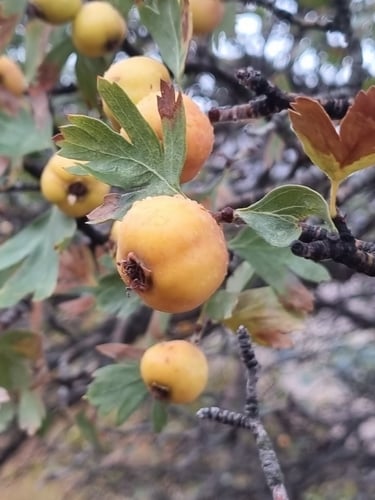
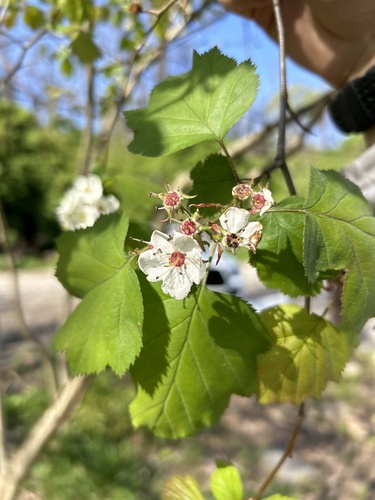
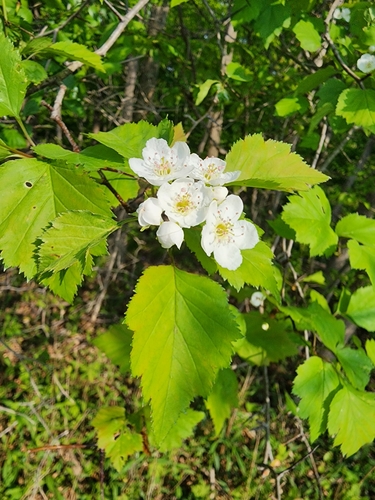
An evergreen plant. The small branches are red-brown or purple. They are stiff. The young plants are covered with fine yellow hairs. The flowers are white. There are 3-5 flowers in a bunch. The fruit are round or oval.
Edible Uses
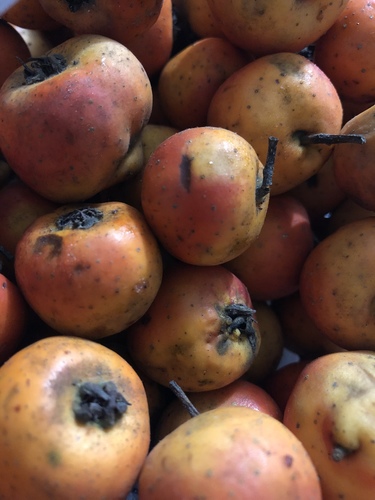
The fruit can be eaten raw, cooked, or used in preserves. When fully ripe it resembles an apple in character, and measures around 4cm in diameter.
Traditional Uses
The ripe fruit are eaten raw or salted. They are pickled and eaten with chilli sauce. The ripe fruit are also used to ripen persimmon.
This uses section is brief — help expand it
Medicinal Uses
No medicinal uses are known for this plant.
Distribution
A tropical plant. Plants grow on bright, sunny slopes. They grow between 1500-1800 m above sea level in Yunnan in China. In Sichuan.
Where It Grows
Asia, China, Indochina, Myanmar, SE Asia, Vietnam,
Propagation
Sow seed as soon as it is ripe in autumn in a cold frame. Prick seedlings out into individual pots once large enough to handle and grow on under glass for at least their first winter. Plant out into permanent positions in late spring or early summer, after the last expected frosts.
Other Uses
The fruits are used to speed up the ripening of persimmons (Diospyros kaki). Fruits of both species are layered alternately in a large container, covered with rice husks, and within 10 hours the persimmons are ready to eat.
Production
In southern China fruit are available Aug-Sept.
Other Information
It is sold in local markets.
Nutrition
| Part | Moisture | kJ | kcal | Protein | Vit A | Vit C | Iron | Zinc |
|---|---|---|---|---|---|---|---|---|
| Fruit | 82 | — | — | — | — | 1.6 | — | — |
Also Known As
Aqkaqpyuq, Biu meng yang, Guo mian, Qile, Shi bu, Sibu, Si pi er si, Tao-yi
References (12)
- Altschul, S.V.R., 1973, Drugs and Foods from Little-known Plants. Notes in Harvard University Herbaria. Harvard Univ. Press. Massachusetts. no. 1397
- Cao, Y., et al, 2020, Ethnobotanical study on wild edible plants used by three trans-boundary ethnic groups in Jiangcheng County, Pu’er, Southwest China. Journal of Ethnobiology and Ethnomedicine (2020) 16:66
- Facciola, S., 1998, Cornucopia 2: a Source Book of Edible Plants. Kampong Publications, p 198
- Flora of China. www.eFloras.org Volume 9
- Geng, Y., et al, 2016, Traditional knowledge and its transmission of wild edibles used by the Naxi in Baidi Village, northwest Yunnan province. Journal of Ethnobiology and Ethnomedicine. 12:10
Show all 12 references Hide references
- Ghorbani, A., et al, 2012, Diversity of Medicinal and Food Plants as Non-timber Forest Products. Economic Botany XX (X) 2012, pp 1-14
- Ghorbani, A., et al, 2012, A comparison of the wild food plant use knowledge of ethnic minorities in Naban River Watershed Nature Reserve, Yunnan, SW China. Journal of Ethnobiology and Ethnomedicine; 8:17
- Hani Medicine of Xishuangbanna, 1999, p 127
- Jin, Chen et al, 1999, Ethnobotanical studies on Wild Edible Fruits in Southern Yunnan: Folk Names: Nutritional Value and Uses. Economic Botany 53(1) pp 2-14
- Plants for a Future database, The Field, Penpol, Lostwithiel, Cornwall, PL22 0NG, UK. http://www.scs.leeds.ac.uk/pfaf/
- Repert. Spec. Nov. Regni Veg. 3:180. 1906
- Wang, J. et al, 2013, A Study on the Utilization of Wild Plants for Food in Liangshan Yi Autonomous Prefecture. Plant Diversity and Resources. 35(4): 416-471