Diplazium esculentum
(Retz.) Swartz
Vegetable-fern, Paco fern
iNaturalist· cc-by
(c) Jacy Chen, some rights reserved (CC BY), uploaded by Jacy Chen
iNaturalist· cc0
no rights reserved
Summary
Source: WikipediaDiplazium esculentum, the vegetable fern, is an edible fern found throughout Asia and Oceania. It is probably one of the most commonly consumed ferns. The genus Diplazium is in the family Athyriaceae, in the eupolypods II clade of the order Polypodiales, in the class Polypodiopsida.
Description
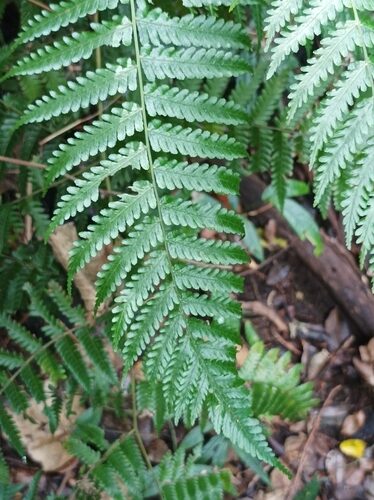
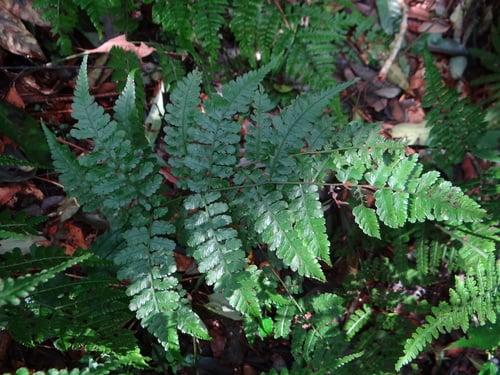
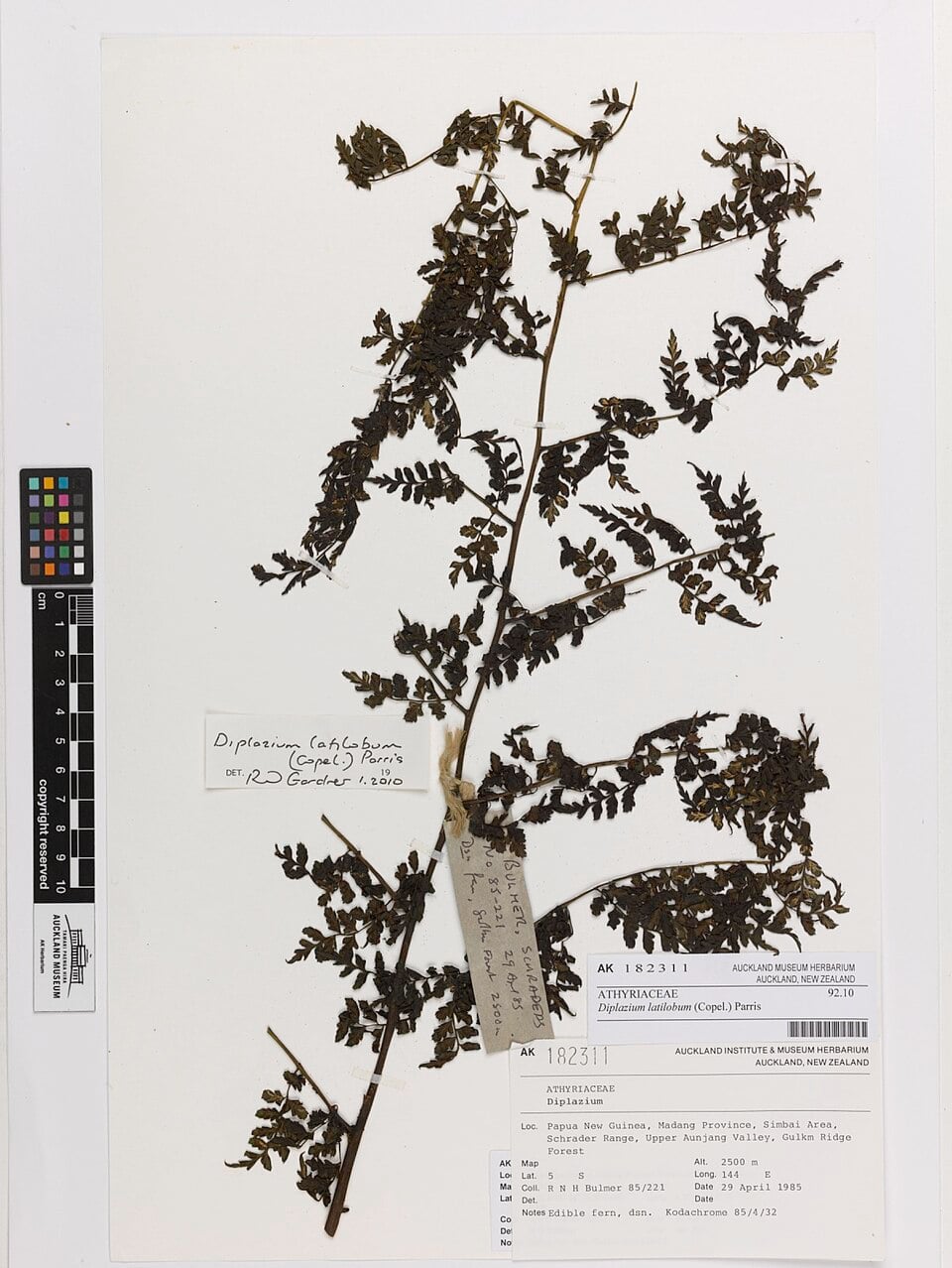
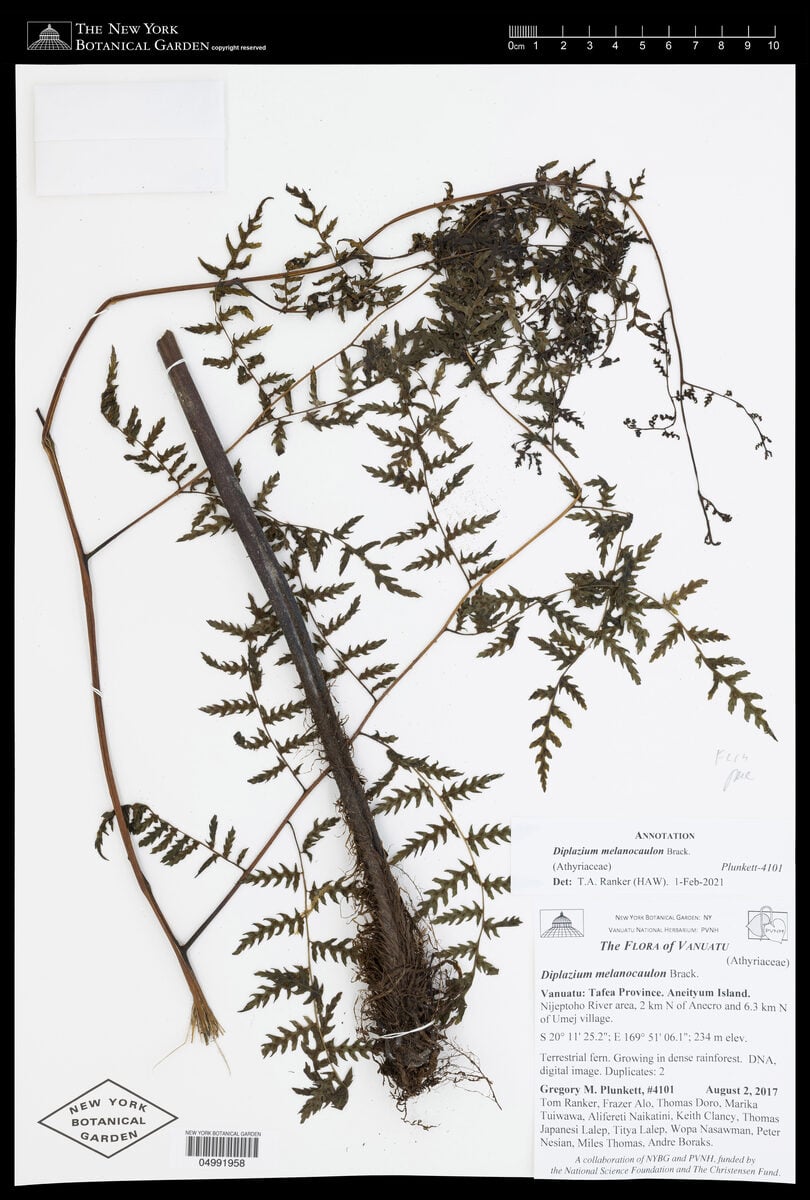
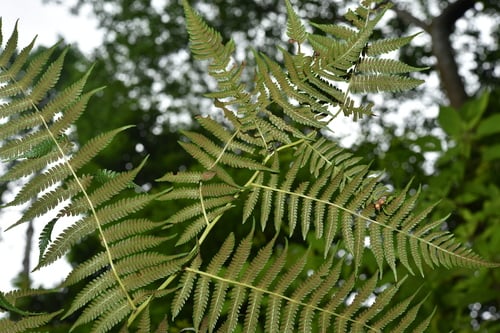
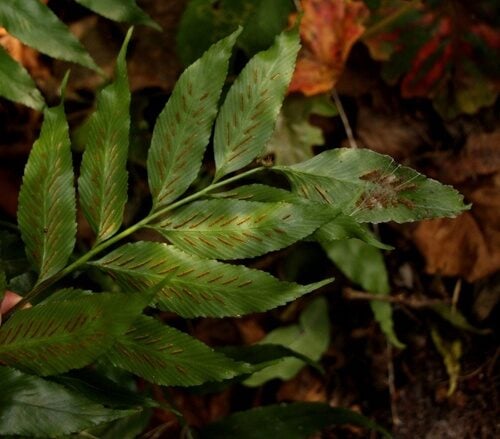
A large fern with an upright stem. It forms tufts. It is only woody near the base. It can be 1 m high and 1 m wide. It usually grows as a large clump. It spreads by underground runners. They have feather like fronds which are 50 to 80 cm long and divided 2 or 3 times. The leaf stalks are black near the bottom. The secondary leaflets are pointed at the tip. The end sections of the leaf are many, about 8 cm long and 1 cm wide. The leaflets are notched like a saw and about 2 to 5 cm long.
Edible Uses
Diplazium esculentum is considered the most important edible fern worldwide and is widely used as a vegetable across Asia, Oceania, and the Himalayas. It is notably rich in iron, phosphorus, potassium, and proteins. The young leaves are eaten as lalab — a vegetable salad served with sambal and rice. Young fronds are also boiled, stir-fried, used in salads, blanched, pickled, or dried and reconstituted for later cooking. The flavour is often compared to overcooked asparagus, and fronds are generally cooked before eating to avoid bitterness.
Traditional Uses
The fronds are cooked and eaten as a vegetable. They are also used in stews. They can be fried. They can be steamed in earth ovens. They are cooked with daal. Very young leaves are also eaten raw in salads.
Medicinal Uses
A decoction of the leaves is used as a tonic for women after childbirth. Traditional medicinal uses include treatment of fever, dermatitis, measles, headaches, pain, coughs, wounds, dysentery, glandular swellings, toothaches, and diarrhoea. The plant is reported to have laxative, anti-inflammatory, antioxidant, anthelmintic, analgesic, antimicrobial, and cytotoxic activities. Extracts have also shown in vitro anti-trypanosomal activity.
Known Hazards
The young fronds are stir-fried and used in salads. They may have mild amounts of fern toxins but no major toxic effects are recorded. It is known as pakô ("wing") in the Philippines, pucuk paku and paku tanjung in Malaysia, sayur paku or pakis in Indonesia, phak koot (Thai: ผักกูด) in Thailand, rau dớn in Vietnam, dhekia (Assamese: ঢেঁকীয়া) in Assamese, Dhenki Shaak (Bengali: ঢেঁকি শাক) in Bengali, paloi saag (Bengali: পালই শাগ) in Eastern Bengali, ningro in Nepali, dingkia in Boro and linguda in northern India, referring to the curled fronds. It is known as pohole or hō'i'o in Hawaiian cuisine. The ferns grow in wet areas of shady valleys. The fern species Diplazium esculentum is believed to have been introduced and naturalized in Hawaii and was first reported collected in 1910. The fern also has medicinal uses.
Distribution
A tropical plant. It grows in moist tropical places. It mostly occurs in coastal areas. It is common in wet areas. It grows along riversides and in wet areas usually with running water. It grows in wetlands. It also occurs in Malaysia, Indonesia, Philippines and Fiji and is used as a food there. They are widely distributed in the Philippines on areas of gravel and the banks of streams. Plants are frost tender. In Vietnam it grows up to 2,000 m above sea level. In China it grows between 100-1,200 m above sea level. In Yunnan.
Where It Grows
Africa, Asia, Bangladesh, Bhutan, Bougainville, Cambodia, China, Fiji, Hawaii, Himalayas, India, Indochina, Indonesia, Japan, Laos, Malaysia, Nepal, Nigeria, Northeastern India, NW India, Oceania, Pacific, Pakistan, Papua New Guinea, PNG, Philippines, SE Asia, Sikkim, Singapore, Solomon Islands, Sri Lanka, Taiwan, Thailand, Tibet, USA, Vanuatu, Vietnam, West Africa, West Papua,
Cultivation
Plants can be grown from spores. They need to be in a well drained potting medium and kept with a high humidity. The spores need a temperature of 21°C and sown as soon as ripe. Plants should be transplanted into a moist well drained soil with partial shade. Plants can also be grown by separating out the underground runners.
Propagation
Spores germinate readily and develop quickly. The plant can also be propagated by division of plantlets produced at the roots.
Other Uses
Diplazium esculentum is an attractive ornamental garden plant whose spores are sold online and through local nurseries. It can be grown in containers and makes a good groundcover in semi-shady locations, though it performs poorly in full sun or deep shade. Dried rhizomes are used as an insecticide, and the leaves are used as green manure and cattle bedding.
Production
The fronds will only store for a very short time so need to be used quickly.
Other Information
It is a commercially cultivated vegetable. One of the commonly used and popular ferns of the Asian tropical lowland areas. Young freshly uncurled fronds are common in markets.
Notes
There are about 400 Diplazium species. They have also been put in the families Aspleniaceae and Woodsiaceae.
Nutrition
| Part | Moisture | kJ | kcal | Protein | Vit A | Vit C | Iron | Zinc |
|---|---|---|---|---|---|---|---|---|
| Leaves | 94 | 81 | 19 | 2.4 | 211 | 2 | 2.4 | 1.8 |
Synonyms
Also Known As
Akwukwo nni, Aule chipley nigro, Bajey, Cha-kawk, Churuli, Corotonh, Daoche, Daomalai, Denkhi, De pi, Dhekia sak, Dhekia shak, Dhekiya, Dhuskia, Dumkek, Edible fern, Gamchekoh, Gleilei, Guo gun, Hasdam, Hokapadma, Injjo arxa, Itsatam, Jhur-tyrkhang, Jiao gai, Kaaki, Kalasevu-ni-veikau, Kasroor, Kasume, Keeraicurry, Kochiya, Konji, Konkodi kura, Kosikosiri, Kuanji, Kukri sag, Kukuling, Kuturke, Kutherku, Kuthalla, Kuut khue, Kuware-shida, Lauta, Lingra, Lingura, Lochanch, Machuovu, Mangaling, Masino neuro, Muikhonchuk, Mula, Nchubua, Neuro, Nigrou, Niguro, Ningro, Niuro, Okang, Ota, Pagu, Pahu, Pakis beunyeur, Pakis sayur, Pakis wilis, Pako, Pakpako, Paku benar, Paku besar, Paku bunyur, Paku ikam, Paku jukut, Paku kerjaie, Paku luhur, Paku pukut, Paku tanjong, Paku tanjung, Paku-sayur, Palu, Pani neuro, Pani niguro, Pani nyuro, Pfochou chojii, Pfuchowbu, Phak kud, Phak kuut, Pucha, Pundukum, Pusa, Raramea, Rau don, Rau ron, Surulisoppu, Tagabas, Takang, Takuma liliafe, Takuma sisimia, Ta-wai, Tyrkhang, Wakal, Zadha
References (146)
- Agarwal, R. & Chandra, V., 2019, Diversity of wild edible plants in the Mandal-Chopta forest, Uttarakhand. Journal of Medicinal Plants Studies 2019; 7(1): 89-92
- Alegado, A. M. & De Guzman, R. B., 2014, Indigenous food crops of the Aetas tribe in the Philippines and their traditional methods of food preparation. in Promotion of Underutilized Indigenous Food Resources for Food Security and Nutrition in Asia and Pacific. FAO. Bangkok p 160 (As Athyrium esculentum)
- Ambasta S.P. (Ed.), 2000, The Useful Plants of India. CSIR India. p 60 (As Athyrium esculentum)
- Amoroso, V., et al, 2017, Indigenous edible ferns in southern Philippines: Utilization and conservation. China_Botanical Congress. p 3
- Amoroso, V. B., et al., 2017, Bringing back the Lost Value of Philippine EdibleFerns: Their Antioxidant, Proteins and Utilization. International Journal of Advanced research. 5(4), 757-770
Show all 146 references Hide references
- Anderson, E. F., 1993, Plants and people of the Golden Triangle. Dioscorides Press. p 209
- Avinash, B. K., Kumar, R., et al, 2013, Ethnoboptany of Tharus of Dudhwa National Park, India. Mintage journal of Pharmaceutical & Medical Science 6-11
- Azam, F. M. S., et al, 2014, Are Famine Food Plants Also Ethnomedicinal Plants? An Ethnomedicinal Appraisal of Famine Food Plants of Two Districts of Bangladesh. Evidence-Based Complementary and Alternative Medicine Volume 2014, Article ID 741712, 28 pages
- Bandyopadhyay, S. et al, 2009, Wild edible plants of Koch Bihar district, West Bengal. Natural Products Radiance 8(1) 64-72
- Bandyopadhyay, S., et al, 2012, A Census of Wild Edible Plants from Howrah District, West Bengal, India. Proceedings of UGC sponsored National Seminar 2012
- BARC, 2016, State of Biodiversity for Food and Agriculture in Bangladesh. Bangladesh Agricultural Research Council.
- Bhatia, H., et al, 2018, Traditionally used wild edible plants of district Udhampur, J&K, India. Journal of Ethnobiology and Ethnomedicine (2018) 14:73
- Bhattarai, S. & Rajbhandary, S., 2017, Pteridophyte Flora of Manaslu Conservation Area, Central Nepal. American Journal of Plant Sciences, 2017, 8, 680-687
- Brickell, C. (Ed.), 1999, The Royal Horticultural Society A-Z Encyclopedia of Garden Plants. Convent Garden Books. p 371
- Brown, W.H., 1920, Wild Food Plants of the Philippines. Bureau of Forestry Bulletin No. 21 Manila. p 19
- Burkill, I.H., 1966, A Dictionary of the Economic Products of the Malay Peninsula. Ministry of Agriculture and Cooperatives, Kuala Lumpur, Malaysia. Vol 1 (A-H) p 848
- Call, C. A., et al, 2004, Participatory Rural Appraisal in the Upland Ecosystem of Mt Malindang, Misamis Occidental, Philippines. Biodiversity Research Programme for Development in Mindanao.
- Cao, Y., et al, 2020, Ethnobotanical study on wild edible plants used by three trans-boundary ethnic groups in Jiangcheng County, Pu’er, Southwest China. Journal of Ethnobiology and Ethnomedicine (2020) 16:66
- Chai, P. P. K. (Ed), et al, 2000, A checklist of Flora, Fauna, Food and Medicinal Plants. Lanjak Entimau Wildlife Sanctuary, Sarawak. Forestry Malaysia & ITTO. p 159
- Chai, P.P.K., 2000, Development of the Lanjak Entimau Wild life sanctuary. Final report. ITTO and Sarawak Forestry. p 19
- Chai, T., et al, 2015, Evaluation of Glucosidase Inhibitory and Cytotoxic Potential of Five Selected Edible and Medicinal Ferns. Tropical Journal of Pharmaceutical Research March 2015; 14 (3): 449-454.
- Chao, Pi-Yu, et al, 2014, Antioxidant Activity in Extracts of 27 Indigenous Taiwanese Vegetables. Nutrients 2014, 6, 2115-2130 (As Anisogonium esculentum)
- Chettri, S., et al, 2018, Nutrient and Elemental Composition of Wild Edible Ferns of the Himalaya. American Fern Journal 108(3):95–106
- Chowdery, T., et al, 2014, Wild edible plants of Uttar Dinajpur District, West Bengal. Life Science Leaflets. 47:pp 20-36 http://lifesciencesleaflets.ning.com
- Chowdhury, A. & Das, A. P., 2014, Conservation through sustainable utilization of wetland leafy vegetables of Terai and Duars, West Bengal, India. International Journal of Advanced Life Sciences (IJALS), 7(4) p 654
- Chowdhury, M. & Mukherjee, R., 2012, Wild Edible Plants Consumed by Local Communities of Maldah of West Bengal, India. Indian J.Sci.Res.3(2) : 163-170
- Dangol, D. R. et al, 2017, Wild Edible Plants in Nepal. Proceedings of 2nd National Workshop on CUAOGR, 2017.
- Deb, D., et al, 2013, Wild Edible Plants and Their Utilization in Traditional Recipes of Tripura, Northeast India. Advances in Biological Research 7(5):203-211
- Delos Angeles, M. D., & Buot Jr., I. E., 2012, Orders and Families of Philippine Pteridophytes. Journal of Nature Studies 11 (1 & 2): 19-33
- Dobriyal, M. J. R. & Dobriyal, R., 2014, Non Wood Forest Produce an Option for Ethnic Food and Nutritional Security in India. Int. J. of Usuf. Mngt. 15(1):17-37
- Facciola, S., 1998, Cornucopia 2: a Source Book of Edible Plants. Kampong Publications, p 45
- Flora of Solomon Islands
- Food Composition Tables for use in East Asia FAO http://www.fao.org/infoods/directory No. 502
- French, B.R., 1986, Food Plants of Papua New Guinea, A Compendium. Asia Pacific Science Foundation p 84
- French, B.R., 2010, Food Plants of Solomon Islands. A Compendium. Food Plants International Inc. p 106
- Furusawa, T., et al, 2014, Interaction between forest biodiversity and people's used of forest resources in Roviana, Solomon Islands: implications for biocultural conservation under socioeconomic changes. Journal of Ethnobiology and Ethnomedicine, 10:10
- Gangwar, A. K. & Ramakrishnan, P. S., 1990, Ethnobotanical Notes on Some Tribes of Arunachal Pradesh, Northeastern India. Economic Botany, Vol. 44, No. 1 pp. 94-105
- Garcia, G. S. C., 2006, The mother-child nexus. Knowledge and valuation of wild food plants in Wayanad, Western Ghats, India. Journal of Ethnobiology and Ethnomedicine, 2:39
- Gautam, R. S., et al, 2022, Ethnobotanical Review of Wild Edible Plants of Nepal. Journal of Natural History Museum Volume 32, 2021-22 p 107
- Ghorbani, A., et al, 2012, A comparison of the wild food plant use knowledge of ethnic minorities in Naban River Watershed Nature Reserve, Yunnan, SW China. Journal of Ethnobiology and Ethnomedicine; 8:17
- Ghosh, C. & Das A. P., 2011, Some useful and poisonous tea garden weeds from the Darjiling District of West Bengal, India. Pleione 5(1): 91 - 114
- Goudey, C.J., 1988, A Handbook of Ferns for Australia and New Zealand. Lothian. p 97
- Gul, A., et al, 2016, Traditional, medicinal and food uses of Pteridophytes of district Mansehra (Pakistan) and their some adjacent areas. International Journal of Biosciences. Vol. 9, No. 5 p. 116-133
- Hariyadi, B., 2008, The Entwined Tree: Traditional Natural Resource Management of Serampas, Jambi, Indonesia. Ph. D thesis. Univ. or Hawaii. p 444 (As Athyrium esculentum)
- Hedrick, U.P., 1919, (Ed.), Sturtevant's edible plants of the world. p 279
- Henderson, C.P. and I.R.Hancock, 1988, A Guide to the Useful Plants of the Solomon Islands. Res. Dept. Min of Ag. & Lands. Honiara, Solomon Islands. p 84
- Hoe, V. B. & Siong, K. H., 1999, The nutritional value of indigenous fruit and vegetables in Sarawak. Asia Pacific J. Clin. Nutr. 8(1):24-31 (As Diplazium esculentum)
- Hossain, U. & Rahman, A., 2018, Study and quantitative analysis of wild vegetable floral diversity available in Barisal district, Bangladesh. Asian J. Med. Biol. Res. 2018, 4 (4), 362-371
- Hu, Shiu-ying, 2005, Food Plants of China. The Chinese University Press. p 273 (As Anisogonium)
- Irawan, D., et al, 2006, Ethnobotanical study and nutrient potency of local traditional vegetables in Central Kalimantan. Tropics Vol. 15(4)
- Islam, M., 1983, Utilisation of Certain Ferns and Fern Allies in the North-Eastern Region, India. J.Econ. Tax. Bot. Vol.4.No.3 pp 861- (As Athyrium esculentum)
- IUCN (2013). Ecological Survey of the Mekong River between Louangphabang and Vientiane Cities, Lao PDR, 2011-2012. Vientiane, Lao PDR: IUCN. 241 pp.
- Jacquat, C., 1990, Plants from the Markets of Thailand. D.K. Book House p 33
- Japanese International Research Centre for Agricultural Science www.jircas.affrc.go.jp/project/value_addition/Vegetables
- J. Bot. (Schrader) 1801(1,2):312. 1803-1804
- Johnson, N., 2002, Environmental Change in northern Thailand: Impact on Wild Edible Plant Availability. Ecology of Food and Nutrition, 41: 5, 373-399
- Joshi, K. and Joshi, A. R., 2008, Ethnobotanical Studies on Some Lower Plants of the Central Development Region, Nepal. Ethnobotanical Leaflets 12:832-40
- Joshi, N. & Siwakoti, M., 2012, Wild Vegetables Used by Local Community of Makawanpur District and Their Contribution to Food Security and Income Generation. Nepal Journal of Science and Technology Vol. 13, No. 1 (2012) 59-66
- Kar, A., 2004, Common wild vegetables of Aka tribe of Arunachal Pradesh. Indian Journal of Traditional Knowledge 3(3) pp 305-313
- Kar, A., et al, 2013, Wild Edible Plant Resources used by the Mizos of Mizoram, India. Kathmandu University Journal of Science, Engineering and Technology. Vol. 9, No. 1, July, 2013, 106-126
- Kays, S. J., and Dias, J. C. S., 1995, Common Names of Commercially Cultivated Vegetables of the World in 15 languages. Economic Botany, Vol. 49, No. 2, pp. 115-152
- Khakurel, D., et al, 2021, Foods from the wild: Local knowledge, use pattern and distribution in Western Nepal. PLOS ONE.
- Konsam, S., et al, 2016, Assessment of wild leafy vegetables traditionally consumed by the ethnic communities of Manipur, northeast India. Journal of Ethnobiology and Ethnomedicine, 12:9
- Kiple, K.F. & Ornelas, K.C., (eds), 2000, The Cambridge World History of Food. CUP p 1875
- Kumar, A., et al, 2012, Ethnobotanical Edible Plant Biodiversity of Lepcha Tribes. Indian Forester, 138 (9):798-803
- Kumar, S. A., Manus, D. & Mallika, M., 2018, Impact of non-timber forest products on Forest and in Livelihood Economy of the People of Adjoining Areas of Jalpaiguri Forest Division, West Bengal, India. Int. J. of Life Sciences, 2018; 6 (2):365-385
- Kuo, W. H. J., (Ed.) Taiwan's Ethnobotanical Database (1900-2000), http://tk.agron.ntu.edu.tw/ethnobot/DB1.htm
- Lacuna-Richman, C., 2006, The use of non-wood forest products by migrants in a new settlement: experiences of a Visayan community in Palawan, Philippines. Journal of Ethnobiology and Ethnomedicine. 2:36 (As Athyrium)
- Leach, G. J., 1988, Bush Food Plants of the Blackwater and Karawari Rivers Area, East Sepik Province, Papua New Guinea. Science in New Guinea 14(2). p 98
- Li, S., et al, 2020, Monpa, memory, and change: an ethnobotanical study of plant use in Mêdog County, South-east Tibet, China. Journal of Ethnobiology and Ethnomedicine. (2020) 16:5 p 16
- Liu, Y., et al, 2012, Food uses of ferns in China: a review. Acta Societatis Botanicorum Poloniae 84(4): 263-270 (As Callipteris esculenta) (Also as Callipteris esculenta var. pubescens)
- Luczaj, L., et al, 2021, Wild food plants and fungi sold in the markets of Luang Prabang, Lao PDR. Journal of Ethnobiology and Ethnomedicine (2021) 17:6
- Lugod, G.C. and de Padua L.S., 1979, Wild Food Plants in the Philippines. Vol. 1. Univ. of Philippines Los Banos. p 66
- Luo, B., et al, 2019, Wild edible plants collected by Hani from terraced rice paddy agroecosystem in Honghe Prefecture, Yunnan, China. Journal of Ethnobiology and Ethnomedicine 15:56 (As Callipteris esculenta)
- Macmillan, H.F. (Revised Barlow, H.S., et al), 1991, Tropical Planting and Gardening. Sixth edition. Malayan Nature Society. Kuala Lumpur. p 356 (As Asplenium esculentum)
- Maghirang, R. G., et al, 2018. Ethnobotanical Studies of Some Plants Commonly Used as Vegetables in Selected Provinces of the Philippines. Journal of Nature Studies. 17(2), 30-43.
- Manandhar, N.P., 2002, Plants and People of Nepal. Timber Press. Portland, Oregon. p 203
- Marandi, R. R. & Britto, S. J., 2015, Medicinal Properties of Edible Weeds of Crop Fields and Wild plants Eaten by Oraon Tribals of Latehar District, Jharkhand. International Journal of Life Science and Pharma Research. Vo. 5. (2) April 2015
- Maroyi, A., 2014, Not just minor wild edible forest products: consumption of pteridophytes in sub-Saharan Africa. Journal of Ethnobiology and Ethnomedicine. 10:78
- Masoodi, H. U. R. & Sundriyal, R. C., 2020, Richness of non-timber forest products in Himalayan communities—diversity, distribution, use pattern and conservation status. Journal of Ethnobiology and Ethnomedicine 16:56
- Medhi, P. & Borthakur, S. K., 2012, Phytoresources from North Cachur Hills of Assam -3: Edible plants sold at Hflong market. Indian Journal or Natural Products and Resources. 3(1) pp 84-109
- Medhi, P. & Borthakur, S. K., 2013, Wild edible plants sold by the Zeme Nagas at the makeshift market of Mahur, Dima Hasao district of Assam. Pleione 7(1): 84 - 93. 2013
- Medhi, P., Sarma, A and Borthakur, S. K., 2014, Wild edible plants from the Dima Hasao district of Assam, India. Pleione 8(1): 133-148
- Miya, M. S. & Gautum, D., 2021, Checklist of floral species at the Institute of Forestry, Pokhara Campus, Pokhara, Nepal. Journal of Institute of Forestry, Nepal 18 (2021) 133-177
- Monsalud, M.R., Tongacan, A.L., Lopez, F.R., & Lagrimas, M.Q., 1966, Edible Wild Plants in Philippine Forests. Philippine Journal of Science. p 445 (As Athyrium esculentum)
- Mot So Rau Dai an Duoc O Vietnam. Wild edible Vegetables. Ha Noi 1994, p 166
- Narayanan Ratheesh, M. K. et al, 2011, Wild edible plants used by the Kattunaikka, Paniya and Kuruma tribes of Wayanad District, Kerala, India. Journal of Medicinal Plants Research Vol. 5(15), pp. 3520-3529
- Nombo, P. & Leach, J. 2010, Reite Plants: An Ethnobotanical Study in Tok Pisin and English. ANU press. p 111 (As Athyrium)
- Ochse, J. J. et al, 1931, Vegetables of the Dutch East Indies. Asher reprint. p 600
- Ogle, B. M., et al, 2003, Food, Feed or Medicine: The Multiple Functions of Edible Wild Plants in Vietnam. Economic Botany 57(1): 103-117
- Ong, H., et al, 2012, Traditional knowledge and usage of edible plants among the Semai community of Kampung Batu 16, Tapah, Perak, Malaysia. Scientific Research and Essays Vol. 7(4), pp. 441-445, 30 January, 2012
- Oomen, H.A.P.C., & Grubben, G.J.H., 1978, Tropical Leaf Vegetables in Human Nutrition, Communication 69, Department of Agricultural research, RTI Amsterdam, p 36
- Ojha, R. & Devkota, H. P., 2021, Edible and Medicinal Pteridophytes of Nepal: A Review. Ethnobotany Research & Applications 22:16
- Pagag, K. & Borthakur, S.K., 2012, Wild edible wetland plants from Lakhimpur district of Assam, India. Pleione 6(2): 322 - 327
- Partha, P., 2014, Ethnobotany of the Laleng (Patra) Community in Bangladesh. Journal of Pharmacognosy and Phytochemistry. 2(6):173-184
- Patiri, B. & Borah, A., 2007, Wild Edible Plants of Assam. Geethaki Publishers. p 162
- Pawera, L., et al, 2020, Wild Food Plants and Trends in Their Use: From Knowledge and Perceptions to Drivers of Change in West Sumatra, Indonesia, Foods. 2020, 9, 1240
- Peekel, P.G., 1984, (Translation E.E.Henty), Flora of the Bismarck Archipelago for Naturalists, Division of Botany, Lae, PNG. p 13, 15.
- Pegu, R., et al, 2013, Ethnobotanical study of Wild Edible Plants in Poba Reserved Forest, Assam, India. Research Journal of Agriculture and Forestry Sciences 1(3):1-10
- Pfoze, N. L., et al, 2012, Assessment of Local Dependency on Selected Wild Edible Plants and fruits from Senapati district, Manipur, Northeast India. Ethnobotany Research & Applications 10:357-367
- Pfoze, N. L., et al, 2012, Survey and assessment of floral diversity on wild edible plants from Senapati district of Manipur, Northeast India. Journal or Biodiversity and Environmental Sciences. 1(6):50-52
- Pham-Hoang Ho, 1999, An Illustrated Flora of Vietnam. Nha Xuat Ban Tre. p 164
- Phangchopi, U., et al, 2015, Diversity of wild edible plants in Marat Longri Wildlife Sanctuary, Assam. Indian Journal of Natural Products and Resources Vol. 6(4), December 2015 pp. 305-313
- Phatlamphu, N., et al, 2021, Ethnobotany of edible plants in Muang District, Kalasin Province, Thailand, Biodiversitas Vol. 22, No. 12 pp 5432-5444
- Phawa, G. M., Dkhar, E. K. & Marbaniang, D., 2019, Indigenous Wild Edible Plants of Bataw Village, East Jaintia Hills District, Meghalaya. International Journal of Arts, Science and Humanities. 7(2)
- Piggott, A. G. 1988, Ferns of Malaysia in Colour. Tropical press, Malaysia. p 309
- Priyadi, H., et al, 2010, Five hundred plant species in Gunung Halimun Salak National Park West Java. A checklist including Sundanese names, distribution and use. CIFOR, FFPRI, SLU p 125
- Ramachandran, V. S., 2007, Wild edible plants of the Anamalais, Coimbatore district, western Ghats, Tamil Nadu. Indian Journal or Traditional Knowledge. 6(1) pp 173-176
- Ramachandran,V. S., & Udhayavani, C., 2013, Knowledge and uses of wild edible plants by Paniyas and Kurumbas of Western Nilgiris, Tamil Nadu. Indian Journal of Natural Products and Resources. 4(4) December 2013, pp 412-418
- Rao, M. L. S., et al, 2014, Indigenous Plant Foods which are commonly consumed by the tribal communities in Dumbriguda Area of Visakhapatnam District, Andhra Pradesh, India. Biolife. Vol 2, Issue 3
- Rashid, A., Anand, V.K. & Serwar, J., 2008, Less Known Wild Plants Used by the Gujjar Tribe of District Rajouri, Jammu and Kashmir State. International Journal of Botany 4(2):219-244
- Saikia, M., 2015, Wild edible vegetables consumed by Assamese people of Dhemaji District of Assam, NE India and their medicinal values. Archives of Applied Science Research, 2015, 7 (5):102-109
- Sakar, A. & Das, A. P., 2018, The traditional knowledge on edible wild leafy vegetables of Rabha Tribe in Duars of North Bengal: a potential reinforcement to food security. Pleione 12(2): 275 - 281. 2018.
- Sakunpak, A. & Panichayupakaranant, P., 2012, Antibacterial activity of Thai edible plants against gastrointestinal pathogenic bacteria and isolation of a new broad spectrum antibacterial polyisoprenylated benzophenone, chamuangone. Food Chemistry 130 (2012) 826–831
- Sang, D. T., & Mizoue, K. O. N., 2012, Use of Edible Forest Plants among Indigenous Ethnic Minorities in Cat Tien Biosphere Reserve, Vietnam. Asian Journal of Biodiversity Vol. 3 (1), p 23-49
- Sarker, S. K., & Enayet Hossain, A. B. M., 2009, Pteridophytes of Greater Mymensingh District of Bangladesh used as Vegetables and Medicines. Bangladesh J. Plant Taxon. 16(1) 47-56. p 52
- Seal, T., 2012, Evaluation of Nutritional Potential of Wild Edible Plants, Traditionally Used by the Tribal People of Meghalaya. American Journal of Plant Nutrition and FertilizationTechnology 2(1): 19-26
- Singh, K.K., & Maheshwari, J.K., 1984, Studies of the Flora of Dudwa National Park. Kheri District, U.P. (Part 1) J. Econ. Tax. Bot. Vol 5 No. 2 pp 379
- Solomon, C., 2001, Encyclopedia of Asian Food. New Holland. p 144 (As Athyrium esculentum)
- Srichaiwong, P., et al, 2014, A Study of the Biodiversity of Natural Food Production to Support Community Upstream of Chi Basin, Thailand. Asian Social Science 10 (2):
- Srivastava, R. C., 2010, Traditional knowledge of Nyishi (Daffla) tribe of Arunachal Pradesh. Indian Journal of Traditional Knowledge. 9(1):26-37
- Staples, G.W. and Herbst, D.R., 2005, A tropical Garden Flora. Bishop Museum Press, Honolulu, Hawaii. p 29
- Sujarwo, W., et al, 2014, Ethnobotanical Study of Edible Ferns Used in Bali Indonesia. Asia Pacific Journal of Sustainable Agriculture Food and Energy. 2(2): 1-4.
- Sukarya, D. G., (Ed.) 2013, 3,500 Plant Species of the Botanic Gardens of Indonesia. LIPI p 865
- Sukenti, K., et al, 2016, Ethnobotanical study on local cuisine of the Sasak tribe in Lombok Island, Indonesia. Journal of Ethnic Foods. 3 (2016) 189-200 p 198
- Sundriyal, M., et al, 1998, Wild edibles and other useful plants from the Sikkim Himalaya, India. Oecologia Montana 7:43-54
- Sundriyal, Manju and R. C. Sundriyal, Wild Edible Plants of the Sikkim Himalaya: Marketing, Value Addition and Implications for Management. Economic Botany: Vol. 58, No. 2, pp. 300–315.
- Sundriyal, M., et al, 2004, Dietary Use of Wild Plant Resources in the Sikkim Himalaya, India. Economic Botany 58(4) pp 626-638
- Tanaka, Y. & Van Ke, N., 2007, Edible Wild Plants of Vietnam: The bountiful garden. Orchid books. p 36
- Taram, M., et al, 2018, Wild Food Plant Resources of Komkar Adi Tribe of Upper Siang District in Arunachal Pradesh, India. Bulletin of Arunachal Forest Research, Vol. 33(2), 27-35
- Teron, R. & Borthakur, S. K., 2016, Edible Medicines: An Exploration of Medicinal Plants in Dietary Practices of Karbi Tribal Population of Assam, Northeast India. In Mondal, N. & Sen, J.(Ed.) Nutrition and Health among tribal populations of India. p 149
- Thapa, L. B., et al, 2014, Wild Edible Plants used by endangered and Indigenous Raji Tribe in Western Nepal. International Journal of Applied Sciences and Biotechnology. Vol 2(3):243-252
- Thoa, P. T. K., et al, 2013, Biodiversity indices and utilization of edible wild plants a case study of the Cham Island in Quang Nam Province, Vietnam. Journal of research in Environmental Science and Toxicology Vol. 2(9): 167-174
- Tsering, J., et al, 2017, Ethnobotanical appraisal on wild edible plants used by the Monpa community of Arunchal Pradesh. Indian Journal of Traditional Knowledge. Vol 16(4), October 2017, pp 626-637
- Tsherig, K., 2012, Edible Wild Plants of Bhutan and their contribution to Food and Nutrition Security. Ministry of Ag. and Forests, Bhutan. www.fao.org
- Turner, N. J. et al, 2011, Edible and Tended Wild Plants, Traditional Ecological Knowledge and Agroecology. Critical Reviews in Plant Sciences, 30:198-225
- Uprety, Y., et al, 2012, Diversity of use and local knowledge of wild edible plant resources in Nepal. Journal of Ethnobotany and Ethnomedicine 8:16
- USDA, ARS, National Genetic Resources Program. Germplasm Resources Information Network - (GRIN). [Online Database] National Germplasm Resources Laboratory, Beltsville, Maryland. Available: www.ars-grin.gov/cgi-bin/npgs/html/econ.pl (10 April 2000)
- Van Sam, H. et al, 2008, Uses and Conservation of Plant Species in a National Park. A case study of Ben En, Vietnam. Economic Botany 62:574-593
- Wahyudi, 2017, Non-timber Forest Product (NTFP) Commodities Harvested and Marketed by Local People at the Local Markets in Manokwari - West Papua. Indonesian Journal of Forestry Research Vol. 4, No. 1, 27-35
- Wiersema, J. H. & Leon, B., 2013, World Economic Plants. A Standard Reference CRC Press. 2nd Ed. p 250
- Wild edible plants of Himachal Pradesh (As Athyrium esculentum)
- Wiriadinata, H., 1995, Ethnobotany of Economic Plants in the Baliem Valley, Jayawijaya, Irian Jaya, Indonesian Institute of Science, Bogor, Indonesia
- World Checklist of Useful Plant Species 2020. Royal Botanic Gardens, Kew
- Xu, You-Kai, et al, 2004, Wild Vegetable Resources and Market Survey in Xishuangbanna, Southwest China. Economic Botany. 58(4): 647-667. (As Callipteris esculenta) (Also as Callipteris esculenta var. pubescens)
- Yusuf, U. K., 2010, Ferns of Malaysian Rain Forest. A Journey Through the Fern World. Universiti Putra Malaysia Press p 32