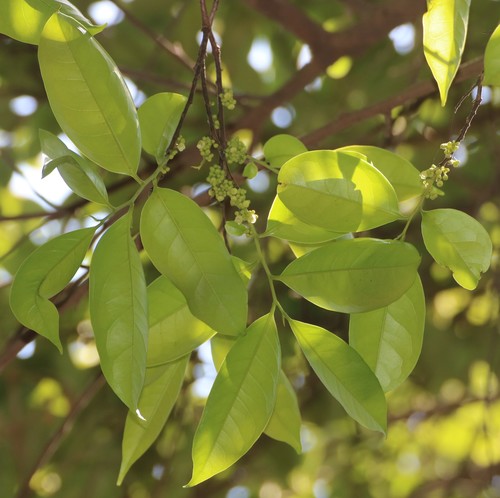
Diospyros barteri
Hiern.
iNaturalist· cc-by-nc
(c) peterneuenschwander, some rights reserved (CC BY-NC)
iNaturalist· cc-by-nc
(c) peterneuenschwander, some rights reserved (CC BY-NC)
Description
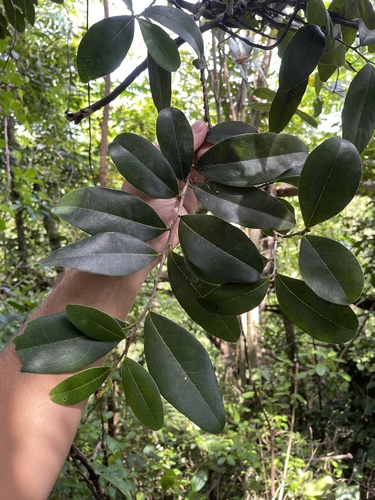
A scrambling tree in the Ebenaceae family that grows up to 7 m high. It is found in evergreen forests of West Africa in tropical regions.
This description is brief — help expand it
Edible Uses
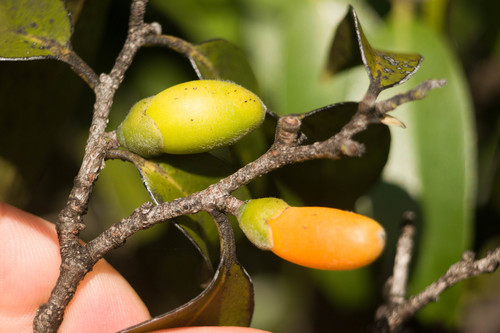
The thin pulp of the pale yellow or orange fruit is eaten. It is a minor item of diet. The oblong-conical fruit is up to 28mm long, containing a single, large seed.
Traditional Uses
The ripe fruit is eaten.
This uses section is brief — help expand it
Distribution
A tropical plant. It grows in evergreen forest in West Africa.
Where It Grows
Africa, Cameroon, Central Africa, Equatorial Guinea, Gabon, Ghana, Nigeria, West Africa,
Cultivation
Plants are grown from seeds.
Propagation
Seed - in general the seed of Diospyros species has a very short viability and so should be sown as soon as possible. The flesh should be removed since this contains germination inhibitors. Sow the seed in a shady position in a nursery seedbed. The sowing media for ebony uses soil and fine sand at the ratio 3:1. The seed is planted horizontally or vertically with the radicle end down, with a sowing depth of 1 - 1½ times the thickness of seed. Distance between the seeds is 3 - 5cm. Seeds are very sensitive to desiccation during germination and early growth, so must be regularly watered at this time. Normally the seed will germinate after one week. As a rule fresh seeds have a high percentage of fertility. The seedlings develop long taproots at an early stage, often before any appreciable elongation of the shoot takes place. The growth of the seedling is decidedly slow .
Other Uses
The stems are used as chew-sticks to maintain the health of the teeth and gums. The wood is hard. It is used locally for unspecified purposes.
Other Information
It is a minor food.
Notes
There are about 485 species of Diospyros mostly in the tropics.
Synonyms
Also Known As
Aheneba nastea, Bong, Ivin-oha, Pene
References (7)
- Burkill, H. M., 1985, The useful plants of west tropical Africa, Vol. 2. Kew.
- Busson, 1965,
- Dalziel, J. M., 1937, The Useful plants of west tropical Africa. Crown Agents for the Colonies London.
- Jardin, C., 1970, List of Foods Used In Africa, FAO Nutrition Information Document Series No 2. p 132
- Peters, C. R., O'Brien, E. M., and Drummond, R.B., 1992, Edible Wild plants of Sub-saharan Africa. Kew. p 104
Show all 7 references Hide references
- Vivien, J., & Faure, J.J., 1996, Fruitiers Sauvages d'Afrique. Especes du Cameroun. CTA p 141
- World Checklist of Useful Plant Species 2020. Royal Botanic Gardens, Kew