Dioscorea cayenensis subsp. rotundata
(Poir.) Miege
White Guinea Yam
gbif· cc-by-nc
Madeleine (Magsy) Lombard
gbif· cc-by-nc
Madeleine (Magsy) Lombard
gbif· cc-by-nc
Madeleine (Magsy) Lombard
Description
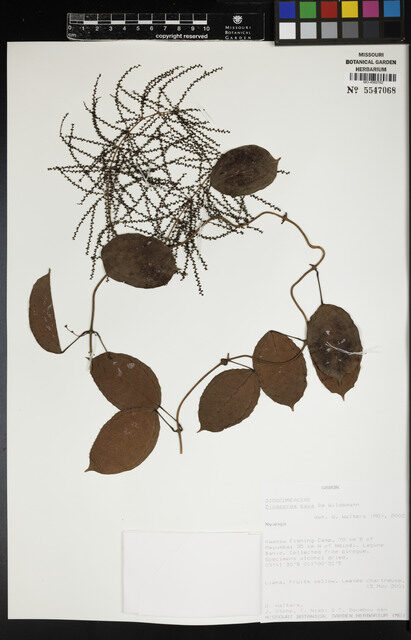
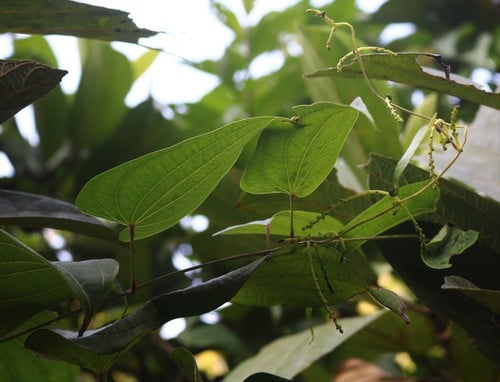
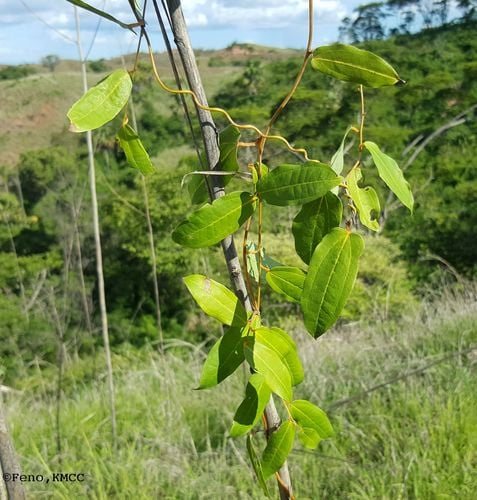
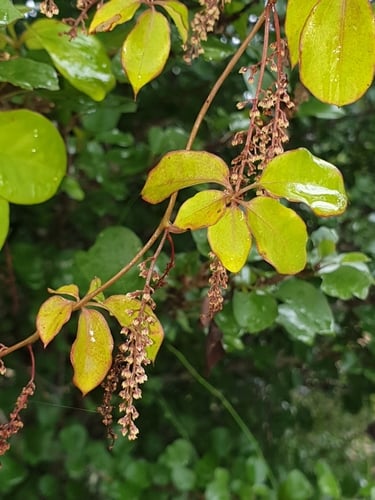
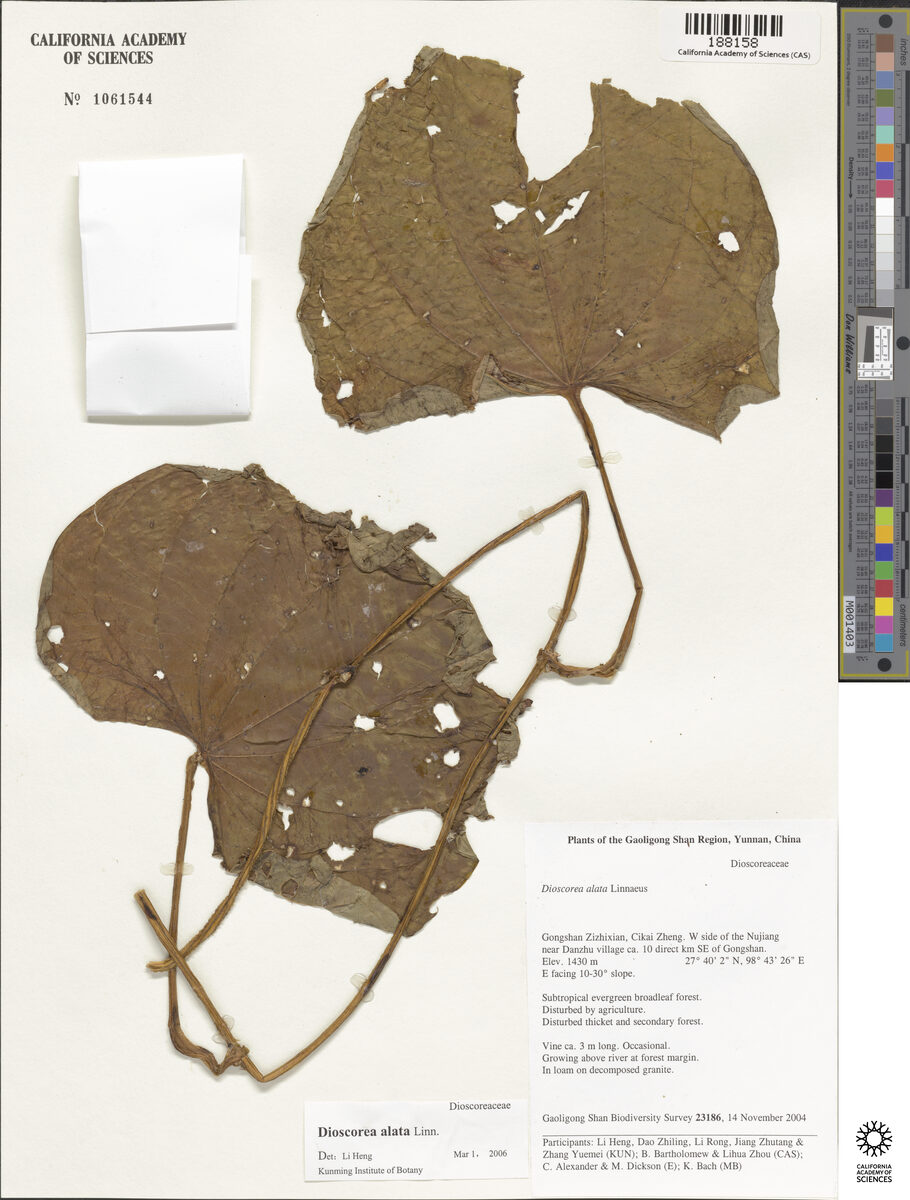
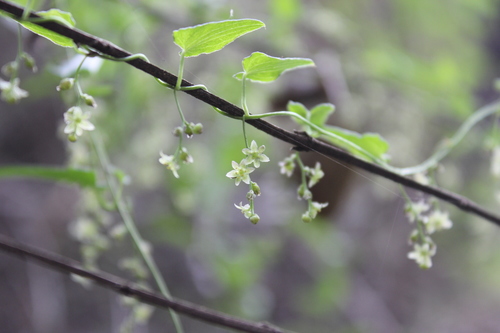
A climbing yam plant. The stems are round and can be 10-12 m long. They twine to the right around sticks. The stems are usually spiny, but can be smooth. There is a white bloom on the stems. The leaves are opposite and simple. They are 10-12 cm long by 6-8 cm wide. They are heart shaped and taper to a point. They are normally dark green and glossy. Some forms have leafy outgrowths (stipules) at the base of the leaf stalks. The flowers are often in groups of 4 and are formed near the leaves. It is mostly male flowers which occur and seeds are rarely produced. The tubers vary in shape, size and texture. Mostly they are like cylinders with rounded or pointed ends. The skin is smooth and brown with white flesh. The tubers can also be distorted in shape. Mostly only one tuber forms and the top end of the tuber is woody. A large number of different cultivated varieties occur.
Edible Uses
The tubers are cooked and eaten as a vegetable.
Traditional Uses
The tubers are cooked and eaten.
This uses section is brief — help expand it
Distribution
A tropical plant. It grows in places with a distinct dry season. Tubers have a time of dormancy. It can tolerate drought more than Greater yam (Dioscorea alata). It suits relatively heavy soils with a reasonable clay content. Rainfall of 1000-1500 mm distributed over 8-10 months is suitable.
Where It Grows
Africa, Asia, Benin, Bougainville, Brazil, Central America, Costa Rica, Côte d'Ivoire, East Africa, Ghana, Guinea, Guinée, Haiti, India, Ivory Coast, Jamaica, Kenya, Martinique, New Caledonia, Nigeria, Northeastern India, Pacific, Papua New Guinea, PNG, Philippines, Puerto Rico, SE Asia, Senegal, Sierra Leone, Sikkim, South America, St. Vincent and Grenadines, Togo, Vanuatu, West Africa, West Indies, Zambia,
Cultivation
Mostly setts of tubers are used. Occasionally seeds are used. Plants can also be grown from cuttings. About 1 sq metre per plant is suitable.
Production
Crops last 8-10 months. Tubers can be stored for several months. Tubers normally weigh 2-5 kg but can be up to 10 kg weight. Yields of 16-20 t/ha are normal. Tubers should not be stored below 15°C as chilling injury can result.
Other Information
It is a commercially cultivated vegetable. The most important yam in West Africa. It has only recently been introduced to Papua New Guinea.
Notes
There are about 650 species of Dioscorea. Many prefer to keep this as a separate species.
Synonyms
Also Known As
Citu, Eboe yam, Eight month yam, Ghar taru, He, Ishu, Njambwa, Round white yam, White yam, Yanwaa
References (29)
- Abbiw, D.K., 1990, Useful Plants of Ghana. West African uses of wild and cultivated plants. Intermediate Technology Publications and the Royal Botanic Gardens, Kew. p 27
- Bourret, D., 1981, Bonnes-Plantes de Nouvelle-Caledonie et des Loyaute. ORSTOM. p 40
- Brouk, B., 1975, Plants Consumed by Man. Academic Press, London. p 144
- Burkill, H. M., 1985, The useful plants of west tropical Africa, Vol. 3. Kew.
- Burkill, I.H., 1966, A Dictionary of the Economic Products of the Malay Peninsula. Ministry of Agriculture and Cooperatives, Kuala Lumpur, Malaysia. Vol 1 (A-H) p 837
Show all 29 references Hide references
- Cobley, L.S. (rev. Steele, W.M.) 2nd Ed., 1976, An Introduction to the Botany of Tropical Crops. Longmans. p 121
- Coursey, D.G., 1979, Yams, in Simmonds N.W.,(ed), Crop Plant Evolution. Longmans. London. p 70
- D'Ambrosio, U., & Puri, R. K., 2016, Foodways in transition: food plants, diet and local perceptions of change in a Costa Rican Ngäbe community. Journal of Ethnobiology and Ethnomedicine (2016) 12:3 p 24 (As Dioscorea rotundata)
- Encycl. suppl. 3:139. 1813
- Kay, D.E., 1973, Root Crops, Digest 2, Tropical Products Institute, London, p 190, 233
- Kays, S. J., and Dias, J. C. S., 1995, Common Names of Commercially Cultivated Vegetables of the World in 15 languages. Economic Botany, Vol. 49, No. 2, pp. 115-152
- Kiple, K.F. & Ornelas, K.C., (eds), 2000, The Cambridge World History of Food. CUP p 1880
- Kumar, A., et al, 2012, Ethnobotanical Edible Plant Biodiversity of Lepcha Tribes. Indian Forester, 138 (9):798-803 (As Dioscorea rotundata)
- Lim, T. K., 2015, Edible Medicinal and Non Medicinal Plants. Volume 9, Modified Stems, Roots, Bulbs. Springer p 38
- Macmillan, H.F. (Revised Barlow, H.S., et al) 1991, Tropical Planting and Gardening. Sixth edition. Malayan Nature Society. Kuala Lumpur. p 339
- Onwueme, I.C., 1978, The Tropical Tuber Crops. Wiley, p 4
- Peters, C. R., O'Brien, E. M., and Drummond, R.B., 1992, Edible Wild plants of Sub-saharan Africa. Kew. p 17
- Purseglove, J.W., 1972, Tropical Crops. Monocotyledons. Longmans p 107
- Schneider, E., 2001, Vegetables from Amaranth to Zucchini: The essential reference. HarperCollins. p 712
- Segnon, A. C. & Achigan-Dako, E. G., 2014, Comparative analysis of diversity and utilization of edible plants in arid and semi-arid areas in Benin. Journal of Ethnobiology and Ethnomedicine 2014, 10:80
- Sharma, B.B., 2005, Growing fruits and vegetables. Publications Division. Ministry of Information and broadcasting. India. p 238
- Smith, K., 1998. Growing Uncommon Fruits and Vegetables. New Holland. p 20
- Tindall, H.D., 1983, Vegetables in the Tropics, Macmillan p 217
- Ulian, T., et al, 2020, Unlocking plant resources to support food security and promote sustainable agriculture. Plants, People, Planet. 2020;2:421–445.
- USDA, ARS, National Genetic Resources Program. Germplasm Resources Information Network - (GRIN). [Online Database] National Germplasm Resources Laboratory, Beltsville, Maryland. Available: www.ars-grin.gov/cgi-bin/npgs/html/econ.pl (10 April 2000)
- Vickery, M.L. and Vickery, B., 1979, Plant Products of Tropical Africa, Macmillan. p 15
- Walter, A. & Lebot, V., 2007, Gardens of Oceania. ACIAR Monograph No. 122 p. 94
- Wiersema, J. H. & Leon, B., 2013, World Economic Plants. A Standard Reference CRC Press. 2nd Ed. p 248 (As Dioscorea rotundata)
- Zeven, A. C. & de West, J. M. J., 1982, Dictionary of cultivated plants and their regions of diversity. Wageningen. p 125 (As Dioscorea rotundata)