Dillenia ovata
Wallich ex Hook. f. & Thomson
Kadah dillenia tree
iNaturalist· cc-by-nc
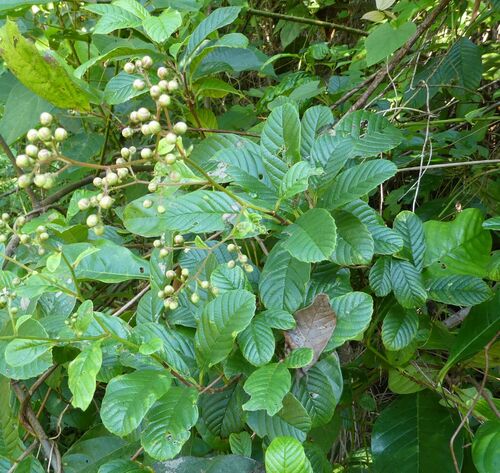
(c) eec, some rights reserved (CC BY-NC), uploaded by eec
iNaturalist· cc-by-nc
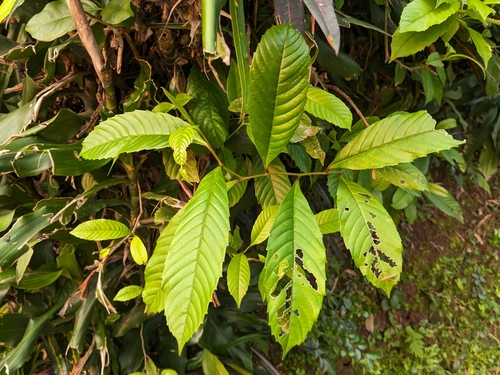
(c) chugbug111, some rights reserved (CC BY-NC)
iNaturalist· cc-by-nc
(c) chugbug111, some rights reserved (CC BY-NC)
Description
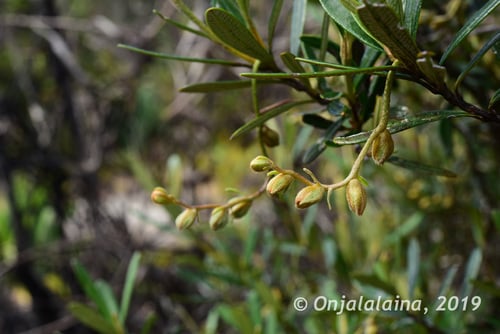
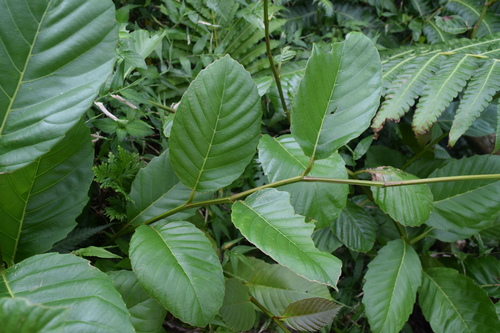
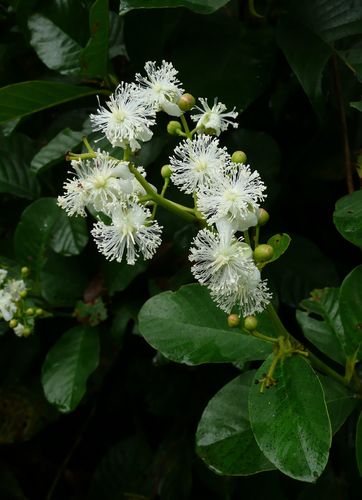
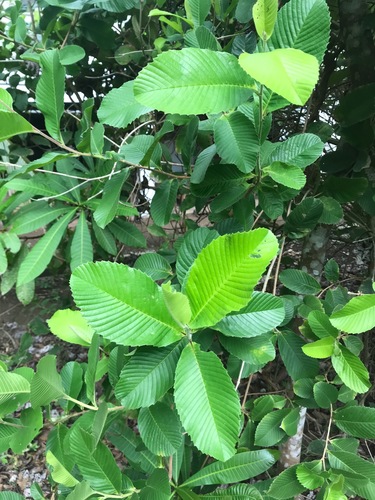
An evergreen tree. It grows 6-12 m tall but can be 30 m tall. The trunk is knotted and without branches for 5 m. The trunk can be 100 cm across. The bark is flaky and reddish brown. The leaves are large. They are oval and 10-20 cm long by 7-13 cm wide. There can be teeth along the edge. They have velvety hairs underneath. The flowers are golden yellow. They can be 16 cm across. The fruit are egg shaped and 4-5 cm long by 3-4 cm wide. They are pale yellow to reddish when ripe. The seeds are blackish brown.
Edible Uses
The fruit are eaten and popular, and the calyx around the fruit is used for flavouring.
Traditional Uses
The fruit are eaten and are popular. The calyx around the fruit is used for flavouring.
This uses section is brief — help expand it
Medicinal Uses
The bark is astringent. It is used in the treatment of diarrhoea.
Distribution
It is a tropical plant. It grows in mixed evergreen and deciduous forest. It grows up to 1,500 m above sea level. It suits hardiness zones 11-12.
Where It Grows
Asia, Cambodia, India, Indochina, Indonesia, Laos, Malaysia, SE Asia, Thailand, Vietnam,
Cultivation
Plants can be grown by seeds or cuttings.
Other Uses
The wood is used for making small items. The wood is suitable for beams, planks, and furniture.
Notes
There are about 60 Dillenia species.
Synonyms
Also Known As
Beriga, Entepung rimba, Jongong, Kadjang, Kayu pajan, Ketang bajut, Kok saan, May san, Phlou thom, Phlu thom, Phul thom, Pohon sempur minyak, San nhai, Simpur, So trai, Suretang, Tempuru
References (16)
- Burkill, I.H., 1966, A Dictionary of the Economic Products of the Malay Peninsula. Ministry of Agriculture and Cooperatives, Kuala Lumpur, Malaysia. Vol 1 (A-H) p 823
- Cengel, D. J. & Dany, C., (Eds), 2016, Integrating Forest Biodiversity Resource Management and Sustainable Community Livelihood Development in the Preah Vihear Protected Forest. International Tropical Timber Organization p 119
- Etherington, K., & Imwold, D., (Eds), 2001, Botanica's Trees & Shrubs. The illustrated A-Z of over 8500 trees and shrubs. Random House, Australia. p 262
- Fl. ind. 1:70. 1855
- Gardner, S., et al, 2000, A Field Guide to Forest Trees of Northern Thailand, Kobfai Publishing Project. p 31
Show all 16 references Hide references
- Kachenchart, B., et al, 2008, Phenology of Edible Plants at Sakaerat Forest. In Proceedings of the FORTROP II: Tropical Forestry Change in a Changing World. Bangkok, Thailand.
- Martin, M.A., 1971, Introduction L'Ethnobotanique du Cambodge. Centre National de la Recherche Scientifique. Paris.
- Pham-Hoang Ho, 1999, An Illustrated Flora of Vietnam. Nha Xuat Ban Tre. p 405
- Phon, P., 2000, Plants used in Cambodia. © Pauline Dy Phon, Phnom Penh, Cambodia. p 233
- Sam, H. V. et al, 2004, Trees of Laos and Vietnam: A Field Guide to 100 Economically or Ecologically Important Species. BLUMEA 49: 201-349
- Slik, F., www.asianplant.net
- Sukarya, D. G., (Ed.) 2013, 3,500 Plant Species of the Botanic Gardens of Indonesia. LIPI p 230
- Thorng, R., et al, 2015, Roles of Wild Food Plants in Ethnic Group Communities in Mondulkiri Province, Northeastern Cambodia. Journal of Mekong Societies Vol.11 No.2 May-August 2015 pp. 1-17
- USDA, ARS, National Genetic Resources Program. Germplasm Resources Information Network - (GRIN). [Online Database] National Germplasm Resources Laboratory, Beltsville, Maryland. Available: www.ars-grin.gov/cgi-bin/npgs/html/econ.pl (10 April 2000)
- Van Sam, H. et al, 2004, Trees of Laos and Vietnam: A Field Guide to 100 Economically or Ecologically Important Species. Blumea 29 (2004) 201-349
- World Checklist of Useful Plant Species 2020. Royal Botanic Gardens, Kew