Dicksonia antarctica
Labillardiere
Soft tree fern, Tasmanian tree fern, Man fern, Woolly tree fern
iNaturalist· cc-by-nc
(c) bennybotany85, some rights reserved (CC BY-NC), uploaded by bennybotany85
iNaturalist· cc-by-nc-sa
(c) Reiner Richter, some rights reserved (CC BY-NC-SA), uploaded by Reiner Richter
iNaturalist· cc-by-nc
(c) mmike78, some rights reserved (CC BY-NC)
Summary
Source: WikipediaDicksonia antarctica, commonly known as the soft tree fern, is a species of fern native to eastern Australia, ranging from south-east Queensland to Tasmania. It is commonly grown as an ornamental both in Australia and elsewhere.
Description
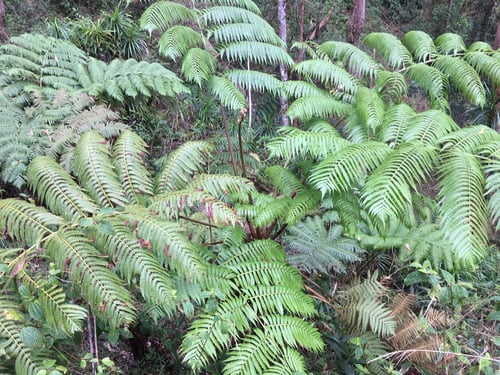
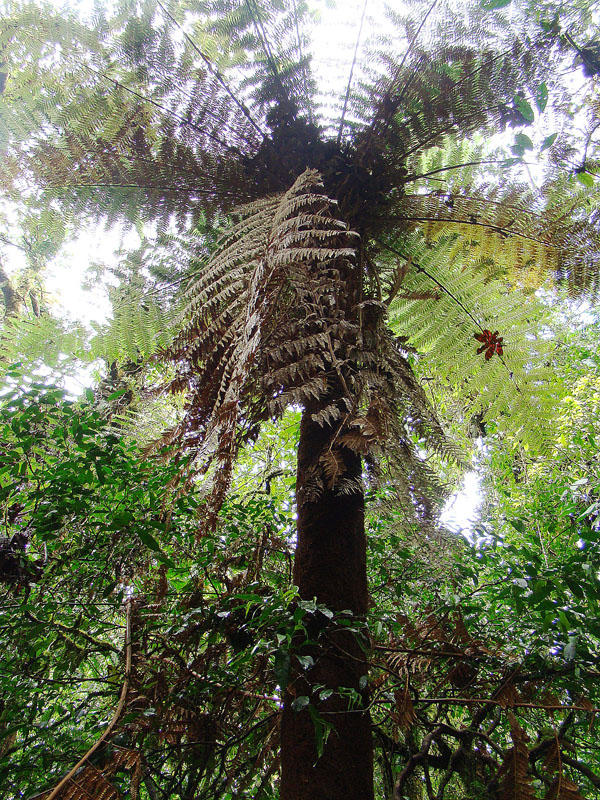
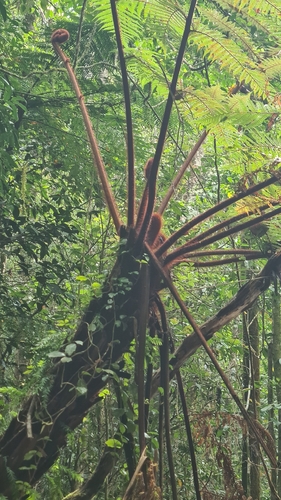
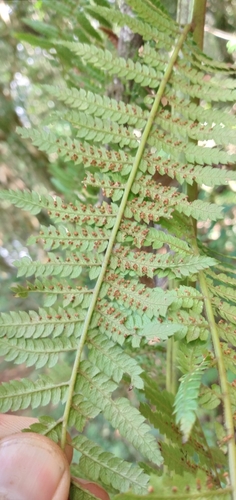
A tree fern. It has fronds all year round. It grows 1.8-3.7 m high and wide. It develops a single furry trunk. This is made up of the fibrous remains of old leaf stalks. The fronds are large and divided. They can be up to 2 m long and are glossy-green on the upper side and matt green underneath. They arch over. Normally a layer of dead fronds hangs down below the new fronds. The fronds are hairy at the base. The spore bodies or sori occur singly on each lobe of the frond.
Edible Uses
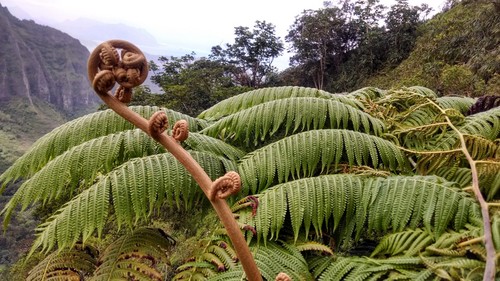
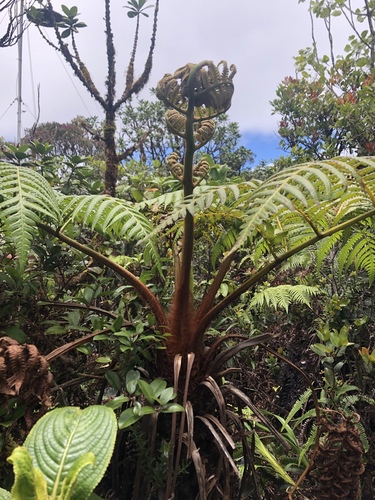
The pith in the upper part of the trunk, just below the growing tip, can be eaten raw or roasted. It is rich in starch but also contains tannin, making it astringent. Reported flavour varies from bitter to sweet, astringent, or like a bad turnip. The stem provides around 61 kilocalories per 100g. Harvesting the stem kills the plant and so this use cannot normally be condoned. Young leaves can be cooked — harvested just before they unfurl, they are juicy and slimy with a flavour resembling bitter celery.
Traditional Uses
The pith from the centre of the trunk is eaten. It is rich in starch. The young unrolled fiddle heads or young leaf tips can be cooked and eaten.
This uses section is brief — help expand it
Medicinal Uses
Astringent.
Known Hazards
Although we have found no reports of toxicity for this species, a number of ferns contain carcinogens so some caution is advisable. Many ferns also contain thiaminase, an enzyme that robs the body of its vitamin B complex. In small quantities this enzyme will do no harm to people eating an adequate diet that is rich in vitamin B, though large quantities can cause severe health problems. The enzyme is destroyed by heat or thorough drying, so cooking the plant will remove the thiaminase.
Distribution
It is a temperate plant. It is frost hardy. It grows in wet mountain gullies. On Mt Roland. It suits hardiness zones 8-10. Tasmania Herbarium. Arboretum Tasmania.
Where It Grows
Asia, Australia*, India, Tasmania*,
Cultivation
Requires a sheltered woodland position and a moist soil. Strongly resents drought or dryness at the roots. A very ornamental plant, it is hardy to about -5°c, succeeding outdoors in the milder areas of Britain where it thrives and often self-sows in Cornish gardens. One report says that some forms are hardy to at least -7°c. Plants can tolerate snow but are intolerant of severe frosts. Members of this genus are rarely if ever troubled by browsing deer. The 'trunk' of this plant is merely the decaying remains of earlier growth of the plant and forms a medium through which the roots grow. Plants can be cut down and, if they are kept moist, the top portions can be replanted and will form new roots. The stump, however, will not regenerate since it is simply dead organic matter. It is best to leave old fronds on the plant in order to protect the trunk from cold and desiccation.
Propagation
Spores can be sown at any time in a warm greenhouse. Surface sow and enclose the pot in a plastic bag to retain moisture, placing it in light shade. Germination takes 1–3 months at 20°C. Prick out small clumps when large enough to handle and grow on in a shaded greenhouse for at least the first 2 years. Plant out in late spring after the last expected frosts. Spores can be stored dry for up to 10 years.
Other Uses
This species is used in New Zealand to stabilise roadside cuttings.
Production
It is slow growing.
Notes
There are about 25-30 Dicksonia species.
Synonyms
Also Known As
Combadik, Garag, Kum-ba-da, Wonon tulong
References (37)
- Andrews, S.B., 1990, Ferns of Queensland. A handbook to the ferns and fern allies. Queensland DPI p 136
- Bodkin, F., 1991, Encyclopedia Botanica. Cornstalk publishing, p 339
- Brickell, C. (Ed.), 1999, The Royal Horticultural Society A-Z Encyclopedia of Garden Plants. Convent Garden Books. p 364
- Caton, J.M. & Hardwick, R. J., 2016, Field Guide to Useful Native Plants from Temperate Australia. Harbour Publishing House. p 240 (As Dicksonia)
- Chaffey, C.H., 1999, Australian Ferns. Growing them successfully. Kangaroo Press. p 138
Show all 37 references Hide references
- Cherikoff V. & Isaacs, J., The Bush Food Handbook. How to gather, grow, process and cook Australian Wild Foods. Ti Tree Press, Australia p 195
- Collier, P., 1992, Rainforest Plants of Tasmania. Plant Identikit. Society for growing Australian Plants. Tasmania. p 57
- Cribb, A.B. & J.W., 1976, Wild Food in Australia, Fontana. p 135
- Cronin, L., 1989, The Concise Australian Flora. Reed. p 290
- Cundall, P., (ed.), 2004, Gardening Australia: flora: the gardener's bible. ABC Books. p 497
- De Angelis, D., 2005, Aboriginal Plant Use of the Greater Melbourne Area. La Trobe University Environment Collective
- Elliot, W.R., & Jones, D.L., 1984, Encyclopedia of Australian Plants suitable for cultivation. Vol 3. Lothian. p 266
- Etherington, K., & Imwold, D., (Eds), 2001, Botanica's Trees & Shrubs. The illustrated A-Z of over 8500 trees and shrubs. Random House, Australia. p 261
- Gott, B & Conran, J., 1991, Victorian Koorie Plants. PO Box 666 Hamilton, Victoria 3300, Australia. p 37
- Goudey, C.J., 1988, A Handbook of Ferns for Australia and New Zealand. Lothian. p 93
- Greig, D., 1996, Flowering Natives for Home Gardens. Angus & Robertson. p 142
- Hardwick, R.J., 2000, Nature's Larder. A Field Guide to the Native Food Plants of the NSW South Coast. Homosapien Books. p 112
- Harris, S., Buchanan, A., Connolly, A., 2001, One Hundred Islands: The Flora of the Outer Furneaux. Tas Govt. p 149
- Hastings Advance Community College, 2017, Uses for Native Plants of the Mornington Peninsula. 86pp. p 37
- Isaacs, J., 1987, Bush Food, Aboriginal Food and Herbal Medicine. Weldons. p 124
- Jones D, L, 1986, Ornamental Rainforest Plants in Australia, Reed Books, p 308
- Joyce, D., 1998, The Garden Plant Selector. Ryland, Peters and Small. p 334
- Large, M.F., & Braggins, J.E., 2004, Tree Ferns. CSIRO Publishing, Melbourne, Australia. p 284 Plates 100, 101
- Lazarides, M. & Hince, B., 1993, Handbook of Economic Plants of Australia, CSIRO. p 80
- Lord, E.E., & Willis, J.H., 1999, Shrubs and Trees for Australian gardens. Lothian. p 95
- Low, T., 1991, Wild Food Plants of Australia. Australian Nature FieldGuide, Angus & Robertson. p 86
- Low, T., 1992, Bush Tucker. Australia’s Wild Food Harvest. Angus & Robertson. p 130
- Marinelli, J. (Ed), 2004, Plant. DK. p 318
- Minchin, R.F., Tasmanian Wildflowers. A Field Guide. Volume one. Regal Publications, Launceston p 120
- Nash, D., 2004, Aboriginal Plant Use in south-eastern Australia. Australian National Botanic Gardens. p 10
- Nicholson, N & H., 1996, Australian Rainforest Plants 3, Terania Rainforest Publishing. NSW. p 21
- Nov. Holl. pl. 2:100, t. 249. 1807
- Plants for a Future database, The Field, Penpol, Lostwithiel, Cornwall, PL22 0NG, UK. http://www.scs.leeds.ac.uk/pfaf/
- Ratcliffe D & P., 1987, Australian Native Plants for Indoors. Little Hills press. p 82
- Tasmanian Herbarium Vascular Plants list p 97
- Williams, J.B., Harden, G.J., and McDonald, W.J.F., 1984, Trees and shrubs in rainforests of New South Wales and Southern Queensland. Univ. of New England, Armidale. p 17
- Woolmore, E et al, 2002, King Island Flora: A Field Guide. p 116