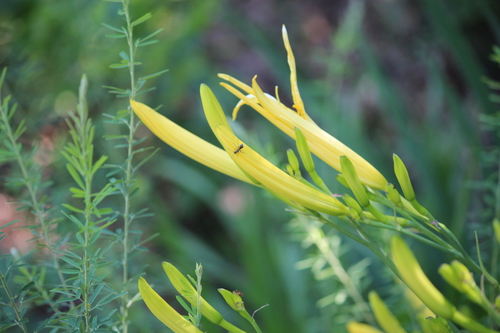
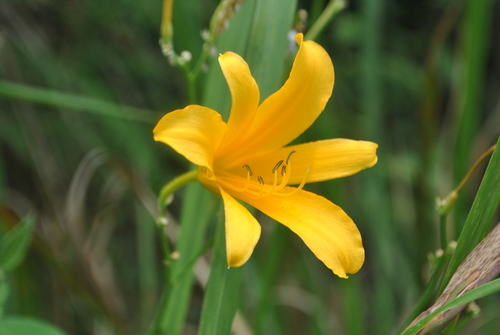
Dianella tasmanica
Lam. ex Juss
Flax lilies, Large flax Lily, Tasman flaxlily, Blueberry
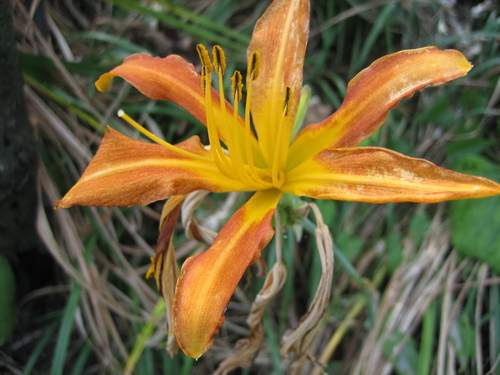
iNaturalist· cc-by-nc-sa
(c) Reiner Richter, some rights reserved (CC BY-NC-SA), uploaded by Reiner Richter
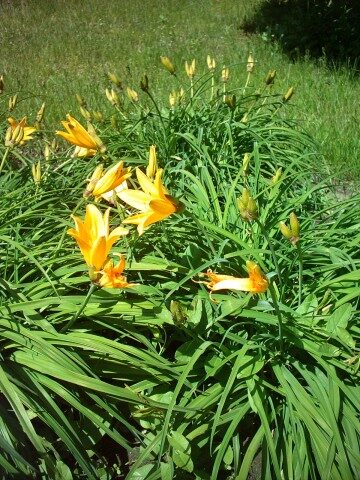
iNaturalist· cc-by
(c) Geoff Shuetrim, some rights reserved (CC BY), uploaded by Geoff Shuetrim
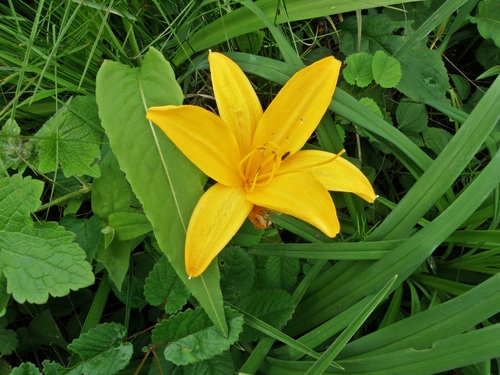
iNaturalist· cc-by-nc-sa
(c) Anne Roberts, some rights reserved (CC BY-NC-SA)
Summary
Source: WikipediaDianella tasmanica, commonly known as the Tasman flax-lily or Tasmanian flax-lily, is a herbaceous strappy perennial herb of the family Asphodelaceae, subfamily Hemerocallidoideae, found in southeastern Australia including Tasmania. Its leaves are up to 80 centimetres (30 inches) in length, and the flower stem is up to 1.5 m (4 ft 11 in) tall. Blue flowers in spring and summer are followed by violet berries. It adapts readily to cultivation and is commonly seen in Australian gardens. Unlike other Dianella species, its fruits are toxic.
Description
A robust spreading lily. It keeps growing from year to year. It grows 0.5-1.5 m high and spreads 0.5-2 m wide. It forms tufts. The leaves are thick and shiny and strap like. The leaves can be 1.2 m long. They are 15-30 mm wide. They are keeled. The sheath at the base is reddish or purple. The flowers occur in loose clusters. They are on long branching stems and are blue. They are star like. The fruit are deep blue berries. They are 25 mm across. They contain many black seeds.
Edible Uses
No edible uses are known for this plant.
Traditional Uses
The fruit can be used for jam.
This uses section is brief — help expand it
Medicinal Uses
No medicinal uses are known for this plant.
Known Hazards
The fruits of Dianella tasmanica are toxic to an unknown degree and should not be eaten. They are markedly larger than the fruits of other Dianella species, and produce an irritating tingling sensation in the mouth when consumed. The fruits have reportedly been used by Aboriginal peoples to dye baskets, and the leaves may be used for weaving.
Distribution
It is a temperate plant and will grow in the subtropics. It needs well drained soil. It can grow in full sun or light shade. It is frost hardy. It grows naturally in damp sites under forest. In Tasmania it grows from sea level to 800 m altitude. In Hobart Botanical gardens. Melbourne Botanical Gardens. It suits hardiness zones 8-10. Tasmanian Herbarium.
Where It Grows
Australia*, Tasmania*,
Cultivation
Succeeds in ordinary garden soil in sun or dappled shade. Requires a well-drained neutral to acid soil. Requires a sunny sheltered position when grown outdoors in Britain. Although not very cold-tolerant, this species can survive in sheltered stable environments in dappled shade, such as a woodland, if temperatures do not drop far below zero for long periods.
Propagation
Seed: pre-soak for 24 hours in lukewarm water, then sow in spring in a greenhouse with gentle heat. Germination typically takes 1–3 months at 25°C. Once large enough to handle, prick seedlings out into individual pots and grow on in the greenhouse for at least their first two years before planting out in late spring or early summer. Division: divide as plants come into growth in spring. Larger clumps can go directly into permanent positions; pot up smaller clumps in a cold frame until rooting well, then plant out in spring.
Other Uses
The leaves yield a very strong, silky fibre and are also used in basketry.
Notes
There are about 20-30 Dianella species. Also put in the family Hemerocallidaceae.
Also Known As
Tasman Flax-lily
References (20)
- Bodkin, F., 1991, Encyclopedia Botanica. Cornstalk publishing, p 337
- Brickell, C. (Ed.), 1999, The Royal Horticultural Society A-Z Encyclopedia of Garden Plants. Convent Garden Books. p 357
- Cameron, M., (Ed.) 1981, A Guide to Flowers & Plants of Tasmania. Reed p 56
- Collier, P., 1992, Rainforest Plants of Tasmania. Plant Identikit. Society for growing Australian Plants. Tasmania. p 43
- Cundall, P., (ed.), 2004, Gardening Australia: flora: the gardener's bible. ABC Books. p 491
Show all 20 references Hide references
- Curtis, W.M., & Morris, D.I., 1994, The Student's Flora of Tasmania. Part 4B St David's Park Publishing, Tasmania, p 378
- Elliot, W.R., & Jones, D.L., 1984, Encyclopedia of Australian Plants suitable for cultivation. Vol 3. Lothian. p 260
- Gilfedder, L et al, 2003, The Nature of the Midlands. Midlands Bushweb. PO Box 156 Longford, Tasmania. p 69
- Hardwick, R.J., 2000, Nature's Larder. A Field Guide to the Native Food Plants of the NSW South Coast. Homosapien Books. p 53
- Harris, S., Buchanan, A., Connolly, A., 2001, One Hundred Islands: The Flora of the Outer Furneaux. Tas Govt. p 148
- Hibbert, M., 2002, The Aussie Plant Finder 2002, Florilegium. p 85
- Jones D, L, 1986, Ornamental Rainforest Plants in Australia, Reed Books, p 270
- Lavelle, M., 2008, Wild Flowers of Australia and Oceania. Southwater. p 117
- Low, T., 1991, Wild Food Plants of Australia. Australian Nature FieldGuide, Angus & Robertson. p 113
- Molyneux, B & Forrester, S., 1997, The Austraflora A-Z of Australian Plants. Reed. p 74
- Morley, B. & Everard, B., 1970, Wild Flowers of the World. Ebury press. Plate 142
- Ratcliffe D & P., 1987, Australian Native Plants for Indoors. Little Hills press. p 81
- Tasmanian Herbarium Vascular Plants list p 69
- Whiting, J. et al, 2004, Tasmania's Natural Flora. Tasmania's Natural Flora Editorial Committee PO Box 194, Ulverstone, Tasmania, Australia 7315 p 353
- Woolmore, E et al, 2002, King Island Flora: A Field Guide. p 91