Dialium englerianum
Henriques
Kalahari podberry
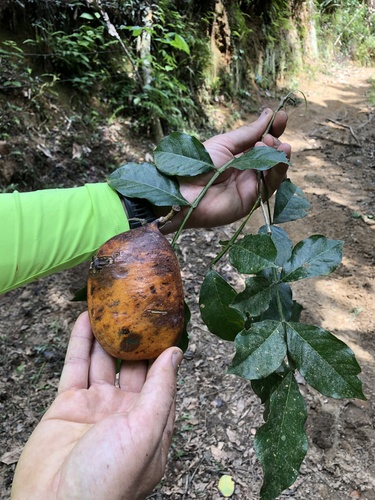
iNaturalist· cc-by-nc
(c) Peter Erb, some rights reserved (CC BY-NC), uploaded by Peter Erb
iNaturalist· cc-by-nc
(c) Peter Erb, some rights reserved (CC BY-NC), uploaded by Peter Erb
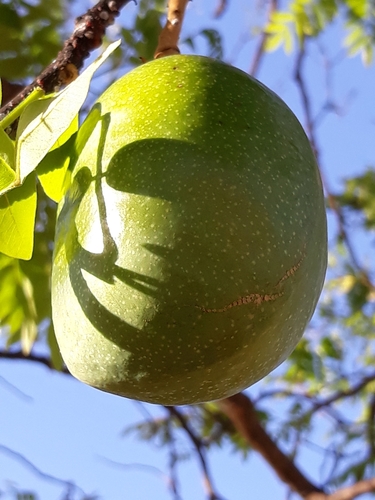
iNaturalist· cc-by-nc
(c) Silke Rugheimer, some rights reserved (CC BY-NC)
Description
A small to large tree. It grows to 6-18 m tall. The crown is rounded with many branches. The trunk has rough grey furrowed bark. The leaves are compound and up to 15 cm long. The leaf is made up of several pairs of opposite leaflets and a terminal bud. These leaflets are pointed. They are 2.5-8 cm long and 2.5-5 cm wide. The buds are small and green. The flowers are small and cream. The fruit don't look like legume pods. They are oval and 2.5 cm or more long with a dry pulp and outer velvety skin. They are brown when ripe. They are edible.
Edible Uses
The fruit are soaked and eaten fresh, boiled with meal, or used for drinks, relishes, and chutneys. The pods are eaten raw. Young leaves are eaten raw. Fresh seeds are eaten raw, and dried seeds are soaked and boiled for consumption during the rainy season. The fruit are an important food of the Kalahari Bushmen.
Traditional Uses
The fruit are soaked and eaten fresh or boiled with meal. They are also used for drinks, relishes and chutneys. The pods are also eaten raw. The young leaves are eaten raw. The seeds are eaten raw. Fresh seeds are eaten raw and dried seeds are kept for the rainy season then soaked, boiled and eaten.
Distribution
A tropical plant. It grows on sand. It grows between 300-1,100 m above sea level. It grows in areas with an annual rainfall of 450-600 mm. It can grow in arid places.
Where It Grows
Africa, Angola, Botswana, Central Africa, Congo DR, East Africa, Mozambique, Namibia, South Africa, Southern Africa, Zambia, Zimbabwe,
Cultivation
Grows wild in deep, sandy soils. Although many species within the family Fabaceae have a symbiotic relationship with soil bacteria, this species is said to be devoid of such a relationship and therefore does not fix atmospheric nitrogen.
Other Uses
The seeds are often used locally in necklaces.
Other Information
The fruit are an important food of the Kalahari Bushmen.
Notes
There are about 40 Dialium species. They grow in tropical SE Asia. They probably all have edible fruit. Also as Caesalpinaceae.
Synonyms
Also Known As
Cha-a, Mbota, Mpgamane, Muhamani, Mulemba, Musala, Non simba, Omufimba, Nsamba nzeke, Tsimba, Umbota, Umbvee, Usimba
References (25)
- Bol. Soc. Brot., ser. 2, 2 48. 1899
- Cheikhyoussef, A & Embashu, W., 2013, Ethnobotanical knowledge on Indigenous fruits in Ohangwena and Oshito regions in Northern Namibia. Journal of Ethnobiology and Ethnomedicine 9:34
- Fowler, D. G., 2007, Zambian Plants: Their Vernacular Names and Uses. Kew. p 30
- Fox, F. W. & Young, M. E. N., 1982, Food from the Veld. Delta Books. p 207
- ILDIS Legumes of the World http:www:ildis.org/Legume/Web
Show all 25 references Hide references
- Lautenschläger, T., et al, 2018, First large-scale ethnobotanical survey in the province of Uíge, northern Angola. Journal of Ethnobiology and Ethnomedicine (2018) 14:51
- Leger, S., 1997, A Description of Today's Use of Plants in West Bushmanland (Namibia). German Development Service. PO Box 220035, 14061 Berlin, Germany. http://www.sigridleger.de/book/
- Maguire, 1978
- Mannheimer, C. A. & Curtis. B.A. (eds), 2009, Le Roux and Muller's Field Guide to the Trees and Shrubs of Namibia. Windhoek: Macmillan Education Namibia. p 150
- Maroyi, A. & Cheikhyoussef, A., 2017, Traditional knowledge of wild edible fruit in southern Africa: A comparative use patterns in Namibia and Zimbabwe. Indian Journal of Traditional Knowledge. 16(3): 385-392
- Marshall, 1976,
- Menninger, E.A., 1977, Edible Nuts of the World. Horticultural Books. Florida p 93
- Palgrave, K.C., 1996, Trees of Southern Africa. Struik Publishers. p 286
- Palmer, E and Pitman, N., 1972, Trees of Southern Africa. Vol. 2. A.A. Balkema, Cape Town p 875
- Peters, C. R., O'Brien, E. M., and Drummond, R.B., 1992, Edible Wild plants of Sub-saharan Africa. Kew. p 122
- Plowes, N. J. & Taylor, F. W., 1997, The Processing of Indigenous Fruits and other Wildfoods of Southern Africa. in Smartt, L. & Haq. (Eds) Domestication, Production and Utilization of New Crops. ICUC p 189
- Rodin, 1985,
- Roodt, V., 1998, Trees & Shrubs of the Okavango Delta. Medicinal Uses and Nutritional value. The Shell Field Guide Series: Part 1. Shell Botswana. p 195
- Royal Botanic Gardens, Kew (1999). Survey of Economic Plants for Arid and Semi-Arid Lands (SEPASAL) database. Published on the Internet; http://www.rbgkew.org.uk/ceb/sepasal/internet [Accessed 21st April 2011]
- Ruiters-Welcome, A. K., 2019, Food plants of southern Africa. Ph.D. thesis. Univ. of Johannesburg p 57
- Unwin, A. H., 1920, West African Forests and Forestry. Fisher Unwin Ltd. pdf on Internet p 85
- van Wyk, Ben-Erik, 2019, The diversity and multiple uses of southern African legumes. Australian Systematic Botany, 2019, 32, 519–546
- Welcome, A. K. & Van Wyk, B.-E., 2019, An inventory and analysis of the food plants of southern Africa. South African Journal of Botany 122 (2019) 136–179
- Wild, 1975,
- World Checklist of Useful Plant Species 2020. Royal Botanic Gardens, Kew