Dendrocalamus brandisii
(Munro) Kurz
Brandisii bamboo, Velvet leaf bamboo
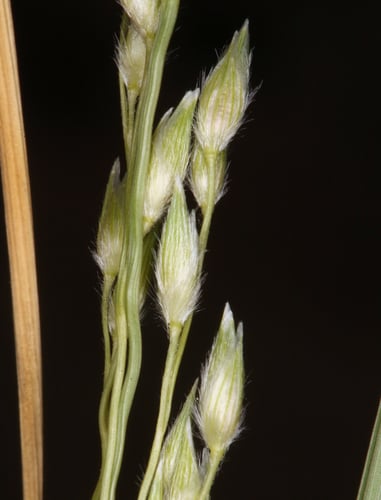
iNaturalist· cc-by-nc
(c) bowuzhizhi, some rights reserved (CC BY-NC)
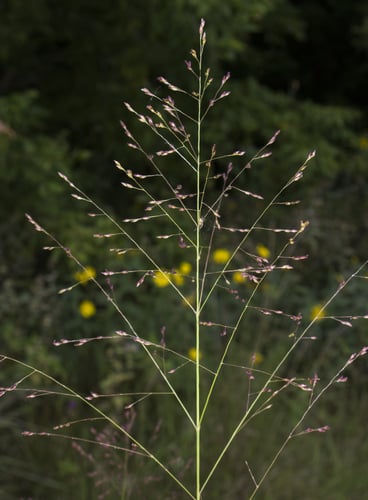
wikimedia· cc0
Wikimedia Commons - Stickpen
Description
A loosely tufted bamboo. The culm is erect and the tip hangs over. The stem or culm can be 30 m high. They are 15-20 cm across at the base. The wall is 2.5-4 cm thick. They are greenish-grey. The internodes are 30-60 cm long. There is a shiny brown line of hairs below and above the node. The nodes are slightly swollen. There are aerial roots in the lower nodes. There can be branches from the middle of the culm. The culm sheath is 40-60 cm long by 20-35 cm wide. It is longer than the internodes. The leaf blade is sword shaped and 20-30 cm long by 2.5-5 cm wide. It is pale green on the upper surface.
Edible Uses
The young shoots are used as a vegetable and are sold in markets in Thailand, where they are also exported and highly valued.
Traditional Uses
The young shoots are used as a vegetable.
This uses section is brief — help expand it
Distribution
It grows in the tropics and subtropics. It grows in wet places in evergreen forests up to 1300 m altitude. It is often on limestone soils. It needs well drained soils. In Yunnan.
Where It Grows
Andaman Islands, Asia, Australia, Bangladesh, China, India, Indochina, Laos, Myanmar, Nicobar, Northeastern India, SE Asia, Singapore, Thailand, USA, Vietnam,
Cultivation
It can be grown from seed, from rhizome cuttings or by cuttings of the culm or stem. For culm cuttings a section of the stem with 2 nodes was planted horizontally just below the soil surface.
Propagation
Seed - many, if not all, members of this genus have a short viability and should be sown within 2 - 3 months of harvest. Sow in containers in a lightly shaded position and only just cover. Germination usually takes place readily. Prick out into individual pots as soon as the plants are large enough to handle. Plant out into permanent positions when 20cm tall. Plants may remain in their low-growing juvenile state for several years - cutting the culms to the ground level can stimulate taller adult growth. Rhizome, culm and branch cuttings. The propagules are raised in the nursery and after they have produced roots they are planted out in the field before or during the first half of the rainy season.
Other Uses
The culms are used for building purposes, furniture, farm implements, baskets and other woven wares and handicrafts. This is one of the strongest and largest bamboos for construction purposes. Harvesting may start 3 - 4 years after a clump has begun to produce culms of maximum size. Only culms older than 3 years are harvestable and harvesting should never be done during the growing season. It is recommended to cut the culms lower than 30cm above the ground level, but not below the 2nd node. Debris and cut branches should always be removed completely.
Production
The young shoots emerge above the soil in the rainy season. A healthy clump produces several shoots each year.
Other Information
In Thailand, young shoots are sold in markets and also exported. They are enjoyed. It is a cultivated food plant.
Notes
There are about 29 Dendrocalamus species. Chemical composition per 100 g edible portion: Water 92 g, Protein 1.1 g, Fat 0.3 g, carbohydrates 1.8 g, Fibre 0.8 g, Ash 0.6 g.
Synonyms
Also Known As
Bo shi tian long zhu, Hok, Kya-lo-wa, Lao gan, Mai wang, Phai-bongyai, Phai-sangyen, Phai tong pa, Taung-wabo, Wabo, Wa-payaung, Wo chi
References (11)
- Cao, Y., et al, 2020, Ethnobotanical study on wild edible plants used by three trans-boundary ethnic groups in Jiangcheng County, Pu’er, Southwest China. Journal of Ethnobiology and Ethnomedicine (2020) 16:66
- Dransfield, S. & Widjaja, EA., 1995, Plant Resources of South East Asia. PROSEA No. 7 Bamboos. Leiden. p 83
- Ghorbani, A., et al, 2012, A comparison of the wild food plant use knowledge of ethnic minorities in Naban River Watershed Nature Reserve, Yunnan, SW China. Journal of Ethnobiology and Ethnomedicine; 8:17
- Hibbert, M., 2002, The Aussie Plant Finder 2002, Florilegium. p 84
- http://www.plantnames.unimelb.edu.au/sorting/Bamboos_Edible.html
Show all 11 references Hide references
- Prelim. rep. forest Pegu App. B 94. 1875
- USDA, ARS, National Genetic Resources Program. Germplasm Resources Information Network - (GRIN). [Online Database] National Germplasm Resources Laboratory, Beltsville, Maryland. Available: www.ars-grin.gov/cgi-bin/npgs/html/econ.pl (10 April 2000)
- Wiersema, J. H. & Leon, B., 2013, World Economic Plants. A Standard Reference CRC Press. 2nd Ed. p 238
- World Checklist of Useful Plant Species 2020. Royal Botanic Gardens, Kew
- Yang, Y., et al, A review of bamboo resources in Yunnan, China www.bioversityinternational.org
- Zeven, A. C. & de West, J. M. J., 1982, Dictionary of cultivated plants and their regions of diversity. Wageningen. p 53