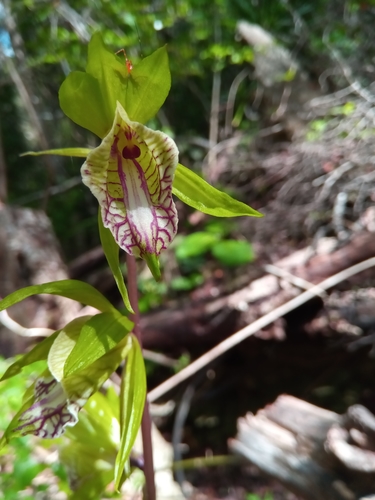
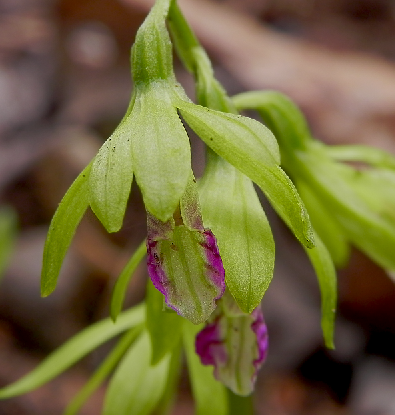
Dendrobium salaccense
(Blume) Lindl.
Cooking orchid
iNaturalist· cc-by
(c) VanLap Hoàng, some rights reserved (CC BY)
iNaturalist· cc-by-nc
(c) tspkumar, some rights reserved (CC BY-NC)
Description
An orchid. It grows on trees. The stems are erect and tough. It is 1 m long and 3-4 mm wide. It is enclosed in the leaf sheaths. The leaves are arranged in 2 rows. They are narrowly sword shaped and 15 cm long by 2 cm wide. The flowering stalks emerge through the sheaths.
Edible Uses
The leaves are used as a condiment and spice, traditionally placed near cooking rice to impart an aromatic flavor.
Traditional Uses
The leaves are placed near rice which is cooking to give the rice an aroma.
This uses section is brief — help expand it
Distribution
A tropical plant. It grows on tree trunks in forests and on rocks in open forests between 600-1,000 m above sea level in southern China.
Where It Grows
Asia, Bhutan, China, Himalayas, India, Indochina, Indonesia, Laos, Malaysia, Myanmar, SE Asia, Sri Lanka, Thailand, Tibet, Vietnam,
Cultivation
The plant has a symbiotic relationship with a species of soil-dwelling fungus. It is important that spores of this fungus are present in any soil in which the plant is grown.
Propagation
Seed - surface sow, preferably as soon as it is ripe, in a container and do not allow the compost to dry out. The seed of this species is extremely simple, it has a minute embryo surrounded by a single layer of protective cells. It contains very little food reserves and depends upon a symbiotic relationship with a species of soil-dwelling fungus. The fungal hyphae invade the seed and enter the cells of the embryo. The orchid soon begins to digest the fungal tissue and this acts as a food supply for the plant until it is able to obtain nutrients from decaying material in the soil. It is best to use some of the soil that is growing around established plants in order to introduce the fungus, or to sow the seed around a plant of the same species and allow the seedlings to grow on until they are large enough to move.
Other Uses
The leaves have a strong liquorice-like odour, especially during drying or steaming. Women wear the aromatic leaves in their hair..
Notes
There are about 900-1200 Dendrobium species orchids.
Synonyms
References (5)
- Burkill, I.H., 1966, A Dictionary of the Economic Products of the Malay Peninsula. Ministry of Agriculture and Cooperatives, Kuala Lumpur, Malaysia. Vol 1 (A-H) p 791
- Heyne, K., 1927,
- Martin, F.W. & Ruberte, R.M., 1979, Edible Leaves of the Tropics. Antillian College Press, Mayaguez, Puerto Rico. p 98
- PROSEA handbook Volume 13 Spices. p 276
- Seidemann J., 2005, World Spice Plants. Economic Usage, Botany, Taxonomy. Springer. p 134