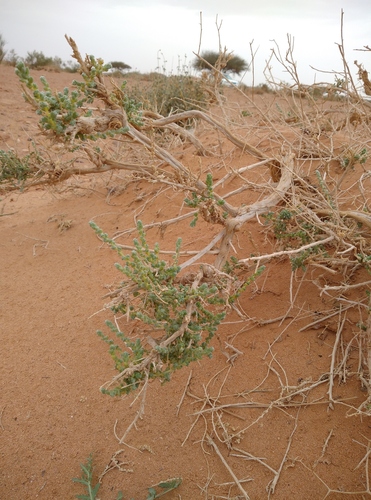
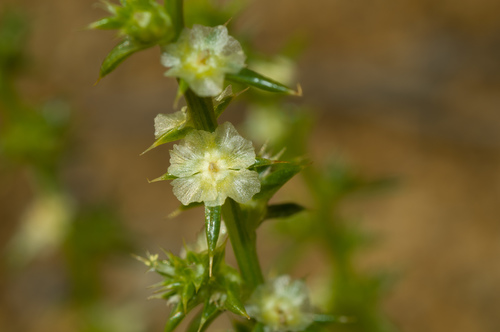
Deeringia amaranthoides
(Lamk.) Merr.
Shrubby deeringia
iNaturalist· cc0
no rights reserved, uploaded by 葉子
iNaturalist· cc-by-nc
(c) Alan Wynn, some rights reserved (CC BY-NC)
iNaturalist· cc-by-nc
(c) Alan Wynn, some rights reserved (CC BY-NC)
Summary
Source: WikipediaDeeringia amaranthoides is a species of plant in the Amaranthaceae family and is distributed from the western Himalayas east across southern China, down through south east Asia and Indonesia, across New Guinea to parts of Australia. It was first described as Achyranthes amaranthoides by Jean-Baptiste Lamarck in 1785 and reclassified as Deeringia amaranthoides by Elmer Drew Merrill in 1917.
Description
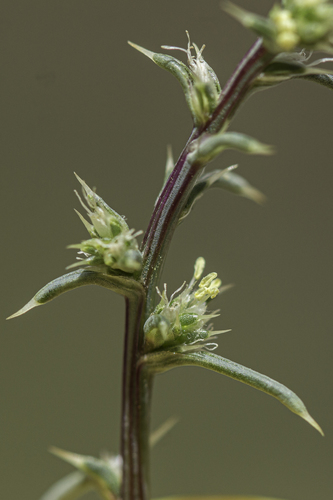
A small shrub or climber up to 5 m tall. The stem is woody and it branches. Young shoots are slender and smooth. The leaves are alternate and oval or sword shaped. They are 10 cm long and 2-4 cm wide. They are drawn out to a long point and are bright green with a thin texture. The flowers occur in slender spikes up to 25 cm long. These are in the axils of the upper leaves. Flowers are 0.4 cm across and greenish white. Flowers contain both sexes. Seeds are about 1.2 mm across, smooth and black. They are inside a bright red berry which is carried in clusters on long slender spikes. The fruit are 0.5 cm long with 3 furrows long it.
Edible Uses
The young leaves are cooked and eaten as a vegetable, and can be stored for 3-4 days.
Traditional Uses
The young leaves are cooked and eaten as a vegetable. CAUTION This plant is suspected of poisoning cattle. (Often cattle forget to cook their food!!) The young leaves can be stored for 3-4 days.
Medicinal Uses
A decoction of the leaves is considered a cure for dysentery. An infusion is given to children for treating chicken pox. Used externally, the leaves are applied to sores, inflammatory tumours, and are placed as a poultice on the stomach to treat stomach-ache and on the forehead to treat fevers and headache. The powder of the root is inhaled to cause violent sneezing. It is drawn into the nostrils, together with vinegar and onion juice, to get rid of mucous obstructions and the headache caused by the obstruction. Several complex triterpenoid saponins and several triterpene glycosides of olean-12-en-28-oate have been isolated from the fruits. The leaves probably also contain a considerable amount of alkaloids (without further specification). In older literature, the plant is reported to possess anticancer and spermicidal activity.
Known Hazards
This plant is suspected of poisoning cattle.
Distribution
A tropical plant. It occurs in the Sepik, Madang, Morobe and Central Provinces in Papua New Guinea. It is often near forest edges near creeks in the rainforest. It occurs up to 1200 m altitude. This plant is also used as food in Fiji, Indonesia and Taiwan. It needs a well drained humus rich soil. It needs a sheltered position and partial shade. It is drought and frost tender.
Where It Grows
Africa, Asia, Australia, Bhutan, China, Christmas Island, East Timor, Fiji, Himalayas, India, Indochina, Indonesia, Laos, Malaysia, Micronesia, Myanmar, Nepal, Northeastern India, Pacific, Pakistan, Papua New Guinea, PNG, Philippines, Sao Tome and Principe, Saipan, SE Asia, Sikkim, Slovenia, Solomon Islands, Taiwan, Thailand, Timor-Leste, Vietnam,
Cultivation
It grows wild. Plants are grown from seed. The seed need to be sown fresh. Plants can also be easily grown from cuttings.
Propagation
Seed - sown fresh, it can germinate within 4 weeks. Cuttings produce roots easily.
Other Information
It is a cultivated plant.
Notes
There are about 6-12 Deeringia species.
Synonyms
Also Known As
Bajam besar, Bajam pohon, Bakri sag, Bayam besar, Bayem luur, Chhorachhuri saag, Dalbergia karat, Dialinh den, Ditiran, Gaulmauni, Gola-mohani, Handing, Hanthai, Janger, Kakum, Kala-loari, Khruea yang, Kyet-sa-gwe, Latman, Mathak thuka, Mborowa, Men meni, Monbir, Onno ligbo reibe, Parongbee, Peh-zerak, Phaahom plaa, Rangoli lota, Rangoli-lota, Sili-silihan, Tokoi
References (38)
- Ambasta, S.P. (Ed.), 2000, The Useful Plants of India. CSIR India. p 165
- Bao Bojian; Steve Clemants, Thomas Borsch, Amaranthaceae [Draft], Flora of China
- Bodkin, F., 1991, Encyclopedia Botanica. Cornstalk publishing, p 330
- Borrell, O.W., 1989, An Annotated Checklist of the Flora of Kairiru Island, New Guinea. Marcellin College, Victoria Australia. p 48
- Burkill, I.H., 1966, A Dictionary of the Economic Products of the Malay Peninsula. Ministry of Agriculture and Cooperatives, Kuala Lumpur, Malaysia. Vol 1 (A-H) p 787
Show all 38 references Hide references
- Chowdery, T., et al, 2014, Wild edible plants of Uttar Dinajpur District, West Bengal. Life Science Leaflets. 47:pp 20-36 http://lifesciencesleaflets.ning.com
- Cooper, W. and Cooper, W., 2004, Fruits of the Australian Tropical Rainforest. Nokomis Editions, Victoria, Australia. p 14
- Dangol, D. R. et al, 2017, Wild Edible Plants in Nepal. Proceedings of 2nd National Workshop on CUAOGR, 2017.
- Dutta, U., 2012, Wild Vegetables collected by the local communities from the Churang reserve of BTD, Assam. International Journal of Science and Advanced Technology. Vol. 2(4) p 121
- Elliot, W.R., & Jones, D.L., 1984, Encyclopedia of Australian Plants suitable for cultivation. Vol 3. Lothian. p 215
- Franklin, J., Keppel, G., & Whistler, W., 2008, The vegetation and flora of Lakeba, Nayau and Aiwa Islands, Central Lau Group, Fiji. Micronesica 40(1/2): 169–225, 2008
- French, B.R., 1986, Food Plants of Papua New Guinea, A Compendium. Asia Pacific Science Foundation p 341
- French, B.R., 2010, Food Plants of Solomon Islands. A Compendium. Food Plants International Inc. p 318
- Gautam, R. S., et al, 2022, Ethnobotanical Review of Wild Edible Plants of Nepal. Journal of Natural History Museum Volume 32, 2021-22 p 101
- Ghosh, C. & Das A. P., 2011, Some useful and poisonous tea garden weeds from the Darjiling District of West Bengal, India. Pleione 5(1): 91 - 114
- Henty, E.E., 1980, Harmful Plants in Papua New Guinea. Botany Bulletin No 12. Division Botany, Lae, Papua New Guinea. p 8, Pl. 1
- Heywood, V.H., Brummitt, R.K., Culham, A., and Seberg, O. 2007, Flowering Plant Families of the World. Royal Botanical Gardens, Kew. p 29
- Interpr. Herb. amboin. 211. 1917
- Jones, D.L. & Gray, B., 1977, Australian Climbing Plants. Reed. p 95
- Joshi, N., et al, 2007, Traditional neglected vegetables of Nepal: Their sustainable utilization for meeting human needs. Tropentag 2007. Conference on International Agricultural Research for Development.
- Kanis, A in Womersley, J.S., (Ed), 1978, Handbooks of the Flora of Papua New Guinea. Melbourne University Press. Vol 1. p 32
- Kar, A., & Borthakur, S. K., 2008, Wild vegetables of Karbi - Anglong district, Assam, Natural Product Radiance, Vol. 7(5), pp 448-460
- Leach, G. J., 1988, Bush Food Plants of the Blackwater and Karawari Rivers Area, East Sepik Province, Papua New Guinea. Science in New Guinea 14(2). p 101
- Martin, F.W. & Ruberte, R.M., 1979, Edible Leaves of the Tropics. Antillian College Press, Mayaguez, Puerto Rico. p 174
- Ochse, J.J. et al, 1931, Vegetables of the Dutch East Indies. Asher reprint. p 30
- Paczkowska, G. & Chapman, A.R., 2000, The Western Australian Flora. A Descriptive Catalogue. Western Australian Herbarium. p 137
- Patiri, B. & Borah, A., 2007, Wild Edible Plants of Assam. Geethaki Publishers. p 110
- Pham-Hoang Ho, 1999, An Illustrated Flora of Vietnam. Nha Xuat Ban Tre. p 726
- Phangchopi, U., et al, 2015, Diversity of wild edible plants in Marat Longri Wildlife Sanctuary, Assam. Indian Journal of Natural Products and Resources Vol. 6(4), December 2015 pp. 305-313
- Priyadi, H., et al, Five hundred plant species in Gunung Halimun Salak National Park West Java. A checklist including Sundanese names, distribution and use. CIFOR, FFPRI, SLU p 137
- Sakar, A. & Das, A. P., 2018, The traditional knowledge on edible wild leafy vegetables of Rabha Tribe in Duars of North Bengal: a potential reinforcement to food security. Pleione 12(2): 275 - 281. 2018.
- Sarma, H., et al, 2010, Updated Estimates of Wild Edible and Threatened Plants of Assam: A Meta-analysis. International Journal of Botany 6(4): 414-423
- Savita, et al, 2006, Studies on wild edible plants of ethnic people in east Sikkim. Asian J. of Bio Sci. (2006) Vol. 1 No. 2 : 117-125 ( As Deeringia celosioides)
- Smith, A.C., 1981, Flora Vitiensis Nova: A New flora of Fiji, Hawai Botanical Gardens, USA Vol 2 p 283
- Sukarya, D. G., (Ed.) 2013, 3,500 Plant Species of the Botanic Gardens of Indonesia. LIPI p 917
- Wheeler, J.R.(ed.), 1992, Flora of the Kimberley Region. CALM, Western Australian Herbarium, p 112
- Williams, K.A.W., 1999, Native Plants of Queensland Volume 4. Keith A.W. Williams North Ipswich, Australia. p 142
- World Checklist of Useful Plant Species 2020. Royal Botanic Gardens, Kew