Decaisnina signata
(F. Muell. ex Benth.) Tieghm
Mistletoe
iNaturalist· cc-by-nc-nd
(c) Zig Madycki, some rights reserved (CC BY-NC-ND), uploaded by Zig Madycki
iNaturalist· cc-by-nc
(c) Steve Dew, some rights reserved (CC BY-NC)
Summary
Source: WikipediaDecaisnina signata is a species of flowering plant, an epiphytic hemiparasitic plant of the family Loranthaceae native to Australia. It is found from Cape York to the Kimberleys. It was first described by Ferdinand von Mueller as Loranthus signatus in 1867 in George Bentham's Flora Australiensis, but was assigned to the genus, Decaisnina, by Philippe van Tieghem in 1895.
Description
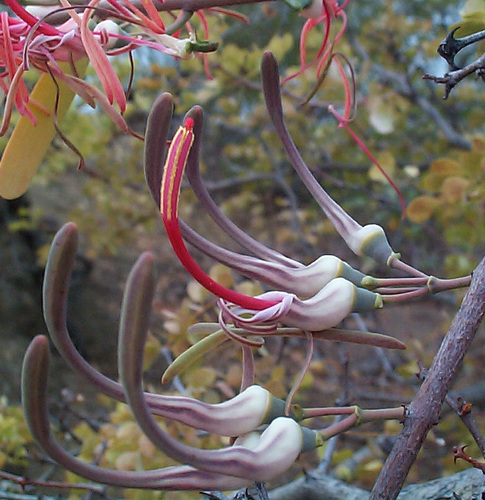
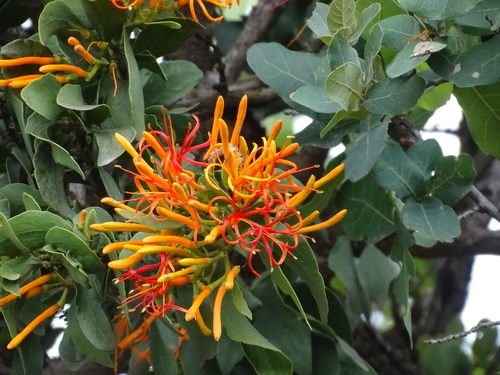
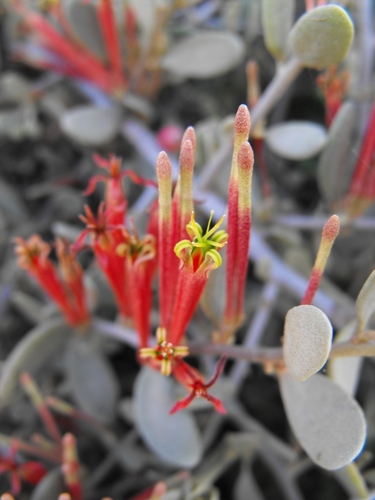
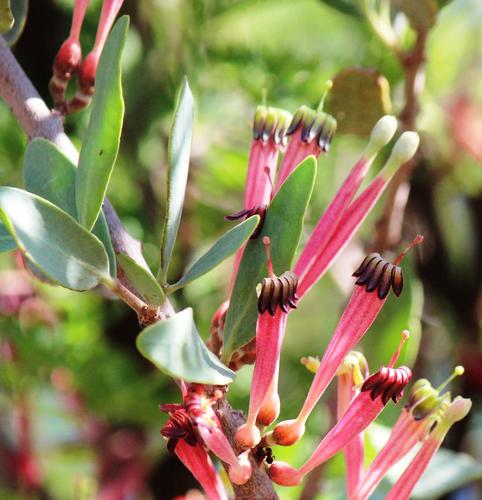
A mistletoe. It can hang down or be spreading. It can grow on several different plants such as Figs, Barringtonia, Terminalia and others. The leaves are simple. They are 4-15 cm long and 3-5 cm wide. The flowers are in threes in the axils of leaves or the ends of branches. The flowers have 6 petals. They are green to yellow at the tip and red of black at the base. They are 24-32 mm long. The fruit is a green berry with white stripes.
Edible Uses
The fruit (berries) are edible.
Distribution
A tropical plant. It grows near sea level in the tropics.
Where It Grows
Australia*,
Notes
There are 30 Decaisnina species.
Synonyms
References (4)
- Cooper, W. and Cooper, W., 2004, Fruits of the Australian Tropical Rainforest. Nokomis Editions, Victoria, Australia. p 273
- Paczkowska, G. & Chapman, A.R., 2000, The Western Australian Flora. A Descriptive Catalogue. Western Australian Herbarium. p 285
- Levitt, D., 1981, Plants and people. Aboriginal uses of plants on Groote Eylandt. Australian Institute of Aboriginal Studies, Canberra. p 98
- Wheeler, J.R.(ed.), 1992, Flora of the Kimberley Region. CALM, Western Australian Herbarium, p 577