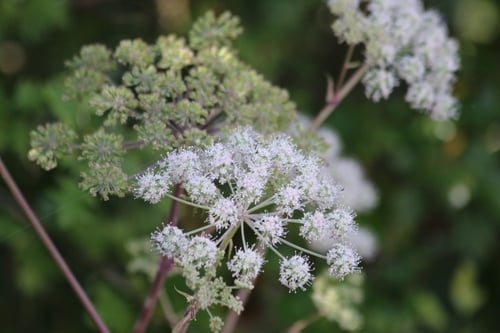
Daucus carota subsp. sativus
Hoffm.
Carrot
iNaturalist· cc-by-nc
(c) Nancy Lasiter, some rights reserved (CC BY-NC), uploaded by Nancy Lasiter
iNaturalist· cc-by-nc
(c) KF, some rights reserved (CC BY-NC)
Summary
Source: WikipediaDaucus carota, whose common names include wild carrot, European wild carrot, bird's nest, bishop's lace, carrot flower, and Queen Anne's lace (North America), is a flowering plant in the family Apiaceae. It is native to temperate regions of the Old World with a number of regional subspecies, and is naturalised widely elsewhere. Carrots cultivated as a food crop are cultivars of the domesticated subspecies Daucus carota subsp. sativus.
Description
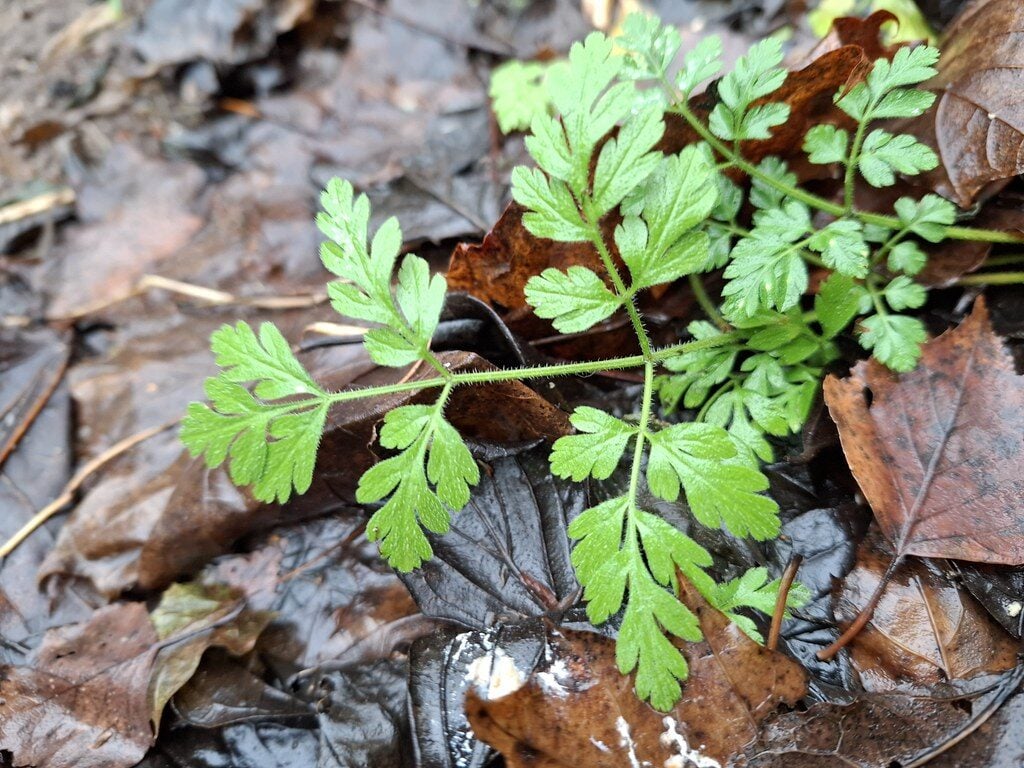
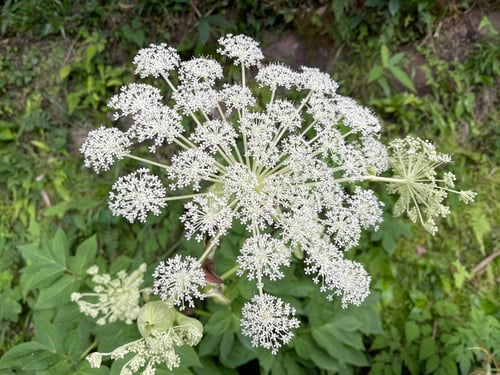
A root crop grown from seed. It normally grows a fattened root one year then forms a flower the next year. It can be 60 cm high and spread to 50 cm wide. The root is long in shape and orange in colour. The stem is erect, tough and furrowed. The leaves are feathery and divided 3 times. The leaves have a sheath clasping the stalk at the base. The flowers are white and lacy. They form a dense compound cluster at the top of the plant. Sometimes flowers are only produced into the second year of growth, depending on temperature.
Edible Uses
Like the cultivated carrot, the wild carrot root is edible while young, but quickly becomes too woody to consume. The flowers are sometimes battered and fried. The leaves and seeds are also edible. The seeds and flowers have been used as a method of contraception and an abortifacient for centuries, but scientific research has not confirmed any such effects and there is no evidence of safety. If used as a dyestuff, the flowers give a creamy, off-white colour.
Traditional Uses
Both the roots and the leaves are edible. The young leaves are used in soups. The roots can be eaten raw or cooked. They can be steamed, fried, pickled, made into jam, or used in stews. Carrot seed oil is used as a flavouring. The juice is used raw and fermented. The roots can be dried and the flour used to flavour and thicken soups.
Known Hazards
Like many other species of Apiaceae, the leaves of the wild carrot may cause phytophotodermatitis; skin contact with the foliage, especially wet foliage, can cause skin irritation in some people, so caution should be used when handling the plant. It may also have a mild effect on horses. The compound falcarinol is naturally found in Daucus carota for protection against fungal diseases. Laboratory tests show the compound is toxic to mice and to the water flea Daphnia magna. Normal consumption of carrots has no toxic effect in humans.
Distribution
A temperate plant. In the tropics it is mostly grown in the highlands, but will grow from sea level to 2600 m altitude. Sometimes on the coast only leaves are produced. Carrots are frost resistant. In Nepal carrots are grown up to 1700 m altitude. It needs a deep loose soil. Seed germinate well in the temperature range 7-24°C. Plants grow well with a temperature about 15°C. It grows best with a pH of 6.0-7.0. It suits hardiness zones 3-9.
Where It Grows
Afghanistan, Africa, Andorra, Angola, Asia, Australia, Balkans, Bangladesh, Barbados, Belgium, Benin, Bhutan, Bolivia, Botswana, Bougainville, Brazil, Britain, Burkina Faso, Burundi, Cambodia, Cameroon, Canada, Cape Verde, Caucasus, Central Africa, Central African Republic, CAR, Central America, Central Asia, Chad, Chile, China, Colombia, Congo, Cook Islands, Costa Rica, Côte d'Ivoire, Cuba, Czech, Dominican Republic, East Africa, East Timor, Equatorial-Guinea, Eritrea, Ethiopia, Europe, Fiji, Finland, France, Gabon, Gambia, Georgia, Germany, Ghana, Greece, Grenada, Guam, Guinea, Guinée, Guinea-Bissau, Guyana, Haiti, Hawaii, Himalayas, India, Indochina, Indonesia, Iran, Iraq, Italy, Ivory Coast, Jamaica, Japan, Kazakhstan, Kenya, Korea, Kurdistan, Kyrgyzstan, Liberia, Macedonia, Madagascar, Malawi, Malaysia, Mauritania, Mediterranean, Mexico, Middle East, Moldova, Mozambique, Myanmar, Namibia, Nepal, Netherlands, New Zealand, Niger, Nigeria, North America, Northeastern India, Pacific, Pakistan, Papua New Guinea, PNG, Philippines, Poland, Puerto Rico, Rotuma, Russia, Rwanda, Sahel, Scandinavia, SE Asia, Senegal, Serbia, Sierra Leone, Sikkim, Slovakia, Slovenia, Solomon Islands, Somalia, South Africa, Southern Africa, South America, Spain, Sri Lanka, St. Kitts and Nevis, Sudan, Switzerland, Tajikistan, Tanzania, Tasmania, Thailand, Timor-Leste, Togo, Tonga, Turkey, Türkiye, Uganda, Ukraine, Uruguay, USA, Uzbekistan, Vanuatu, Vietnam, West Africa, West Indies, Zambia, Zimbabwe,
Cultivation
They are grown from seeds sown directly. Because seed are very small, seed are mixed with sand before sowing to allow a more even distribution of plants. A spacing 5 cm apart in rows 15-20 cm apart is suitable. Often this spacing is achieved by thinning out plants. For seed production a low temperature of 4-9°C for 40-60 days is needed before flowering to break the dormancy.
Production
There are tropical varieties that mature within 90-110 days.
Other Information
It is a commercially cultivated vegetable. Within Papua New Guinea carrots are not common but occasionally seen in gardens in many areas of the country. Often it is grown for sale.
Notes
There are about 22-25 Daucus species.
Dangerous Lookalikes
This plant can be confused with the following toxic species. Always verify identification carefully before consuming any wild plant.
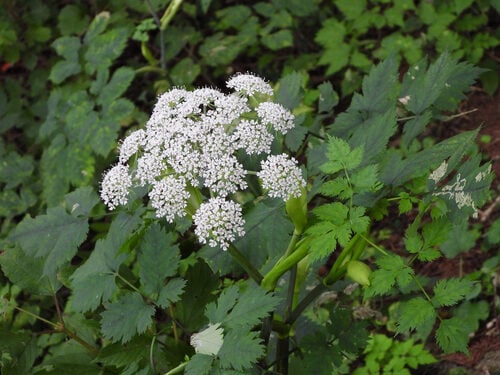
Poison Hemlock
Conium maculatum
MPF
Carrot
Daucus carota subsp. sativus
(c) Nancy Lasiter, some rights reserved (CC BY-NC), uploaded by Nancy Lasiter
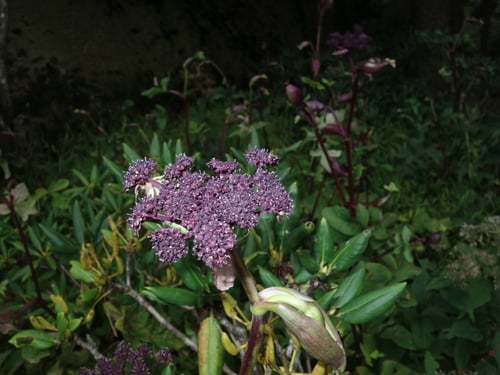
Poison Hemlock: Smooth hairless stem with purple/red blotches, hollow, taller (2-3m), musty smell.
Carrot: Hairy stem, single dark purple flower in center of umbel, "bird's nest" shape when drying, carrot smell when root crushed.
Water Hemlock
Cicuta maculata
Unknown
Carrot
Daucus carota subsp. sativus
(c) Nancy Lasiter, some rights reserved (CC BY-NC), uploaded by Nancy Lasiter
Water Hemlock: Grows near water, cluster of tubers with yellowish oily liquid, smooth stems, no carrot scent.
Carrot: Grows in dry ground, single taproot, hairy stems, carrot scent.
Nutrition
| Part | Moisture | kJ | kcal | Protein | Vit A | Vit C | Iron | Zinc |
|---|---|---|---|---|---|---|---|---|
| Root - raw | 89.9 | 180 | 43 | 1 | 2813 | 6 | 0.6 | 0.4 |
| Root - boiled | 91.5 | 79 | 19 | 0.6 | 2455 | 4 | 0.4 | 0.3 |
| Leaves | 87.4 | — | — | 2.2 | 65 | — | — | — |
Synonyms
Also Known As
Carota, Carotte, Cenoura, Gajar, Gajor, Ganjar ko saag, Heung lo paak, Hu luo bo, Karaoty, Karas, Karati, Kareti, Karoti, Karotte, Ma-la-oo-wa, Markov, Mohre, Monla-wa, Ninjin, Pastineggio, Pastinella, Thaba-di-baw, Zanahoria
References (69)
- Ambasta, S.P. (Ed.), 2000, The Useful Plants of India. CSIR India. p 163
- Banga, O., 1979, Carrot, in Simmonds, N.W., (ed), Crop Plant Evolution. Longmans. London. p 291
- Bernholt, H. et al, 2009, Plant species richness and diversity in urban and peri-urban gardens of Niamey, Niger. Agroforestry Systems 77:159-179
- Bianchini, F., Corbetta, F., and Pistoia, M., 1975, Fruits of the Earth. Cassell. p 104
- Bodkin, F., 1991, Encyclopedia Botanica. Cornstalk publishing, p 327
Show all 69 references Hide references
- Bourke, R. M., Altitudinal limits of 230 economic crop species in Papua New Guinea. Terra australis 32.
- Bremness, L., 1994, Herbs. Collins Eyewitness Handbooks. Harper Collins. p 246
- Brouk, B., 1975, Plants Consumed by Man. Academic Press, London. p 94
- Burkill, H. M., 1985, The useful plants of west tropical Africa, Vol. 5. Kew.
- Bussman, R. W., et al, 2016, A comparative ethnobotany of Khevsureti, Samtskhe-Javakheti, Tusheti, Svaneti, and Racha-Lechkhumi, Republic of Georgia (Sakartvelo), Caucasus. Journal of Ethnobiology and Ethnomedicine (2016) 12:43
- Bussman, R. W. et al, 2017, Ethnobotany of Samtskhe-Javakheti, Sakartvelo (Republic of Georgia), Caucasus. Indian Journal of Traditional Knowledge Vol. 16(1) pp 7-24
- Bussman, R. W., et al, 2021, Unity in diversity—food plants and fungi of Sakartvelo (Republic of Georgia), Caucasus. Journal of Ethnobiology and Ethnomedicine (2021) 17:72 p 5
- Cheifetz, A., (ed), 1999, 500 popular vegetables, herbs, fruits and nuts for Australian Gardeners. Random House p 64
- Chin, H. F., 1999, Malaysian Vegetables in Colour. Tropical Press. p 67
- Cundall, P., (ed.), 2004, Gardening Australia: flora: the gardener's bible. ABC Books. p 476
- Curtis, W.M., 1963, The Students Flora of Tasmania Vol 2 p 262
- D'Ambrosio, U., & Puri, R. K., 2016, Foodways in transition: food plants, diet and local perceptions of change in a Costa Rican Ngäbe community. Journal of Ethnobiology and Ethnomedicine (2016) 12:3 p 22
- Duke, J.A., 1992, Handbook of Edible Weeds. CRC Press. p 84
- Ekman Herbarium records Haiti
- Facciola, S., 1998, Cornucopia 2: a Source Book of Edible Plants. Kampong Publications, 18
- Farooq, S., et al, 2012, Ethnobotanical Studies of the Flora of Tehsil Birmal in South Waziristan Agency, Pakistan. Pak. J. Weed Sci. Res. 18(3): 277-291
- Flora of China. www.eFloras.org
- Foo, J.T.S.(ed), 1996, A Guide to Common Vegetables. Singapore Science Foundation. p 144
- French, B.R., 1986, Food Plants of Papua New Guinea, A Compendium. Asia Pacific Science Foundation p 152
- French, B.R., 2010, Food Plants of Solomon Islands. A Compendium. Food Plants International Inc. p 158
- Grubben, G. J. H. and Denton, O. A. (eds), 2004, Plant Resources of Tropical Africa 2. Vegetables. PROTA, Wageningen, Netherlands. p 284
- Hadfield, J., 2001, The A-Z of Vegetable Gardening in South Africa. Struik p 98
- Hedrick, U.P., 1919, (Ed.), Sturtevant's edible plants of the world. p 264
- Hussey, B.M.J., Keighery, G.J., Cousens, R.D., Dodd, J., Lloyd, S.G., 1997, Western Weeds. A guide to the weeds of Western Australia. Plant Protection Society of Western Australia. p 82
- Jabeen, A., et al, 2009, Indigenous uses of economically important flora of Margallah Hills National Park, Islamabad, Pakistan. African Journal of Biotechnology Vol. 8 (5), pp. 763-784
- Jardin, C., 1970, List of Foods Used In Africa, FAO Nutrition Information Document Series No 2.p 74
- Kapelle, M., et al, 2000, Useful plants within a Campesino Community in a Costa Rican Montane Cloud Forest. Mountain Research and Development, 20(2): 162-171.
- Kays, S. J., and Dias, J. C. S., 1995, Common Names of Commercially Cultivated Vegetables of the World in 15 languages. Economic Botany, Vol. 49, No. 2, pp. 115-152
- Kumar, A., et al, 2012, Ethnobotanical Edible Plant Biodiversity of Lepcha Tribes. Indian Forester, 138 (9):798-803
- Lazarides, M. & Hince, B., 1993, Handbook of Economic Plants of Australia, CSIRO. p 77
- Lembaga Biologi Nasional, 1977, Ubi-Ubian, Balai Pustaka, Jakarta. p 106
- Lim, T. K., 2015, Edible Medicinal and Non Medicinal Plants. Volume 9, Modified Stems, Roots, Bulbs. Springer p 33
- Low, T., 1991, Wild Herbs of Australia and New Zealand. Angus & Robertson. p 86
- Macmillan, H.F. (Revised Barlow, H.S., et al), 1991, Tropical Planting and Gardening. Sixth edition. Malayan Nature Society. Kuala Lumpur. p 362
- Martin, F.W. & Ruberte, R.M., 1979, Edible Leaves of the Tropics. Antillian College Press, Mayaguez, Puerto Rico. p 46, 222
- Miguel, E., et al, 1989, A checklist of the cultivated plants of Cuba. Kulturpflanze 37. 1989, 211-357
- Ochse, J. J. et al, 1931, Vegetables of the Dutch East Indies. Asher reprint. p 710
- Omawale, 1973, Guyana's edible plants. Guyana University, Georgetown p 87
- Paczkowska, G. & Chapman, A.R., 2000, The Western Australian Flora. A Descriptive Catalogue. Western Australian Herbarium. p 146
- Phon, P., 2000, Plants used in Cambodia. © Pauline Dy Phon, Phnom Penh, Cambodia. p 223
- Pieroni, A., 1999, Gathered wild food plants in the Upper Valley of the Serchio River (Garfagnana), Central Italy. Economic Botany 53(3) pp 327-341
- Plants of Haiti Smithsonian Institute http://botany.si.edu
- Purseglove, J.W., 1968, Tropical Crops Dicotyledons, Longmans. p 651
- Schneider, E., 2001, Vegetables from Amaranth to Zucchini: The essential reference. HarperCollins. p 148
- Shah, S. K., 2014, Dietary contribution of underutilized minor crops and indigenous plants collected from uncultivated lands and forests in Nepal. in Promotion of Underutilized Indigenous Food Resources for Food Security and Nutrition in Asia and Pacific. FAO. Bangkok p 64
- Sharma, B.B., 2005, Growing fruits and vegetables. Publications Division. Ministry of Information and broadcasting. India. p 211
- Small, E., 2009, Top 100 Food Plants. The world's most important culinary crops. NRC Research Press. p 153
- Staples, G.W. and Herbst, D.R., 2005, A tropical Garden Flora. Bishop Museum Press, Honolulu, Hawaii. p 114
- Stern, G., 1986, Australian Weeds. A Source of Food and Medicine. Harper & Row. p 217
- Sukenti, K., et al, 2016, Ethnobotanical study on local cuisine of the Sasak tribe in Lombok Island, Indonesia. Journal of Ethnic Foods. 3 (2016) 189-200 p 198
- Termote, C., et al, 2014, Assessing the potential of wild foods to reduce the cost of a nutritionally adequate diet: An example from eastern Baringo District, Kenya. Food and Nutrition Bulletin, vol. 35, no. 4
- Terra, G.J.A., 1973, Tropical Vegetables. Communication 54e Royal Tropical Institute, Amsterdam, p 44
- Thaman, R.R., 1976, The Tongan Agricultural System, University of the South Pacific, Suva, Fiji. p 394
- Tindall, H.D., 1983, Vegetables in the Tropics, Macmillan p 406
- USDA, ARS, National Genetic Resources Program. Germplasm Resources Information Network - (GRIN). [Online Database] National Germplasm Resources Laboratory, Beltsville, Maryland. Available: www.ars-grin.gov/cgi-bin/npgs/html/econ.pl (10 April 2000)
- van Wyk, B., 2005, Food Plants of the World. An illustrated guide. Timber press. p 173
- Vickery, M.L. and Vickery, B., 1979, Plant Products of Tropical Africa, Macmillan. p 49
- Vlkova, M., et al, 2015, Edible Plants Sold on Marginal Rural Markets in Fergana Valley, Southern Kyrgyzstan. Bulgarian Journal of Agricultural Science, 21 (No 2) 2015, 243–250
- Vorstenbosch, T., et al, 2017, Famine food of vegetal origin consumed in the Netherlands during World War II. Journal of Ethnobiology and Ethnomedicine (2017) 13:63
- Walter, A. & Lebot, V., 2007, Gardens of Oceania. ACIAR Monograph No. 122. p 267
- Welcome, A. K. & Van Wyk, B.-E., 2019, An inventory and analysis of the food plants of southern Africa. South African Journal of Botany 122 (2019) 136–179
- Wiersema, J. H. & Leon, B., 2013, World Economic Plants. A Standard Reference CRC Press. 2nd Ed. p 231
- Williamson, J., 2005, Useful Plants of Malawi. 3rd. Edition. Mdadzi Book Trust. p 96
- Zeven, A. C. & de West, J. M. J., 1982, Dictionary of cultivated plants and their regions of diversity. Wageningen. p 86, 119