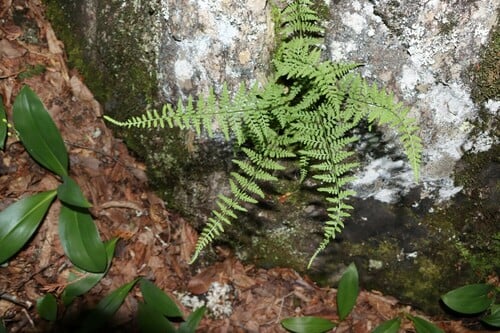
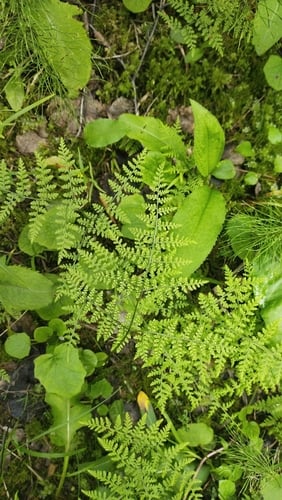
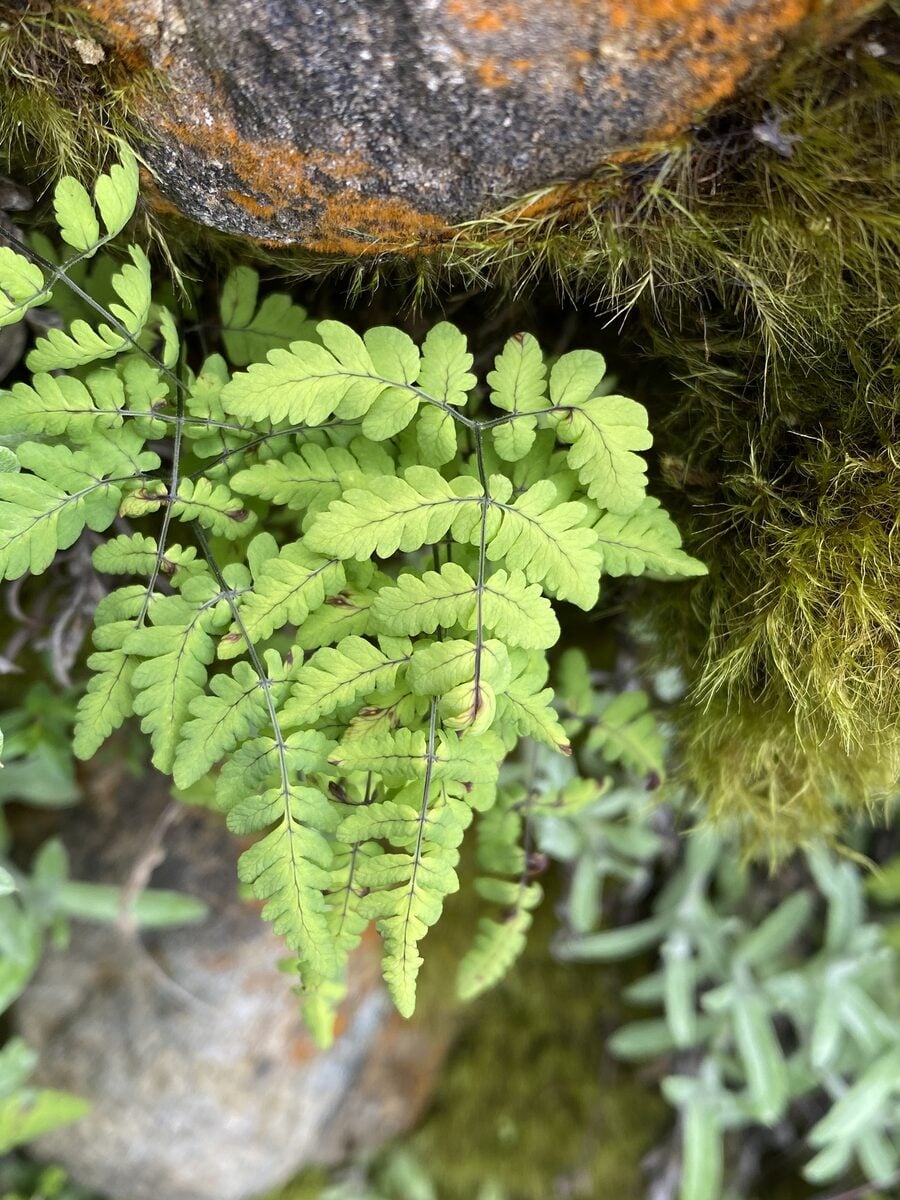
Cystopteris bulbifera
(L.) Bernh.
Berry bladder fern, Bulblet Bladder Fern
iNaturalist· cc-by-nc-sa
(c) thesnaguy, some rights reserved (CC BY-NC-SA), uploaded by thesnaguy
iNaturalist· cc-by-nc
(c) Anita, some rights reserved (CC BY-NC)
iNaturalist· cc-by-nc
(c) Erika Mitchell, some rights reserved (CC BY-NC), uploaded by Erika Mitchell
Summary
Source: WikipediaCystopteris bulbifera, with the common name bulblet fern, bulblet bladderfern, or bulblet fragile fern is a fern in the family Cystopteridaceae.
Description
A fern. It grows 30-45 cm high and 20-30 cm wide. The fronds form swirling rosettes. They are light green and slender. The fronds are divided and have curved tips. Bulbils develop below the midribs. They are lightly tinged with red.
Edible Uses
The root is edible but is considered strictly an emergency food, used only when no other options remain.
Medicinal Uses
None known.
Distribution
It is frost hardy. It is lime tolerant. It often grows on moist shady rock faces. It suits hardiness zones 3-9.
Where It Grows
Australia, Canada, North America, USA,
Cultivation
It can be grown from the small bulbils under the leaves.
Propagation
Sow spores as soon as ripe on the surface of a humus-rich sterilised soil. Keep the compost moist, ideally by placing a plastic bag over the pot. Germination takes 1–3 months at 20°C. Pot on small clumps of plantlets once large enough to handle and keep humid until well established. Do not plant outside until the ferns are at least 2 years old. Division in spring. Bulbils are produced at intervals along the midrib and can be planted into pots as soon as they are ripe.
Other Uses
Makes a good ground cover plant, forming a slowly spreading clump. Space plants 30cm apart each way.
Notes
There are about 18 Cystopteris species. These are also put in the family Athyriaceae and Cystopteridaceae.
References (5)
- Cundall, P., (ed.), 2004, Gardening Australia: flora: the gardener's bible. ABC Books. p 460
- Joyce, D., 1998, The Garden Plant Selector. Ryland, Peters and Small. p 334
- Neues J. Bot. 1:10. 1806
- Plants for a Future database, The Field, Penpol, Lostwithiel, Cornwall, PL22 0NG, UK. http://www.scs.leeds.ac.uk/pfaf/
- Slocum, P.D. & Robinson, P., 1999, Water Gardening. Water Lilies and Lotuses. Timber Press. p 115