Cymbidium canaliculatum
R. Br.
Queensland tree orchid, Channel Leaf Cymbidium, Black Orchid, Cooktown Black Orchid
iNaturalist· cc-by-nc
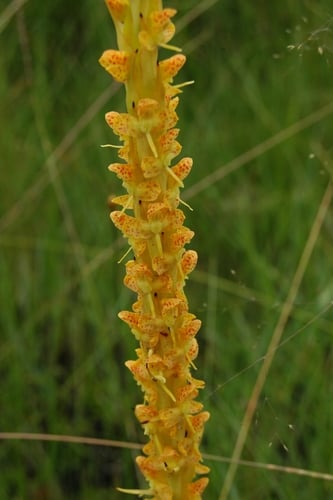
(c) Steven Kurniawidjaja, some rights reserved (CC BY-NC), uploaded by Steven Kurniawidjaja
iNaturalist· cc-by-nc
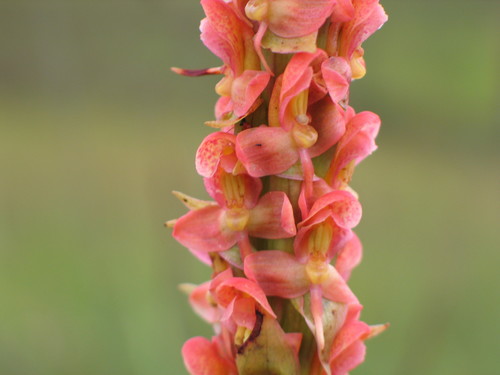
(c) Martin Bennett, some rights reserved (CC BY-NC), uploaded by Martin Bennett
iNaturalist· cc-by-nc-sa
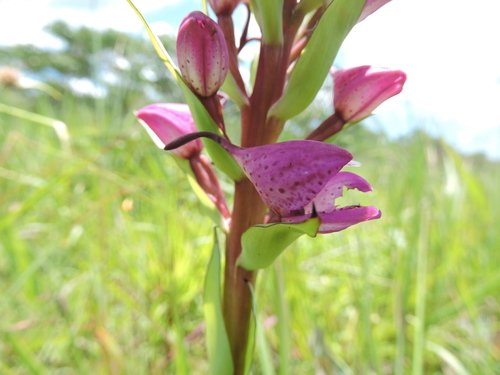
(c) Greg Steenbeeke, some rights reserved (CC BY-NC-SA), uploaded by Greg Steenbeeke
Summary
Source: WikipediaCymbidium canaliculatum, commonly known as the channelled boat-lip orchid, tiger boat-lip orchid, native cymbidium or tiger orchid is a plant in the orchid family and is endemic to Australia. It is a clump-forming epiphyte with large, greyish green pseudobulbs, each with up to six curved, deeply channelled leaves and up to sixty fragrant, variably coloured flowers that often have spots and blotches and a white to cream-coloured labellum with red markings. This orchid usually grows in the forks or hollows of trees and is found from New South Wales to the northern parts of Western Australia.
Description
An orchid which grows attached to trees. It produces thick fleshy bulb like organs. These are 3-12 cm long. The leaves are thick and smooth. They are leathery and V shaped. They are 10-50 cm long by 2-4 cm wide. The midrib is raised underneath. The flowers vary in colour. They can be green and yellow or red-brown. They are 1.5-4 cm long by 2-5 cm wide on stalks 20-40 cm long. These stalks come from the base of the bulb like structure. The fruit is a woody capsule. It is 4.5-5 cm long and about 1-1.7 cm wide. It splits along the edge when ripe. It contains many small seeds.
Edible Uses
The stems and bases of the leaves are eaten raw or cooked. Starch from the tubers is used to make sago.
Traditional Uses
The stems and bases of the leaves are eaten raw or cooked. The starch from the tubers is also used to make sago.
This uses section is brief — help expand it
Distribution
It mostly grows on Eucalypts in open woodland. It grows in tropical and warm temperate places. It can withstand drought. It grows in drier areas. It grows in rotten logs.
Where It Grows
Australia*,
Cultivation
Plants can be grown by division.
Other Uses
The starchy, sticky sap of the plant, was traditionally used by Australian Aborigines to mix with ochre to make a paint.
Notes
There are about 40-50 Cymbidium species and thousands of hybrids.
Nutrition
| Part | Moisture | kJ | kcal | Protein | Vit A | Vit C | Iron | Zinc |
|---|---|---|---|---|---|---|---|---|
| Nuts | 90.4 | — | — | 1.5 | — | 1 | — | — |
Also Known As
Banggaldjun, Bungulyon, Channeled cymbidium, Dampy-ampy, Garrii, Inland tree orchid, Tiger orchid, Wild arrowroot
References (24)
- Bodkin, F., 1991, Encyclopedia Botanica. Cornstalk publishing, p 313
- Brock, J., 1993, Native Plants of Northern Australia, Reed. p 133
- Cherikoff V. & Isaacs, J., The Bush Food Handbook. How to gather, grow, process and cook Australian Wild Foods. Ti Tree Press, Australia p 194, 198
- Cribb, A.B. & J.W., 1976, Wild Food in Australia, Fontana. p 119
- Elliot, W.R., & Jones, D.L., 1984, Encyclopedia of Australian Plants suitable for cultivation. Vol 3. Lothian. p 150 (Photo)
Show all 24 references Hide references
- Hedrick, U.P., 1919, (Ed.), Sturtevant's edible plants of the world. p 256
- Hibbert, M., 2002, The Aussie Plant Finder 2002, Florilegium. p 79
- Hiddins, L., 1999, Explore Wild Australia with the Bush Tucker Man. Penguin Books/ABC Books. p 165
- Holliman, J., (Ed.), 2002, Orchids. Botanica's Pocket. Random House, Australia. p 169
- Kenneally, K.E., Edinger, D. C., and Willing T., 1996, Broome and Beyond, Plants and People of the Dampier Peninsula, Kimberley, Western Australia. Department of Conservation and Land Management. p 213
- Lazarides, M. & Hince, B., 1993, Handbook of Economic Plants of Australia, CSIRO. p 72
- Lim, T. K., 2015, Edible Medicinal and Non Medicinal Plants. Volume 9, Modified Stems, Roots, Bulbs. Springer p 31
- Low, T., 1991, Wild Food Plants of Australia. Australian Nature FieldGuide, Angus & Robertson. p 108
- Low, T., 1992, Bush Tucker. Australia’s Wild Food Harvest. Angus & Robertson. p 125
- Maiden, JH (1889) The Useful Native Plants of Australia. Compendium. Melbourne. Reprinted 1975
- McKerney, M. & White, H., 2011, Bush Tucker, Boomerangs & Bandages. Border River-Gwyder Catchment Management Authority p 201
- Melzer, R. & Plumb, J., 2011, Plants of Capricornia. Belgamba, Rockhampton. p 495
- Morley, B. & Everard, B., 1970, Wild Flowers of the World. Ebury press. Plate 145
- Morley, B.D., & Toelken, H.R., (Eds), 1983, Flowering Plants in Australia. Rigby. p 362
- Paczkowska, G. & Chapman, A.R., 2000, The Western Australian Flora. A Descriptive Catalogue. Western Australian Herbarium. p 83
- Scarth-Johnson, V., 2000, National Treasures. Flowering Plants of Cooktown and Northern Australia. Vera Scarth-Johnson Gallery Association. Cooktown, Australia. p 148
- Smith, M & Kalotas, A. C., 1985, Bardi Plants: An Annotated List of Plants and Their Use by the Bardi Aborigines of Dampierland, in North-western Australia. Rec. West Aust. Mus. 1985, 12(3): 317-359
- Vigilante, T., et al, 2013, Island country: Aboriginal connections, values and knowledge of the Western Kimberley islands in the context of an island biological survey. Records of the Western Australian Museum Supplement 81: 145-182
- Wheeler, J.R.(ed.), 1992, Flora of the Kimberley Region. CALM, Western Australian Herbarium, p 1006