Eremiolirion amboense
(Schinz.)J. C. Manning & Mannheimer
Desert snowdrop
iNaturalist· cc-by
(c) Nathan Van Cooten, some rights reserved (CC BY), uploaded by Nathan Van Cooten
iNaturalist· cc0
no rights reserved
Description
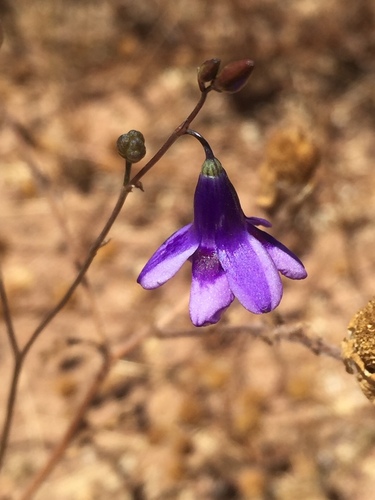
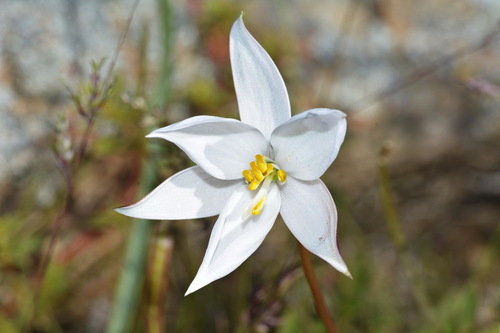
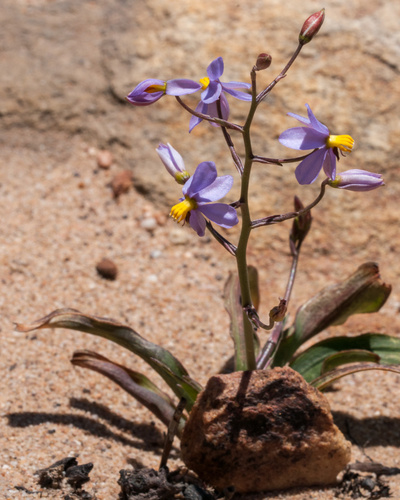
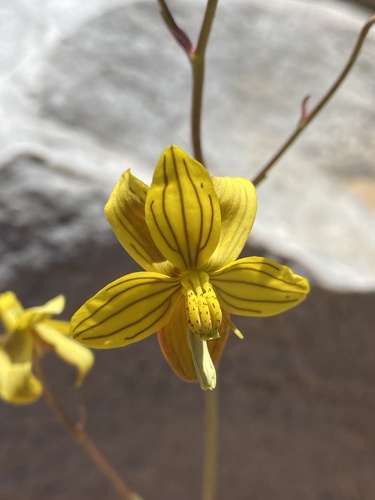
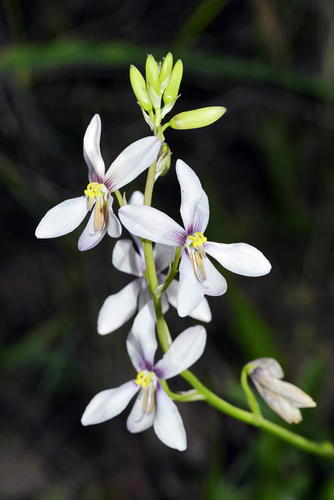
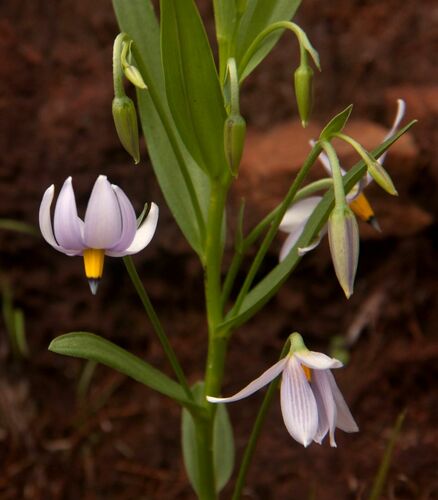
A herb. It keeps growing from year to year but loses its leaves during the year. It grows 25 cm high. The corms are about 3 cm across. They have a covering of netted fibres. There are 2 leaves at the base. These are narrow and sword shaped and 10 cm long by 1-2 cm wide. The flowers are nodding and white with pink. They close at night and open again in the morning. There are about 30 flowers in a group.
Edible Uses
The corms and roots are eaten as part of the traditional bushmen diet.
Distribution
It is a subtropical plant. It grows in hot arid regions with a marked dry season. It grows in well drained soils. It grows between 50-800 m above sea level. It can grow in arid places.
Where It Grows
Africa, Namibia, South Africa, Southern Africa,
Other Information
The corms are part of the traditional bushmen diet.
Synonyms
Also Known As
Uias
References (5)
- Plants for a Future database, The Field, Penpol, Lostwithiel, Cornwall, PL22 0NG, UK. http://www.scs.leeds.ac.uk/pfaf/ (As Cyanella amboensis)
- Royal Botanic Gardens, Kew (1999). Survey of Economic Plants for Arid and Semi-Arid Lands (SEPASAL) database. Published on the Internet; http://www.rbgkew.org.uk/ceb/sepasal/internet [Accessed 11th June 2011] (As Cyanella amboensis)
- Ruiters-Welcome, A. K., 2019, Food plants of southern Africa. Ph.D. thesis. Univ. of Johannesburg p 105
- Welcome, A. K. & Van Wyk, B.-E., 2019, An inventory and analysis of the food plants of southern Africa. South African Journal of Botany 122 (2019) 136–179
- World Checklist of Useful Plant Species 2020. Royal Botanic Gardens, Kew