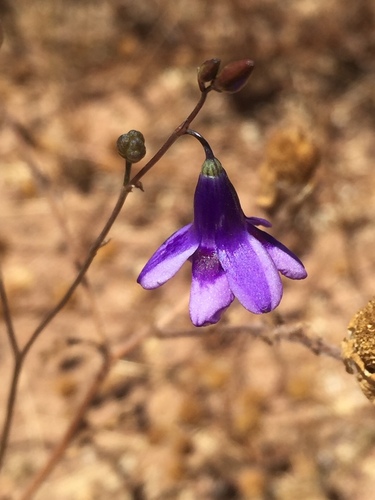
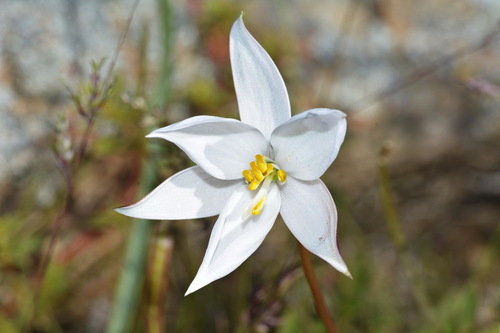
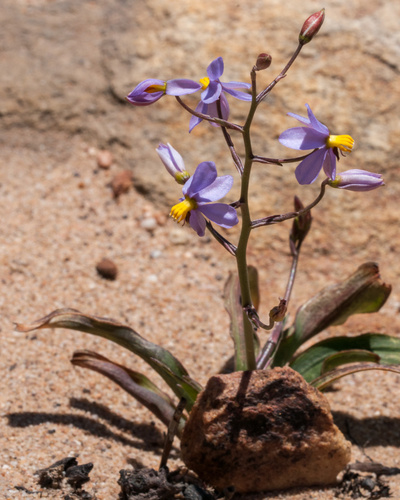
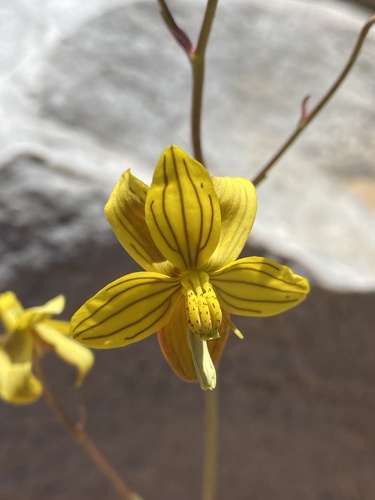
Walleria nutans
J. Kirk
iNaturalist· cc-by-nc
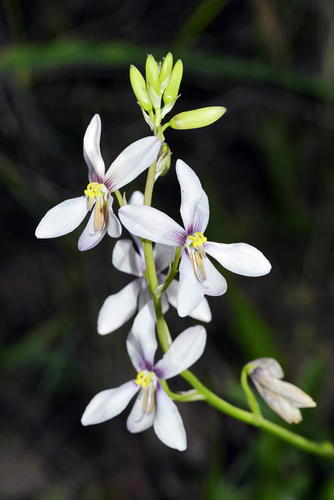
(c) Bart Wursten, some rights reserved (CC BY-NC), uploaded by Bart Wursten
iNaturalist· cc-by-nc-sa
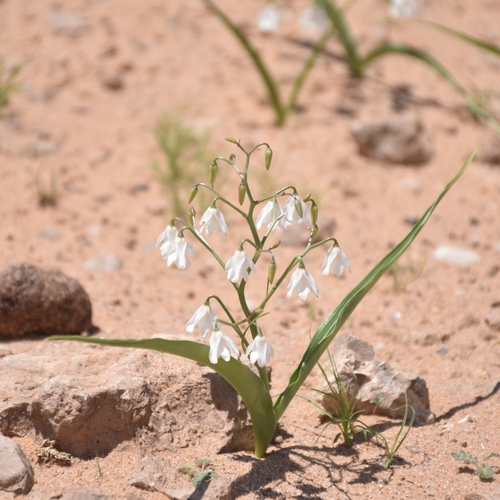
(c) David Hoare, some rights reserved (CC BY-NC-SA)
iNaturalist· cc-by-nc-sa
(c) David Hoare, some rights reserved (CC BY-NC-SA)
Summary
Source: WikipediaWalleria nutans is a perennial flowering plant belonging to the genus Walleria. The species is native to Angola, Botswana, Malawi, Mozambique, South Africa and Zambia.
Description
A herb with a corm or bulb. It grows 30 cm high. There are 1-5 tubers and they are 2-3 cm across. They occur up to 20 cm below the ground. The leaves occur along the stem. They become larger and closer together up the stem. They are narrow and 7-17 cm long by 1 cm wide.
Edible Uses
The tubers are eaten raw, cooked in other food preparations, or roasted. It is an important food in some areas.
Traditional Uses
The tuber is eaten raw. It is also cooked and used in other food preparations. The tubers are also roasted and eaten.
This uses section is brief — help expand it
Distribution
It is a subtropical plant. It grows in hot arid places with a marked dry season. In grows in well drained sandy loams. It grows between 950-1,700 m above sea level. It can re-grow after fire. It can grow in arid places.
Where It Grows
Africa, Angola, Botswana, Central Africa, East Africa, Namibia, South Africa, Southern Africa, Zambia, Zimbabwe,
Production
The tubers can be stored for 3 months. In Namibia they are available for 10 months.
Other Information
It is an important food in some areas.
Nutrition
| Part | Moisture | kJ | kcal | Protein | Vit A | Vit C | Iron | Zinc |
|---|---|---|---|---|---|---|---|---|
| Bulb | 63.8 | 582 | 139 | 1.7 | — | 19.8 | 2.2 | 0.3 |
Synonyms
Also Known As
Dchun
References (13)
- Fox, F. W. & Young, M. E. N., 1982, Food from the Veld. Delta Books. p 256, 349
- Jardin, C., 1970, List of Foods Used In Africa, FAO Nutrition Information Document Series No 2.p 111 (As Walleria sp.)
- Lee, 1979,
- Maguire, 1978
- Marshall, 1976,
Show all 13 references Hide references
- Peters, 1990,
- Peters, C. R., O'Brien, E. M., and Drummond, R.B., 1992, Edible Wild plants of Sub-saharan Africa. Kew. p 40
- Royal Botanic Gardens, Kew (1999). Survey of Economic Plants for Arid and Semi-Arid Lands (SEPASAL) database. Published on the Internet; http://www.rbgkew.org.uk/ceb/sepasal/internet [Accessed 11th June 2011]
- Ruiters-Welcome, A. K., 2019, Food plants of southern Africa. Ph.D. thesis. Univ. of Johannesburg p 105
- Silbauer, 1965, 1972, 1981,
- Wehmeyer, A. S, 1986, Edible Wild Plants of Southern Africa. Data on the Nutrient Contents of over 300 species (As Walleria sp.)
- Welcome, A. K. & Van Wyk, B.-E., 2019, An inventory and analysis of the food plants of southern Africa. South African Journal of Botany 122 (2019) 136–179
- World Checklist of Useful Plant Species 2020. Royal Botanic Gardens, Kew