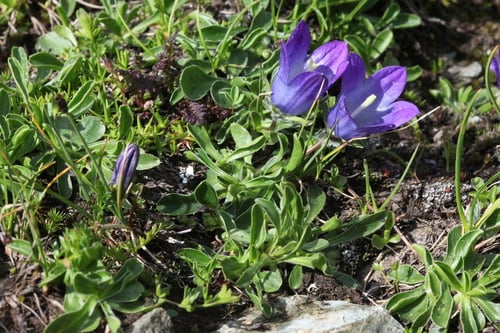
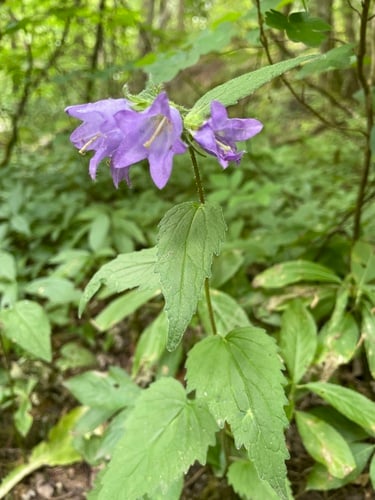
Adenophora triphylla
(Thunb.) A.DC.
Ne Sha shen
iNaturalist· cc-by-nc
(c) Keita Watanabe, some rights reserved (CC BY-NC), uploaded by Keita Watanabe
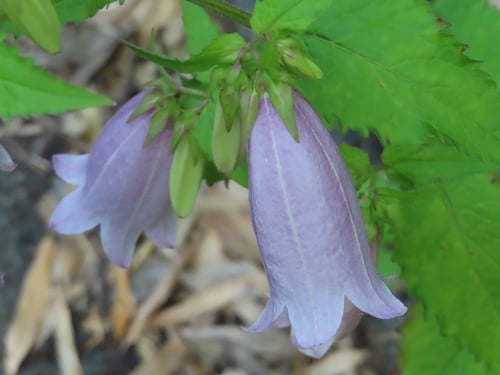
iNaturalist· cc-by-nc
(c) Keita Watanabe, some rights reserved (CC BY-NC), uploaded by Keita Watanabe
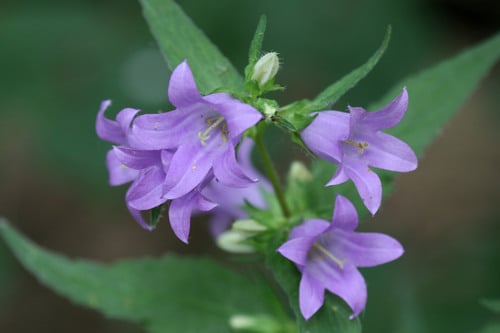
iNaturalist· cc-by-nc
(c) 空猫 T. N, some rights reserved (CC BY-NC), uploaded by 空猫 T. N
Summary
Source: WikipediaAdenophora triphylla, also known as Japanese lady bell, is one of the 62 species of Adenophora. It is a flowering plant in the family Campanulaceae that is distributed mainly over the Korean Peninsula, Japan, and China.
Description
A perennial to 1 m high. It has carrot like roots 7-16 cm long by 1.5-1.8 cm wide.
This description is brief — help expand it
Edible Uses
The root is edible cooked — it is thick and carrot-shaped. The leaves are also edible cooked.
Traditional Uses
The leaves and roots are eaten cooked.
This uses section is brief — help expand it
Medicinal Uses
The root is antifungal, cardiotonic, and expectorant. It is used in Korea to treat bronchial catarrh and coughs, particularly where excess phlegm is present. The root has been shown to contain saponins and triterpenes, which are responsible for its expectorant action.
Distribution
It grows best in a light rich slightly alkaline soil. It needs a sunny position. Plants can tolerate frosts to -20°C.
Where It Grows
Asia, China, Japan, Korea, Mongolia,
Cultivation
Plants can be grown from seed. Seeds germinate in 1-3 months at 10°C. They can be transplanted or sown direct. Plants can also be grown from cuttings.
Propagation
Seed is best sown in a cold frame as soon as it is ripe, though spring sowing also works. Surface sow 2–3 seeds per pot in spring to avoid the need for transplanting. If transplanted as very small seedlings, they grow away without difficulty. Germination takes 1–3 months at 10°C. Plant out into permanent positions while still young. Basal cuttings can be taken in spring. Division in spring is possible but very difficult, as the plant dislikes root disturbance.
Other Uses
None known.
Other Information
It is sometimes cultivated as a food plant in Korea.
Notes
There are about 40 Adenophora species. They are temperate plants.
Synonyms
Also Known As
Ch'andale, Tsurigane-ninjin
References (7)
- Brown, D., 2002, The Royal Horticultural Society encyclopedia of Herbs and their uses. DK Books. p 102 (var. japonica)
- Kim, H. & Song, M., 2013, Ethnobotanical analysis for traditional knowledge of wild edible plants in North Jeolla Province (Korea). Genetic. Resour. Crop Evol. (2013) 60:1571-1585
- Lim, T. K., 2015, Edible Medicinal and Non Medicinal Plants. Volume 9, Modified Stems, Roots, Bulbs. Springer p 3
- Monogr. Campan. 165, 365. 1830
- Plants for a Future database, The Field, Penpol, Lostwithiel, Cornwall, PL22 0NG, UK. http://www.scs.leeds.ac.uk/pfaf/
Show all 7 references Hide references
- Facciola, S., 1998, Cornucopia 2: a Source Book of Edible Plants. Kampong Publications, p 69 (var. japonica)
- Urgamal, M., Oyuntsetseg, B., Nyambayar, D. & Dulamsuren, Ch. 2014. Conspectus of the vascular plants of Mongolia. (Editors: Sanchir, Ch. & Jamsran, Ts.). Ulaanbaatar, Mongolia. “Admon“ Press. 334pp. (p. 158-187).