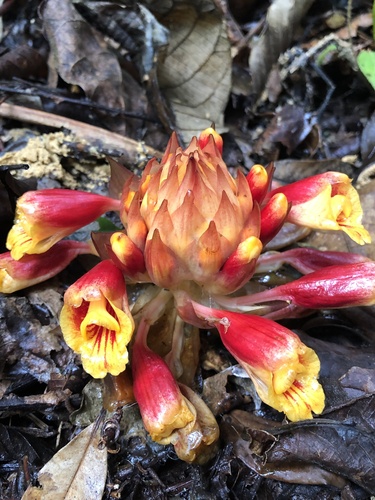
Curcuma heyneana
Valeton & van Zijp
Pale turmeric
gbif· cc-by
The New York Botanical Garden
gbif· cc-by-nc
Copyright Royal Botanic Garden Edinburgh. Contact us for rights to commercial use.
gbif· cc-by-nc
Copyright Royal Botanic Garden Edinburgh. Contact us for rights to commercial use.
Description
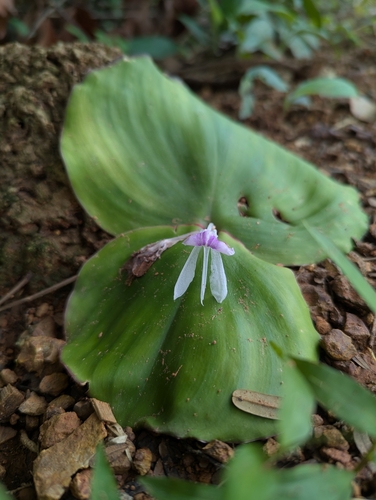
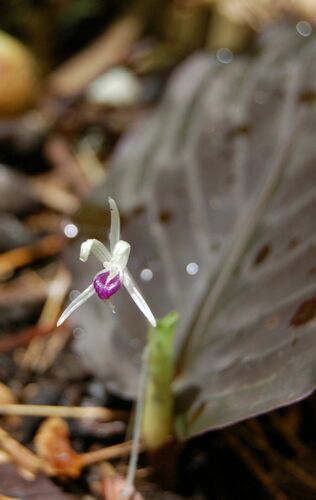
A ginger family herb. It grows 70 cm tall. The rhizomes are branched and pal yellow outside and white inside with a yellow centre. It has an aroma. The leaves are narrowly oval and 18-42 cm long by 8-13 cm wide. The flowers are in dense spikes. These are cylinder shaped and from a stalk from the base. The bracts are narrowly oval and pale green. The flowers are tube shaped and white to pink with a yellow centre. The fruit is an oval capsule. The seeds are shiny and light brown.
Edible Uses
The rhizomes are the edible portion.
Medicinal Uses
The rhizomes are the principal ingredient of a body lotion or powder that is used in traditional Javanese skin treatment. It is often administered to the bride-to-be, and is also often applied in modern beauty parlours. The rhizomes are considered to be anthelmintic, cooling and detergent. As an anthelmintic they are said to be especially useful in the treatment of pinworms. The bitter rhizomes are given, together with other medicinal herbs, to treat fatty degeneration, also as a folk medicine for brides to combat fatigue. Applied externally, the rhizomes are useful for treating skin diseases, abrasions and injuries and, in combination with other plants, as a treatment for lipomatosis.
Distribution
A tropical plant. It grows in secondary forests and open places in teak forests up to 750 m above sea level.
Where It Grows
Asia, Indonesia*, SE Asia,
Cultivation
Plants can be grown by division of the rhizome.
Propagation
Seed - best sown as soon as it is ripe. Germinates best at temperatures around 20°c. Division of the rhizome when the plant is dormant.
Other Information
It is cultivated.
Notes
There are about 50 Curcuma species. They are mostly in SE Asia.
Also Known As
Temu giring
References (5)
- Lembaga Biologi Nasional, 1977, Ubi-Ubian, Balai Pustaka, Jakarta. p 76
- PROSEA handbook Volume 9 Plants yielding non-seed carbohydrates. p 187
- Sukarya, D. G., (Ed.) 2013, 3,500 Plant Species of the Botanic Gardens of Indonesia. LIPI p 1097
- World Checklist of Useful Plant Species 2020. Royal Botanic Gardens, Kew
- Zeven, A. C. & de West, J. M. J., 1982, Dictionary of cultivated plants and their regions of diversity. Wageningen. p 64