Curcuma aeruginosa
Roxb.
Pink and blue ginger
iNaturalist· cc-by-nc
(c) lougarou, some rights reserved (CC BY-NC), uploaded by lougarou
iNaturalist· cc-by-nc
(c) lougarou, some rights reserved (CC BY-NC)
Description
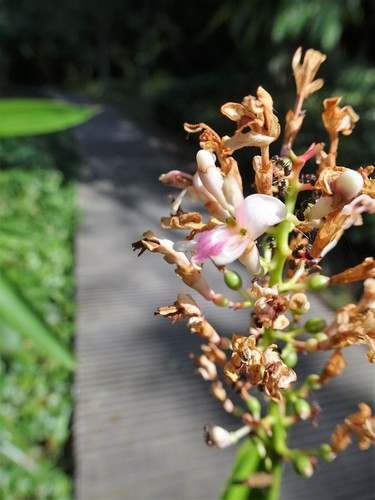
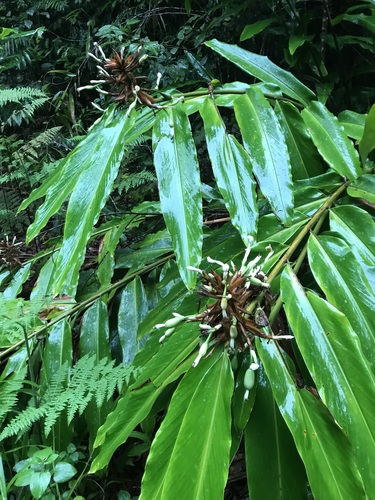
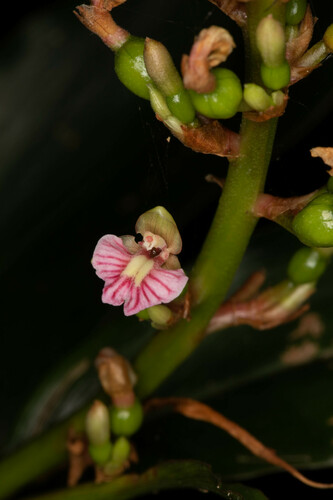
A herb in the ginger family. It grows 40-150 cm high. The underground rhizome is large and branched. It is 16 cm long by 3 cm wide. It is grey on the outside. The tips are white or pink. It is blue inside. The leaves are strap-shaped. The flowers are in a dense cylinder shaped group on a stalk from the base. The flowers are tube shaped and pink. The fruit is a narrowly oval capsule. The seeds have a fleshy layer around them.
Edible Uses
The name is derived from the Sanskrit kuṅkuma, referring to turmeric. Turmeric is used to flavour or colour curry powders, mustards, butters, and cheeses; it may also be used as a substitute for saffron or other yellowish pigments.
Traditional Uses
The young tips are eaten. The rhizomes are used as a spice.
This uses section is brief — help expand it
Medicinal Uses
The rhizomes are considered to be anthelmintic and depurative. They are used to treat a range of conditions including colic, menstrual disorders, asthma and cough, obesity and rheumatism. They are used externally to treat skin conditions such as scurvy and itchy skins. They have been suggested as an application for treating mental derangement. In Indonesia and Thailand, rhizomes are the chief ingredient of a decoction given to women after childbirth to accelerate the lochia. An ethyl alcohol extract of the rhizome has shown interesting oestrogenic properties. In addition, it has shown a growth-promoting effect on skin cells and also reduces cell death from oxidation. The plant has potential as an active ingredient in preparations for the treatment of skin-ageing in post-menopausal women.
Distribution
A tropical plant. It grows in limestone areas. It grows in grassy places and teak forests up to 750 m above sea level. In Queen Sirikit BG.
Where It Grows
Asia, Bangladesh, Cambodia, Indochina, Indonesia, Malaysia, Myanmar, SE Asia*, Thailand, Vietnam, West Timor,
Cultivation
It can be grown from seeds or division of the rhizome.
Propagation
Seed - best sown as soon as it is ripe. Germinates best at temperatures around 20°c. Division of the rhizome when the plant is dormant.
Other Uses
A dye can be obtained from the rhizome.
Notes
There are about 18-40-50 Curcuma species. They are mostly in SE Asia. It is used in medicine.
Also Known As
Dark blue temu, Koneng hideung, Temu erang, Temu hitam, Temu ireng, Temulawak, Temu lotong, Wan mahamek
References (12)
- Anderson, E. F., 1993, Plants and people of the Golden Triangle. Dioscorides Press. p 208
- Asiat. Res. 11:335. 1810
- Burkill, I.H., 1966, A Dictionary of the Economic Products of the Malay Peninsula. Ministry of Agriculture and Cooperatives, Kuala Lumpur, Malaysia. Vol 1 (A-H) p 716
- Larsen, K., Ibrahim, H., Khaw, S.H., & Saw, L.G., 1999, Gingers of Peninsula Malaysia and Singapore. Natural History Publications (Borneo). p 45
- Lembaga Biologi Nasional, 1977, Ubi-Ubian, Balai Pustaka, Jakarta. p 80
Show all 12 references Hide references
- Lim, T. K., 2015, Edible Medicinal and Non Medicinal Plants. Volume 9, Modified Stems, Roots, Bulbs. Springer p 29
- Lim, T. K., 2016, Edible Medicinal and Non-Medicinal Plants: Volume 12 Modified Stems, Roots p 6
- PROSEA handbook Volume 9 Plants yielding non-seed carbohydrates. p 188
- Somnasang, P., Moreno, G and Chusil K., 1998, Indigenous knowledge of wild hunting and gathering in north-east Thailand. Food and Nutrition Bulletin 19(4) p 359f
- Sukarya, D. G., (Ed.) 2013, 3,500 Plant Species of the Botanic Gardens of Indonesia. LIPI p 1097
- Thitiprasert, W., et al, 2007, Country report on the State of Plant Genetic Resources for Food and Agriculture in Thailand (1997-2004). FAO p 95
- World Checklist of Useful Plant Species 2020. Royal Botanic Gardens, Kew