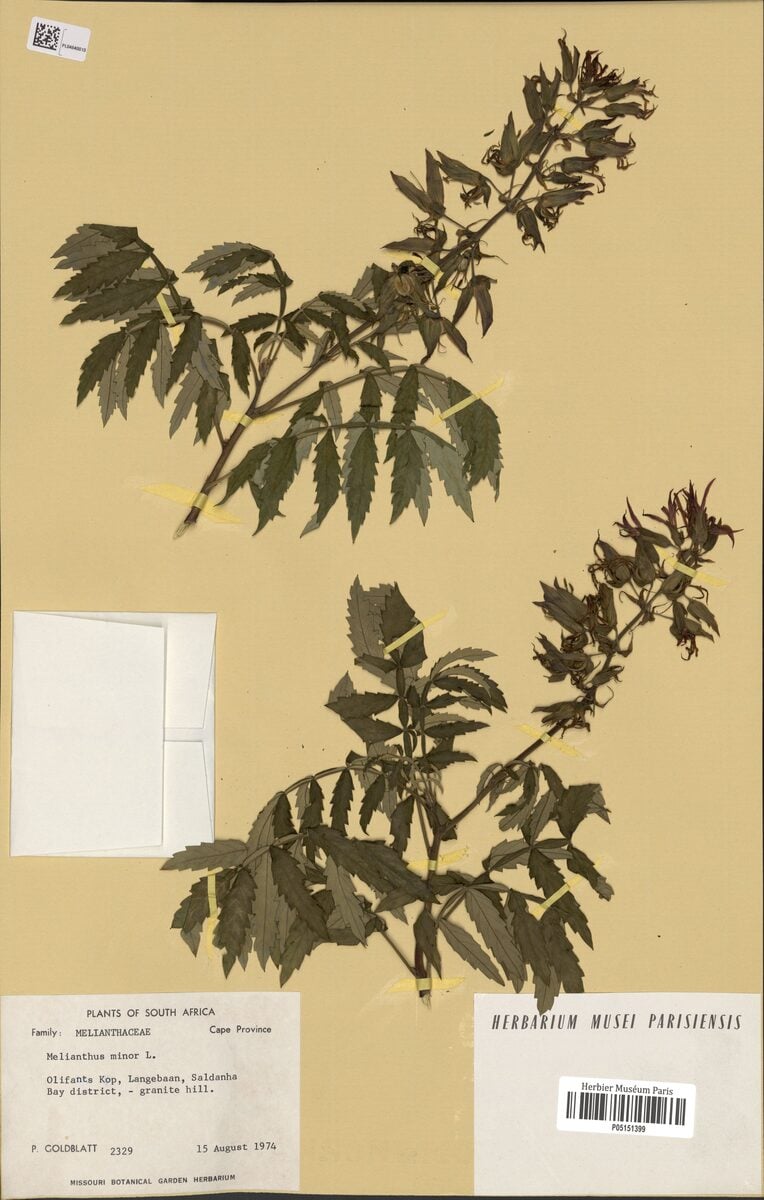
Melianthus comosus
Vahl
iNaturalist· cc-by-nc
(c) Joey Santore, some rights reserved (CC BY-NC), uploaded by Joey Santore
iNaturalist· cc-by-nc
(c) Richard Gill, some rights reserved (CC BY-NC)
iNaturalist· cc-by-nc
(c) Richard Gill, some rights reserved (CC BY-NC)
Summary
Source: WikipediaMelianthus comosus, the honey flower, is a species of flowering plant in the family Francoaceae. It is native to the mostly dry regions of southern Africa. The attractive multi-stemmed shrubs are popular garden subjects. The Afrikaans name kruidjie-roer-my-nie (herb-touch-me-not) alludes to the unpleasant smell that results from bruising of any part of the plant. The vegetative parts are very toxic, as with other Melianthus species, and extracts of the leaves and stem have anti-bacterial properties.
Description
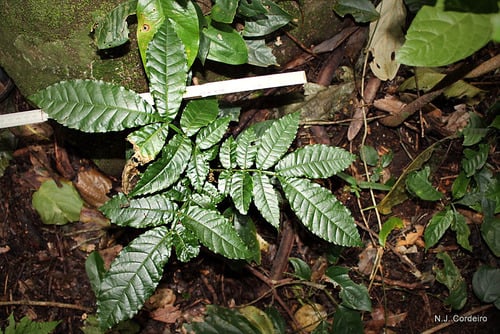
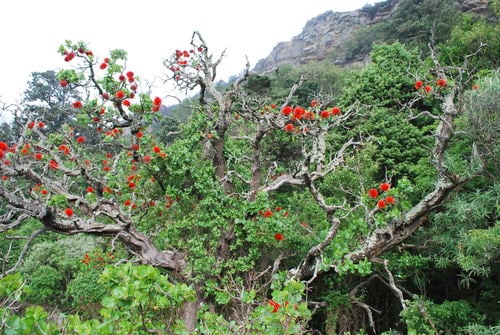
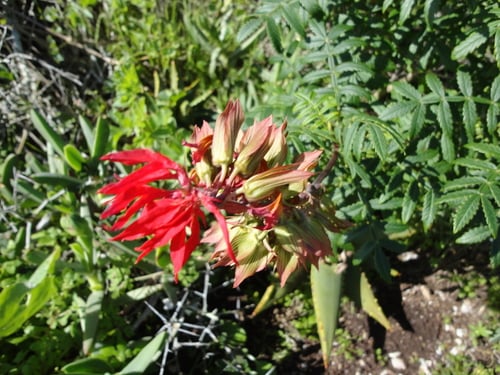
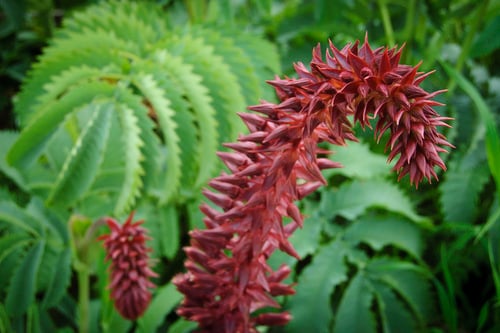
A shrub. It grows 1.5 m tall. The leaves are 6-16 cm long and divided in the top section. The leaflets in a pairs are 3-5 cm long and 0.5-2 cm wide. The flowering shoots hang down with flowers along them. The flowers are dark red. The fruit capsules are 3-5 cm long and have 4 wings. The seeds are 3-4 mm across. They are black and shining.
Edible Uses
The nectar is eaten as a snack.
Traditional Uses
The nectar is eaten as a snack.
This uses section is brief — help expand it
Medicinal Uses
A common traditional medicine in S. Africa, where it is normally only used externally since it is believed to be toxic. The plant has been shown to contain saponins and tannins. The root is used both prophylactically and therapeutically in the treatment of snakebite - for this purpose the root is chewed and a root bark tincture applied locally to the wound. A leaf paste or decoction is also utilised for snakebite Leaf poultices and leaf decoctions are widely used to treat septic wounds, sores, bruises, backache and rheumatic joints. Warm aqueous leaf infusions may be applied as a lotion to sores, ulcers, bruises, swellings or wounds that are slow to heal, including venereal sores. A leaf paste may be applied as a local dressing to the affected area. An ointment of the bark, leaf and flower is used in combination with Melianthus major, Lobostemon fruticosus and Galenia africana to treat wounds. A decoction is used as an antiseptic wash for skin diseases. A watery lotion of similar composition is used to treat syphilis and as a gargle for sore throat. A bath medicated with the herb is said to induce sweating and to relieve joint pains.
Known Hazards
The plant is widely held to be toxic amongst traditional herbalists in S. Africa, where the plant is used in external medicinal applications.
Distribution
It is a subtropical plant.
Where It Grows
Africa, Namibia, South Africa, Southern Africa,
Cultivation
A plant of drier areas, mainly in the subtropics, but extending into the tropical zone. Prefers a light, well-drained, fertile soil. The bruised leaves have a disagreeable smell.
Propagation
Seed - Easily propagated from seed, which is large, black and easy to handle. Sow the seed when it is ripe in deep seed trays in a medium of compost only. When sowing seed in the colder months, germination may take about four weeks. Cover the seeds, keep them moist, leave the seedlings in the trays until the fourth leaf stage. Transplant into a medium of 2 parts compost and 2 parts loam.
Synonyms
References (2)
- Ruiters-Welcome, A. K., 2019, Food plants of southern Africa. Ph.D. thesis. Univ. of Johannesburg p 78
- Welcome, A. K. & Van Wyk, B.-E., 2019, An inventory and analysis of the food plants of southern Africa. South African Journal of Botany 122 (2019) 136–179