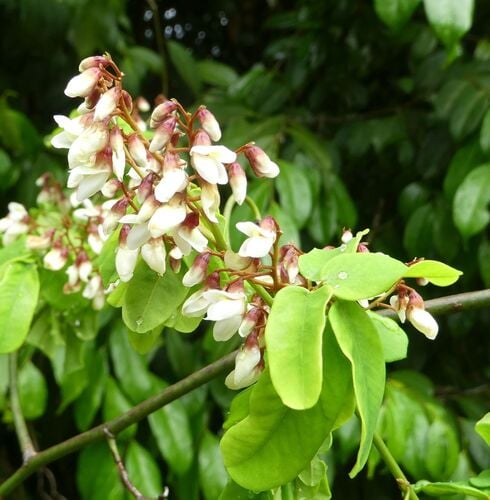
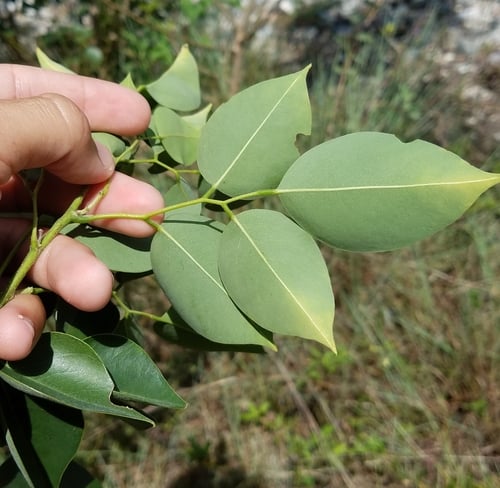
Crotalaria ochroleuca
G. Don
iNaturalist· cc-by
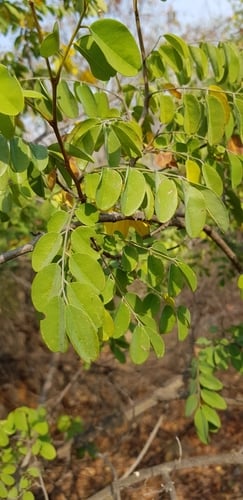
(c) i_c_riddell, some rights reserved (CC BY), uploaded by i_c_riddell
iNaturalist· cc-by-nc
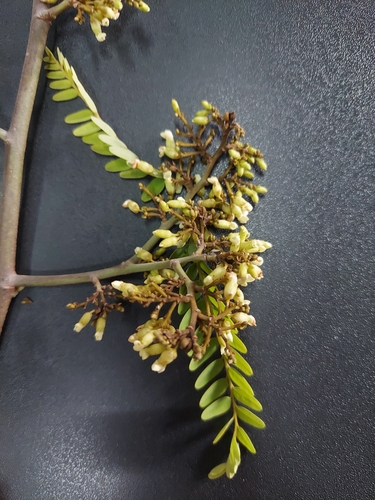
(c) Keith Bradley, some rights reserved (CC BY-NC)
Description
An erect annual, or short lived perennial. It grows 0.5-2.7 m tall. There are fine hairs on the stems. The leaves have 3 leaflets. These are narrow and 5-13 cm long by 0.5-3 cm wide. They are slightly hairy underneath. The flower clusters are 10-50 cm long, with many flowers which are 2 cm long. They are yellow with red streaks. The wings of the flowers have a purple mark at the base. The fruit is like a cylinder and is 5-7 cm long by 1.5-2 cm wide.
Edible Uses
The leaves are cooked and eaten, often dried before preparation, chopped and boiled with other foods. Dried flowers are used for flavouring.
Traditional Uses
The leaves are cooked and eaten. The leaves are often dried. They are also chopped and boiled and eaten with other foods. Caution: Drying often is used to get rid of a poison. People become drowsy if they eat the flowers. Dried flowers are used for flavouring.
Medicinal Uses
The leaves are used as a treatment for yellow fever. The leaves are also applied to sore feet.
Known Hazards
The primary source of toxicity for many species of Crotalaria is the presence of pyrrolizidine alkaloids, which are poisonous to birds and large mammals. The two kinds of pyrrolizidine alkaloids that are found in Crotalaria plants are monocrotaline and spectabiline. Monocrotaline is most toxic to the pulmonary vasculature and is used in animal studies to induce pulmonary arterial hypertension for human modeling. Both alkaloids show clinical hepatotoxicity and carcinogenicity. They can be found in the leguminous seeds, foliage, stems, or roots of Crotalaria plants. Species with higher concentrations of pyrrolizidine alkaloids yield greater toxic effects compared to those with lower concentrations. In addition, species that contain only monocrotaline are more poisonous than species that contain only spectabiline at equal concentrations within the seeds, leaves, stems, or roots. There are no confirmed species to this date that contain both spectabiline and monocrotaline; a Crotalaria plant can only have either one or the other. Thus, plants that are less toxic and therefore more appropriate for human consumption carry only low concentrations of spectabiline. According to one study, species that display the greatest toxicity include Crotalaria spectabilis Roth, C. retusa L., C. alata Leveille, and C. quinquefolia L. Species that are least toxic include Crotalaria australis Bak. Ex Verdoorn, C. maxillaris Klotzsch, C. sphaerocarpa, C. juncea L., and C. brevidens Benth., among many others. The toxic alkaloids are attractive to butterflies in the subfamily Danaiinae and large aggregations of butterflies occur during the flowering of Crotalaria species in Asia. These butterflies also obtain alkaloids from sap emerging from withering stems and terminal branches. Among pyrrolizidine alkaloid-containing plants, Crotalaria species cause the greatest range of tissue damage to most domesticated species, causing lung lesions in cattle, sheep, goats, horses, and pigs, and liver damage in most livestock. Some species produce severe kidney lesions In March 2019, horses in the Federal District of Brazil were fed oats contaminated with Crotalaria seeds, from an earlier seeding intended to increase nitrogen levels in the soil, and at least 13 of them died of liver failure.
Distribution
A tropical plant. In Papua New Guinea is grows from 30 m to 1,800 m altitude. It is mostly on plantations. In Zambia it grows in savannah. In southern China it grows in shady places with thin soil.
Where It Grows
Africa*, Angola, Asia, Australia, Benin, Botswana, Brazil, Burkina Faso, Burundi, Cameroon, Central Africa, Central African Republic, CAR, Chad, Congo, Côte d'Ivoire, East Africa, Eswatini, Ethiopia, Gabon, Gambia, Ghana, Guinea, Guinée, Guinea-Bissau, Ivory Coast, Kenya, Liberia, Madagascar, Malawi, Mali, Mozambique, Niger, Nigeria, Pacific, Papua New Guinea, PNG, Rwanda, Sahel, Sao Tome and Principe, Senegal, Sierra Leone, South Africa, South America, Southern Africa, Sudan, Swaziland, Tanzania, Togo, Uganda, West Africa, Zambia, Zimbabwe,
Cultivation
Plants can be grown from seeds.
Propagation
Seed - sown broadcast or in rows. The seed germinates in 3 - 4 days, early growth is slow and it may take about 8 weeks until the first harvest is ready. The plant dies after about 6 months.
Other Uses
A strong fibre obtained from the bark and stems is used to make nets and ropes. Oil extracted from the seeds is insect repellent. Like the common sunn hemp (Crotalaria juncea) it is used as a green manure in crops or fallows, but this use is rare. If sown as a green manure, the young crop is incorporated in the soil. For mulch, the plants are uprooted or cut at soil level and placed between the crop rows. A recent use for rattlepod is as an agent to promote the germination of Striga, a parasitic plant that is a major concern for maize and millet growers in Africa. In the presence of Crotalaria, Striga germinates and it will subsequently die due to the lack of a suitable host plant. Rattlepod is also known to suppress Meloidogyne root-knot nematode populations and is locally used by East African farmers either in crop rotations or as a companion crop with nematode-susceptible vegetables such as tomatoes.
Production
Young leaves are picked off the plant.
Other Information
It is a cultivated food plant.
Notes
There are about 550 Crotalaria species. They are mostly tropical.
Nutrition
| Part | Moisture | kJ | kcal | Protein | Vit A | Vit C | Iron | Zinc |
|---|---|---|---|---|---|---|---|---|
| Leaves raw | 74.5 | — | — | 8.8 | — | — | 0.8 | — |
Synonyms
Also Known As
Ajalu, Alaju, Alwaru, Bumpo, Kamra, Karelmot, Kumuro, Lala, Marejea, Mitoo
References (28)
- Abbiw, D.K., 1990, Useful Plants of Ghana. West African uses of wild and cultivated plants. Intermediate Technology Publications and the Royal Botanic Gardens, Kew. p 42
- Abukutsa-Onyango, M.O., 2004. Crotalaria brevidens Benth. [Internet] Record from Protabase. Grubben, G.J.H. & Denton, O.A. (Editors). PROTA (Plant Resources of Tropical Africa), Wageningen, Netherlands. < http://database.prota.org/search.htm>. Accessed 15 October 2009.
- Abukutsa-Onyango, Mary, 2007, The diversity of cultivated African leafy vegetables in three communities in western Kenya. AJFAND, Volume 7, No. 3
- Acipa, A. et al, 2013, Nutritional Profile of some Selected Food Plants of Otwal and Ngai Counties, Oyam District, Northern Uganda. African Journal or Food, Agriculture, Nutrition and Development. 13(2)
- Agea, J. G., et al 2011, Wild and Semi-wild Food Plants of Bunyoro-Kitara Kingdom of Uganda: etc. Environmental Research Journal 5(2) 74-86
Show all 28 references Hide references
- Andabati, B., & Muyonga, J., 2014, Phenolic content and antioxidant activity of selected Ugandian traditional medicinal foods. African Journal of Food Science. 8(8), pp 427-434
- Burkill, H. M., 1985, The useful plants of west tropical Africa, Vol. 3. Kew.
- Food Composition Tables for use in Africa FAO http://www.fao.org/infoods/directory No. 604
- Fowler, D. G., 2007, Zambian Plants: Their Vernacular Names and Uses. Kew. p 80
- Gen. hist. 2:138. 1832
- Godfrey, J. et al, 2013, Harvesting, preparationand preservation of commonly consumed wild and semi-wild food plants in Bunyoro-Kitara Kingdom, Uganda. Int. J. Med. Arom. Plants. Vol.3 No.2 pp 262-282
- Goode, P., 1989, Edible Plants of Uganda. FAO p 39
- Grubben, G. J. H. and Denton, O. A. (eds), 2004, Plant Resources of Tropical Africa 2. Vegetables. PROTA, Wageningen, Netherlands. p 230
- INFOODSUpdatedFGU-list.xls
- Jardin, C., 1970, List of Foods Used In Africa, FAO Nutrition Information Document Series No 2.p 71
- Malaisse, F., 1997, Se nourrir en floret claire africaine. Approche ecologique et nutritionnelle. CTA., p 59
- Martin, F.W. & Ruberte, R.M., 1979, Edible Leaves of the Tropics. Antillian College Press, Mayaguez, Puerto Rico. p 198
- Masters, T., 2021, Traditional food plants of the upper Aswa River catchment of northern Uganda—a cultural crossroads. Journal of Ethnobiology and Ethnomedicine (2021) 17:24
- Maundu, P. et al, 1999, Traditional Food Plants of Kenya. National Museum of Kenya. 288p
- Mutie, F. M., et al, 2023, Important Medicinal and Food Taxa (Orders and Families) in Kenya, Based on Three Quantitative Approaches. Plants 2023, 12, 1145
- Peters, C. R., O'Brien, E. M., and Drummond, R.B., 1992, Edible Wild plants of Sub-saharan Africa. Kew. p 132
- Schippers, R.R., 2004. Crotalaria ochroleuca G.Don. [Internet] Record from Protabase. Grubben, G.J.H. & Denton, O.A. (Editors). PROTA (Plant Resources of Tropical Africa), Wageningen, Netherlands. < http://database.prota.org/search.htm>. Accessed 15 October 2009
- Swaziland's Flora Database http://www.sntc.org.sz/flora
- Termote, C., et al, 2014, Assessing the potential of wild foods to reduce the cost of a nutritionally adequate diet: An example from eastern Baringo District, Kenya. Food and Nutrition Bulletin, vol. 35, no. 4
- Verdcourt, B., 1979, Manual of New Guinea Legumes. Botany Bulletin No 11, Division of Botany, Lae, Papua New Guinea. p 582
- Weinberger, K., Msuya J., 2004, Indigenous Vegetables in Tanzania. Significance and Prospects. Technical Bulletin No. 31 AVRDC, Taiwan/FAO p 4
- Williamson, J., 2005, Useful Plants of Malawi. 3rd. Edition. Mdadzi Book Trust. p 83
- World Checklist of Useful Plant Species 2020. Royal Botanic Gardens, Kew