Crataegus succulenta
Schrad. ex Link
Fleshy hawthorn, Succulent hawthorn, Long-spine hawthorn
iNaturalist· cc-by-nc
(c) Levi smith, some rights reserved (CC BY-NC), uploaded by Levi smith
iNaturalist· cc-by-nc
(c) Ryan Durand, some rights reserved (CC BY-NC)
iNaturalist· cc-by-nc
(c) Ryan Durand, some rights reserved (CC BY-NC)
Summary
Source: WikipediaCrataegus succulenta is a species of hawthorn known by the common names fleshy hawthorn, succulent hawthorn, and round-fruited cockspurthorn. It is "the most wide-ranging hawthorn in North America", native to much of southern Canada, and the United States as far south as Arizona, New Mexico, Kansas, Missouri, North Carolina, and Tennessee. In this wide area there are many variant forms that have received species names, but can also be considered as synonyms. It is thought to be the parent, along with Crataegus crus-galli, of the tetraploid species Crataegus persimilis. The fruit is edible and can be made into jelly or crushed to make tea.
Description
A shrub. It can be a tree with several stems. It grows to 6-8 m high. It has dark twigs and thorns. The leaves are 3-8 cm long. They have shallow lobes. There are small, sharp teeth. The leaf stalks have grooves above and wings. The thorns are stout and up to 8 cm long. They are black and glossy. The flowers are white. The fruit are glossy and red. They are 6-8 mm across.
Edible Uses
The fruit can be eaten raw or cooked and is particularly excellent for making jellies; it can also be dried for later use. It is generally a small fruit with sweet, juicy, pulpy flesh up to 17mm in diameter, though one account describes the fruit as large for a Crataegus species — around 35mm in diameter and borne in small clusters. The centre holds up to five fairly large seeds that tend to stick together, giving the impression of eating a cherry-like fruit with a single stone.
Traditional Uses
The fruit are used for jelly. They can be pressed into cakes and dried for later use.
This uses section is brief — help expand it
Medicinal Uses
No specific research has been recorded for this species, but the fruits and flowers of hawthorns in general are well established in herbal folk medicine as a heart tonic — a use that modern research has supported. Both fruits and flowers have a hypotensive effect and act as a mild, direct heart tonic. They are particularly indicated for a weak heart combined with high blood pressure. Prolonged use is needed for the treatment to be effective. It is typically taken as a tea or tincture.
Distribution
Temperate. It suits hardiness zones 4-9. It can grow in a range of soil types and with various pH values. It can tolerate very wet soils as well as drought. It can grow in poor rocky dry soils. It is cold hardy.
Where It Grows
Canada, North America, USA,
Cultivation
Plants can be grown from seed. The seed need cold treatment. Plants can also be grafted.
Propagation
Sow seed as soon as it is ripe in autumn in a cold frame. Some seed will germinate the following spring, but most will likely take another year. Stored seed can be very slow and erratic — warm stratify for 3 months at 15°c, then cold stratify for 3 months at 4°c, and even then germination may take a further 18 months. Scarifying before stratifying may reduce this time, and fermenting the seed for a few days in its own pulp may also help. Alternatively, harvest seed green (once the embryo is fully developed but before the seedcoat hardens) and sow immediately in a cold frame; if timed well, germination can occur in spring. For small quantities, pot seedlings as soon as they are large enough to handle and grow on in individual pots for the first year, planting out in late spring into nursery beds or final positions. For larger quantities, sow directly into an outdoor seedbed with protection from mice and other seed-eating animals, undercutting the roots if plants are to remain in the seedbed for more than two years.
Other Uses
The wood is heavy, hard, tough, and close-grained, making it useful for tool handles, mallets, and other small wooden items. The plant is also noted for its scent.
Notes
There are 200 or more Crataegus species.
Synonyms
References (11)
- Etherington, K., & Imwold, D., (Eds), 2001, Botanica's Trees & Shrubs. The illustrated A-Z of over 8500 trees and shrubs. Random House, Australia. p 241
- Facciola, S., 1998, Cornucopia 2: a Source Book of Edible Plants. Kampong Publications, p 197
- Farrar, J.L., 1995, Trees of the Northern United States and Canada. Iowa State University press/Ames p 392
- Fisk, J. R. & Hoover, E., 2015, Wild Fruits of Minnesota. A Field Guide. University of Minnesota p 23
- Handbuch 2:78. 1829
Show all 11 references Hide references
- Kermath, B. M., et al, 2014, Food Plants in the Americas: A survey of the domesticated, cultivated and wild plants used for Human food in North, Central and South America and the Caribbean. On line draft. p 276
- Little, E.L., 1980, National Audubon Society Field Guide to North American Trees. Alfred A. Knopf. p 484
- Lyle, S., 2006, Discovering fruit and nuts. Land Links. p 164
- MacKinnon, A., et al, 2009, Edible & Medicinal Plants of Canada. Lone Pine. p 80
- Plants for a Future database, The Field, Penpol, Lostwithiel, Cornwall, PL22 0NG, UK. http://www.scs.leeds.ac.uk/pfaf/
- Tanaka,
More from Rosaceae
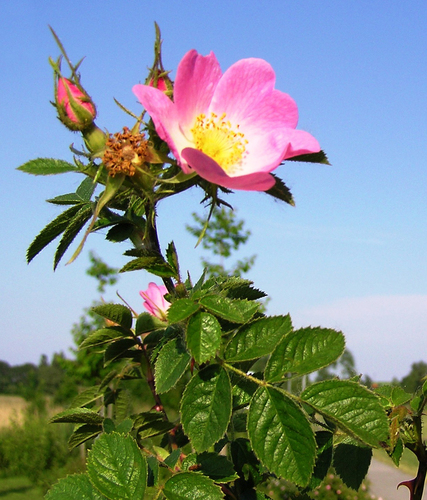
Rosa rubiginosa
Sweetbrier rose, Eglantine Rose, Briar rose
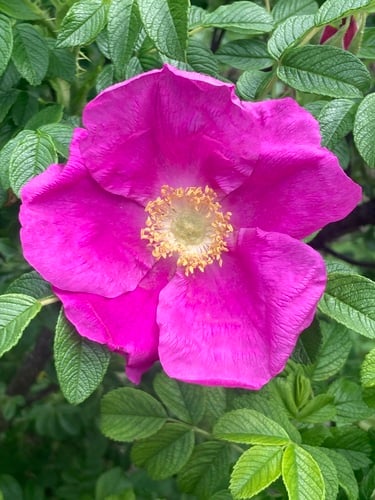
Rosa rugosa
Japanese Rose, Ramanas Rose, Wrinkled rose, Turkestan rose, Meigui, Mau, Humanasi, Beach rose, Hedgehog rose, Rugose rose, Tomato rose, Mei gui
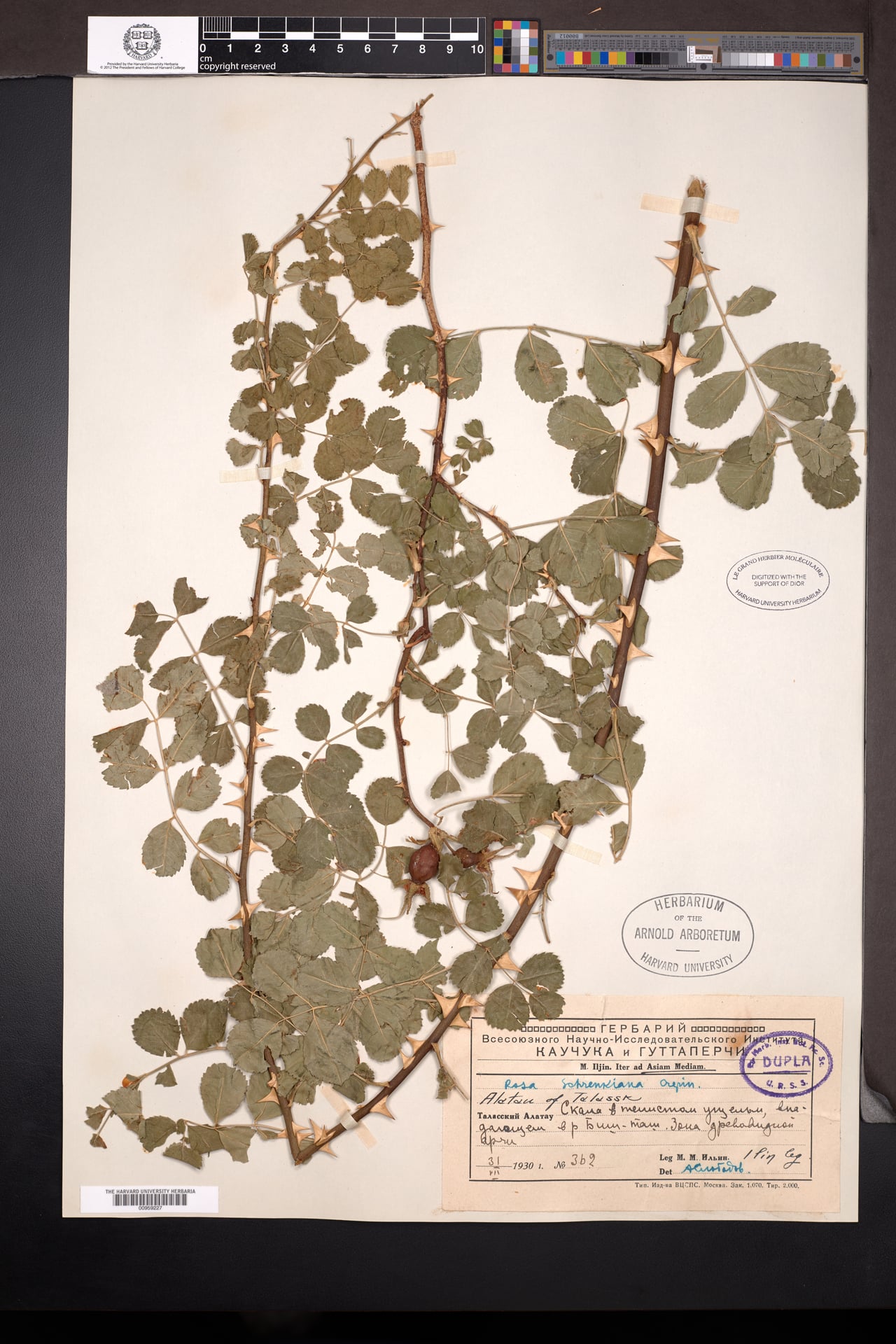
Rosa schrenkiana
Schrenkovskiy rose
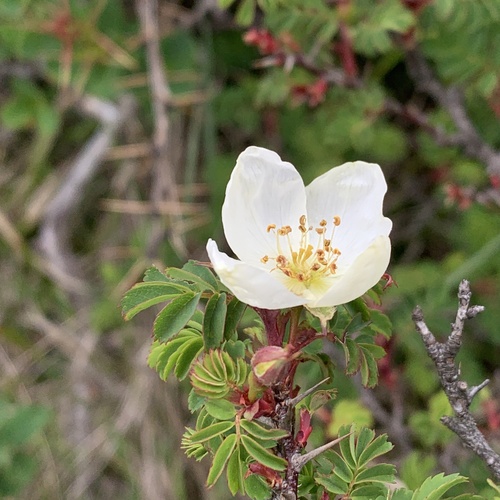
Rosa sericea
Himalayan rose, Maltese cross rose, Silky rose
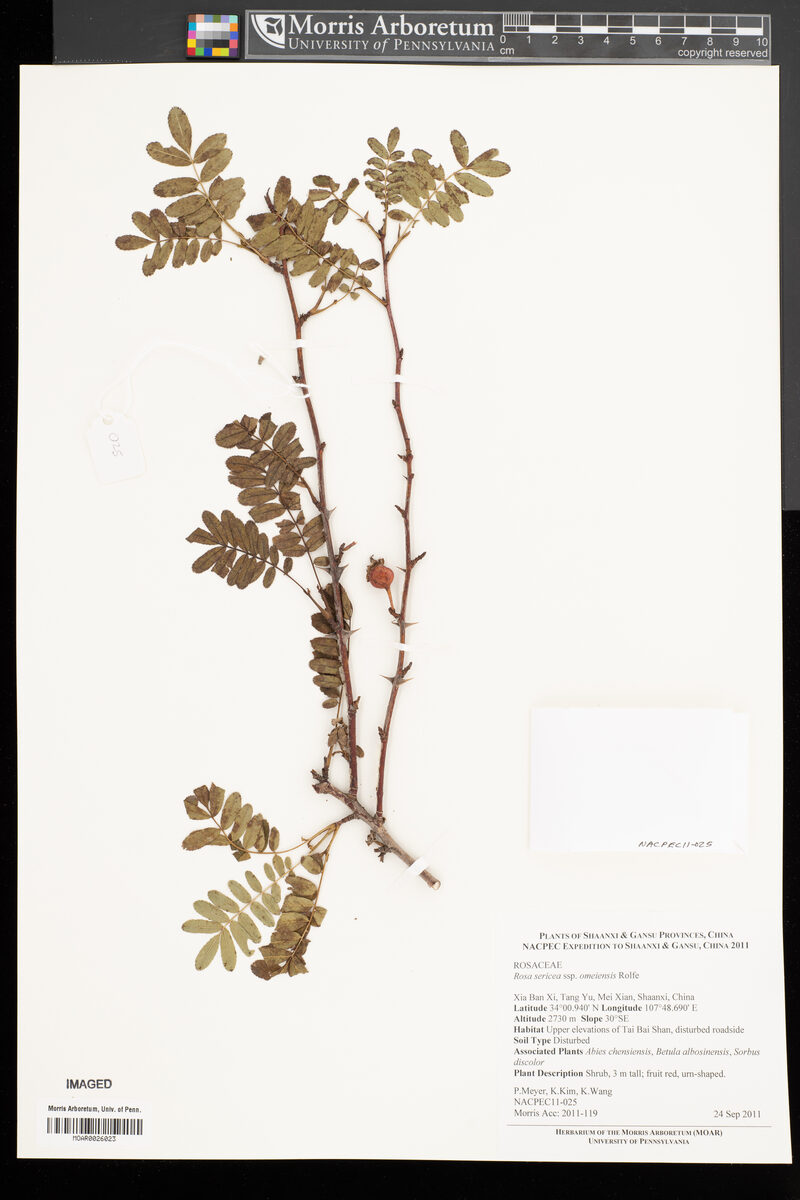
Rosa sericea omeiensis - (Rolfe.)A.V.Roberts.
Himalayan Rose
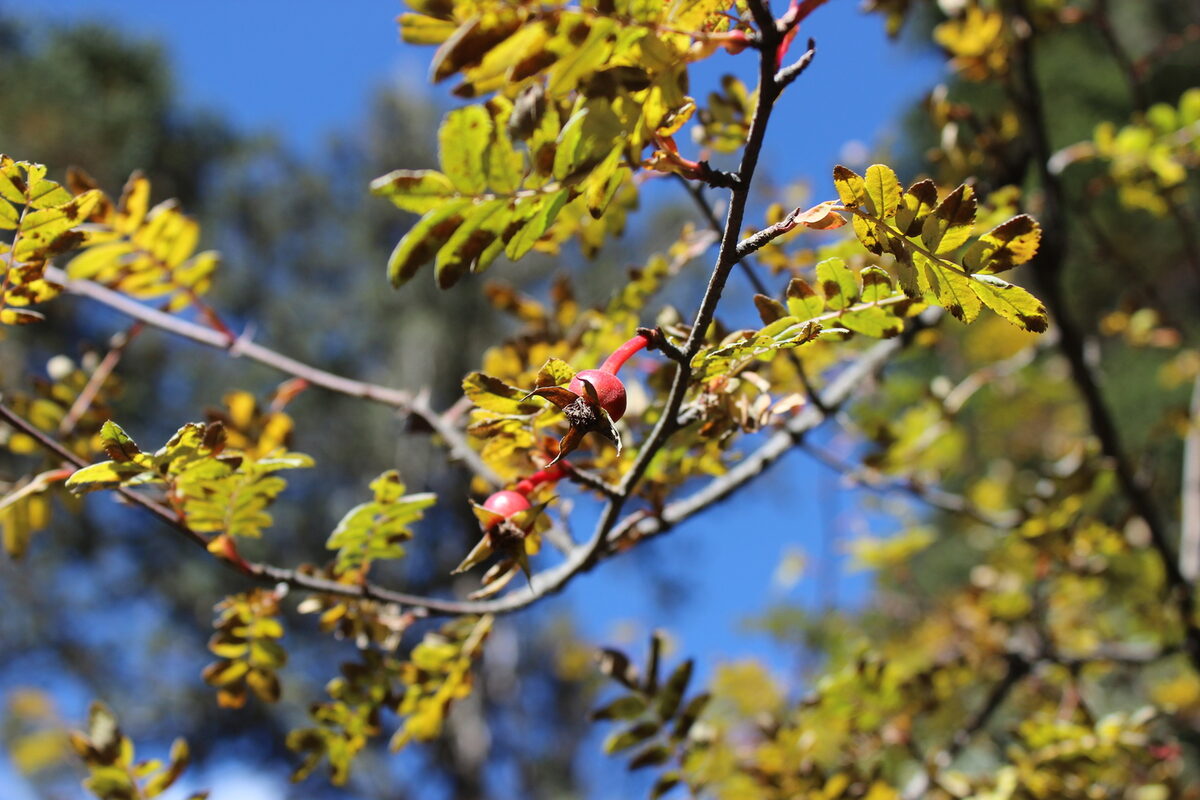
Rosa sericea pteracantha