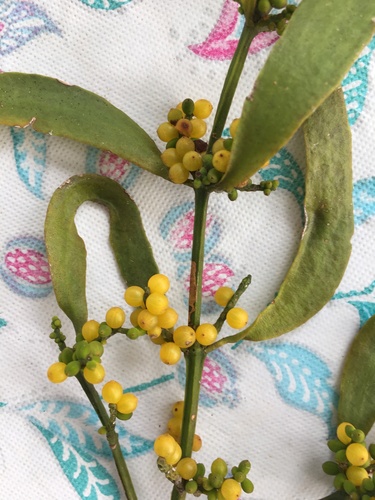
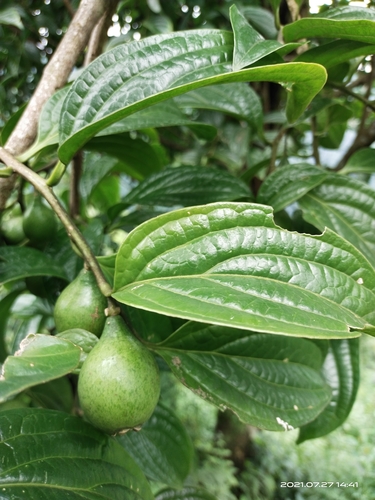
Viscum capense
L.f.
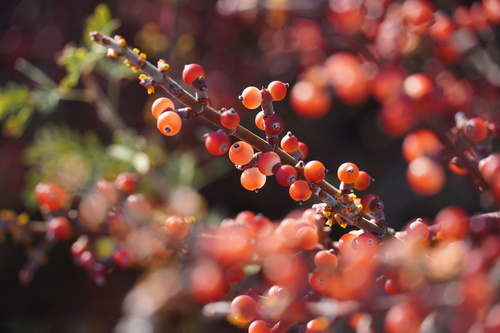
iNaturalist· cc-by-sa
(c) Andrew Gillespie, some rights reserved (CC BY-SA), uploaded by Andrew Gillespie
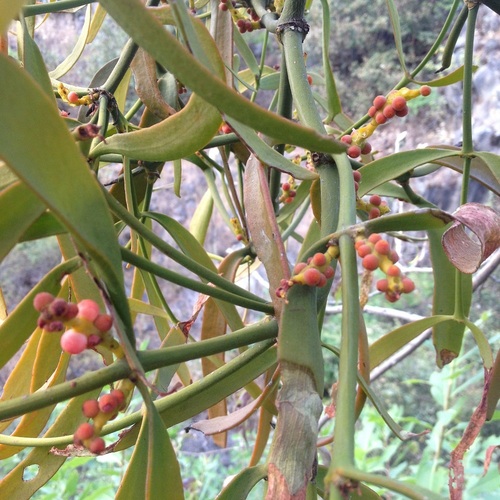
iNaturalist· cc-by-nc
(c) Angela Noske, some rights reserved (CC BY-NC), uploaded by Angela Noske
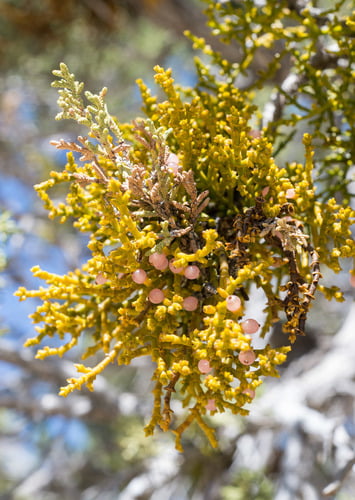
iNaturalist· cc-by-nc
(c) Samantha Montignies, some rights reserved (CC BY-NC), uploaded by Samantha Montignies
Summary
Source: WikipediaViscum capense (common name, Cape mistletoe) is a species of Mistletoe that is indigenous to South Africa, especially the area from Cape Town, northwards along the coast up to Namibia, and eastwards as far as the Eastern Cape province. This parasitic plant has jointed stems, vestigial leaves in the form of small scales around the stem nodes, and tiny yellowish-green flowers that produce translucent pale berries. The fruit is dispersed by birds. The plant is poisonous but is nonetheless used in traditional African medicine, the plant being boiled to make a tea that is used to soothe asthma. It is dioecious, with male and female flowers on separate plants.
Description
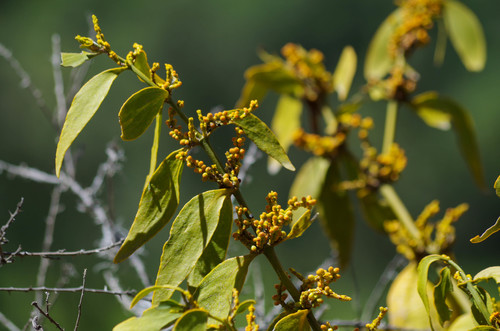
A plant that grows attached to shrubs. It is 50 cm long. The stems are rounded. The leaves are scale like. The fruit are smooth white berries. They are 3-4 mm long.
Edible Uses
The stems are chopped, browned near a fire, and brewed into tea. The smooth white fruit are eaten as a snack.
Traditional Uses
The stems are chopped and browned near the fire then used to make a tea. The fruit are eaten as a snack.
This uses section is brief — help expand it
Medicinal Uses
The stem tea is used traditionally.
Distribution
It is a subtropical plant.
Where It Grows
Africa, Namibia, South Africa, Southern Africa,
Notes
Also put in the family
Also Known As
Voelent, Voelentjie
References (3)
- De Vynk, J. C., et al, 2016, Indigenous edible plant use by contemporary Khoe-San descendants of South Africa's Cape South Coast. South African Journal of Botany. 102 (2016) 60-69
- Ruiters-Welcome, A. K., 2019, Food plants of southern Africa. Ph.D. thesis. Univ. of Johannesburg p 100
- Welcome, A. K. & Van Wyk, B.-E., 2019, An inventory and analysis of the food plants of southern Africa. South African Journal of Botany 122 (2019) 136–179