Quercus poilanei
Hickel & A. Camus
iNaturalist· cc-by-nc
(c) ytt, some rights reserved (CC BY-NC), uploaded by ytt
iNaturalist· cc-by-nc
(c) ytt, some rights reserved (CC BY-NC), uploaded by ytt
iNaturalist· cc-by-nc
(c) ytt, some rights reserved (CC BY-NC), uploaded by ytt
Summary
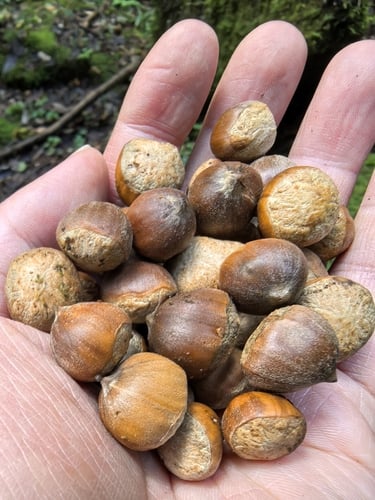
Source: WikipediaQuercus poilanei is an Asian species of tree in the family Fagaceae. It has been found in northern Indochina (Thailand and Vietnam) and also in the Province of Guangxi in southern China. It is placed in subgenus Cerris, section Cyclobalanopsis. Quercus poilanei is a tree up to 16 m. tall. Twigs are orange-brown with a felty coating of hairs. Leaves can be as much as 80 mm long. The acorn is ovoid-ellipsoid or globose, 15-20 × 13–15 mm, with a scar 5–7 mm in diameter.
Description
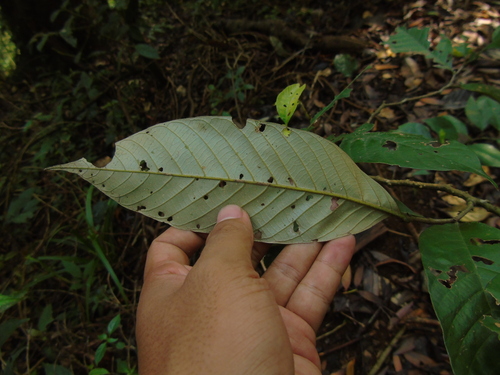
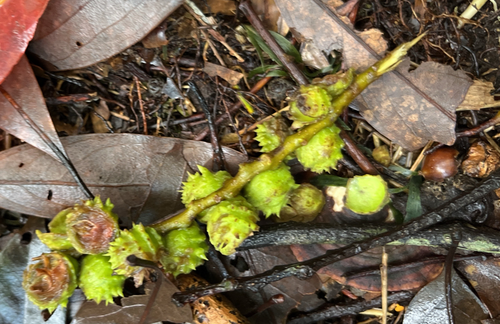
A tree. It grows 16 m tall. The small branches have a dense pale orange coating. The leaves are narrowly oval and 4-8 cm long by 3-6 cm wide. The female flowering shoots are at the ends of new shoots. There are 3-7 cupules that are bowl shaped and 1.5-1.8 cm across. The nuts are oval or round and 1.5-2 cm long by 1.3-1.5 cm wide.
Edible Uses
The bark is chewed, often traditionally combined with betel nut.
Traditional Uses
The nark is chewed with betel nut.
This uses section is brief — help expand it
Distribution
It is a tropical plant.
Where It Grows
Asia, China, SE Asia, Thailand,
Synonyms
References (2)
- Castillo, C., 2013, The Archaeobotany of Khao Sam Kaeo and Phu Khao Thong: The Agriculture of Late Prehistoric Southern Thailand. Ph. D. thesis University College, London p 380
- Flora of China (As Cyclobalanopsis poilanei)