Daphne mucronata
Royle
iNaturalist· cc-by-nc
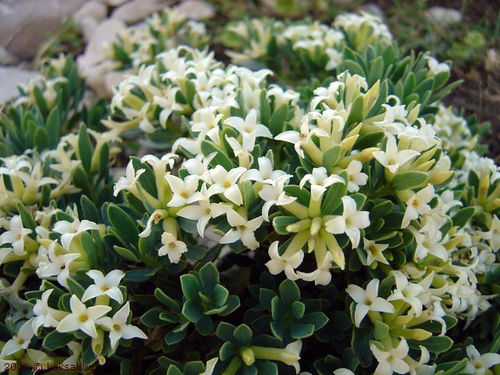
(c) skhussain, some rights reserved (CC BY-NC)
iNaturalist· cc-by-nc
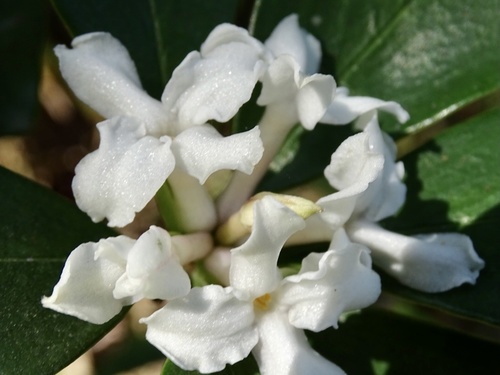
(c) Salman Baloch, some rights reserved (CC BY-NC)
iNaturalist· cc-by-nc
(c) Arya Aras, some rights reserved (CC BY-NC)
Summary
Source: WikipediaDaphne mucronata is a shrub, of the family Thymelaeaceae. It is native to western Asia, ranging from eastern Turkey to the Arabian Peninsula, Iran, Afghanistan, Pakistan, and the western Himalayas.
Description
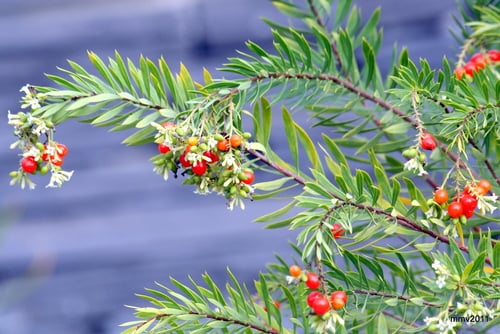
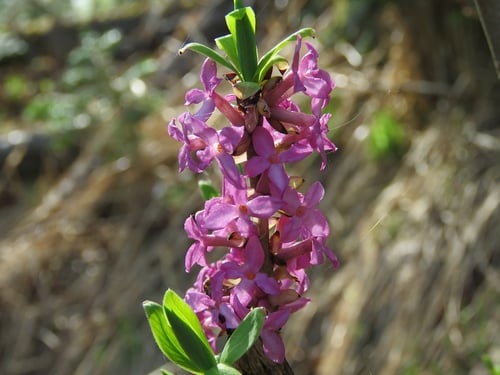
A shrub. It grows 2.5 m tall. The branches are slender and pale green. The leaves are alternate and scattered. They are 3-6 cm long by 0.4-1 cm wide. The flowers are white and in groups in the axils of leaves or at the ends of branches. The fruit are a flattened round shape and 1 cm long. They are hairy and orange.
Edible Uses
The fruit are eaten.
Distribution
It is a temperate plant. It grows between 800-3,000 m above sea level in Pakistan. It is often near rivers.
Where It Grows
Afghanistan, Africa, Asia, Himalayas, Iran, Middle East, North Africa, Pakistan,
Synonyms
Also Known As
Alef, Kheshk, Khoshak, Kutilal, Kuttilal, Laighonai, Lovomekeen, Pipal, Toye
References (4)
- Barkatullah, et al, 2009, Ethnobotanical studies of plants of Charkotli Hills, Batkhela District, Malakand, Pakistan. Front. Biol. China 2009, 4(4): 539–548
- Haj, F., et al, 2012, Species Diversity and Ethno Botanical Classes of the Flora of Allai Valley District Battagram Pakistan. International Journal of Plant Research 2012, 2(4): 111-123
- Jabeen, A., et al, 2009, Indigenous uses of economically important flora of Margallah Hills National Park, Islamabad, Pakistan. African Journal of Biotechnology Vol. 8 (5), pp. 763-784
- Khan, W., et al, 2013, Ethnomedicinal plants of Kakul Hills, District Abbottabad, KPK, Pakistan.