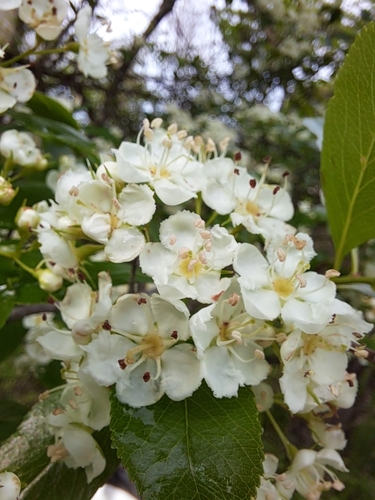
Crataegus canadensis
Sarg.
Canadian Hawthorn
iNaturalist· cc0
no rights reserved, uploaded by Étienne Lacroix-Carignan
iNaturalist· cc0
no rights reserved, uploaded by Étienne Lacroix-Carignan
iNaturalist· cc0
no rights reserved, uploaded by Étienne Lacroix-Carignan
Summary
Source: WikipediaA deciduous tree growing to 9 m tall, not frost tender. Flowers appear in May with seeds ripening by September. Hermaphrodite species pollinated by midges. Accommodates light sandy, medium loamy, and heavy clay soils. Suitable pH ranges from mildly acid to mildly alkaline. Grows in semi-shade or full sun, prefers moist or wet soil but tolerates drought. Withstands strong winds and atmospheric pollution but not maritime exposure.
Description
A deciduous tree growing to 9 m tall, not frost tender. Flowers appear in May with seeds ripening by September. Hermaphrodite species pollinated by midges. Accommodates light sandy, medium loamy, and heavy clay soils. Suitable pH ranges from mildly acid to mildly alkaline. Grows in semi-shade or full sun, prefers moist or wet soil but tolerates drought. Withstands strong winds and atmospheric pollution but not maritime exposure.
Edible Uses
The fruit, which measures up to 16mm long and 12mm wide with a thick flesh, can be eaten raw or cooked. It is suitable for pies and preserves and can also be dried for later use. Up to five fairly large seeds occupy the centre of each fruit, and they often fuse together, creating the sensation of eating a cherry-like fruit with a single stone.
Medicinal Uses
No species-specific research has been recorded, but the fruits and flowers of hawthorns are broadly recognised in herbal folk medicine as a heart tonic, a reputation reinforced by modern research. They have a hypotensive effect and serve as a mild, direct cardiac tonic, particularly for treating a weak heart combined with high blood pressure. Prolonged use is necessary for the treatment to be effective, and it is normally taken as a tea or tincture.
Distribution
It is a temperate plant.
Where It Grows
Canada, North America,
Cultivation
A very easily grown plant, it prefers a well-drained moisture retentive loamy soil but is not at all fussy. Once established, it succeeds in excessively moist soils and also tolerates drought. It grows well on a chalk soil and also in heavy clay soils. A position in full sun is best when plants are being grown for their fruit, they also succeed in semi-shade though fruit yields and quality will be lower in such a position. Most members of this genus succeed in exposed positions, they also tolerate atmospheric pollution. Very closely related to C. mollis, and considered to be part of that species by many botanists. Hybridizes freely with other members of this genus. Seedling trees take from 5 - 8 years before they start bearing fruit, though grafted trees will often flower heavily in their third year. The flowers have a foetid smell somewhat like decaying fish. This attracts midges which are the main means of fertilization. When freshly open, the flowers have more pleasant scent with balsamic undertones. Seedlings should not be left in a seedbed for more than 2 years without being transplanted.
Propagation
Sow seed fresh in a cold frame in autumn; some may germinate the following spring, though most will likely need another year. Stored seed germinates slowly and erratically — warm stratify for 3 months at 15°C, then cold stratify for 3 months at 4°C, and germination may still be delayed a further 18 months. Scarifying before stratification may help, and fermenting the seed in its own pulp for a few days can also speed up the process. Harvesting seed green — once the embryo is fully formed but before the seedcoat hardens — and sowing immediately in a cold frame is another option for spring germination. Pot seedlings individually when large enough to handle, growing on through the first year before planting out in late spring. For larger quantities, sow directly into a protected outdoor seedbed and undercut roots if left undisturbed for more than two years.
Other Uses
The wood is heavy, hard, tough, and close-grained, lending itself to tool handles, mallets, and other small wooden items. The plant is also noted for its scent.
Notes
There are 200 or more Crataegus species.
References (2)
- Plants for a Future database, The Field, Penpol, Lostwithiel, Cornwall, PL22 0NG, UK. http://www.scs.leeds.ac.uk/pfaf/
- Rhodora 3:73. 1901
More from Rosaceae
Crataegus clarkei
Crataegus coccinea
Kansas hawthorn, Scarlet hawthorn
Crataegus coccinioides
Columbian hawthorn, Kansas hawthorn, Mississippi hawthorn
Crataegus coccinoides
Kansas Hawthorn
Crataegus columbiana
Columbia Hawthorn, Red hawthorn
Crataegus crus-galli
Cockspur hawthorn, Cockspurthorn, Hog-apple, Newcastle-thorn