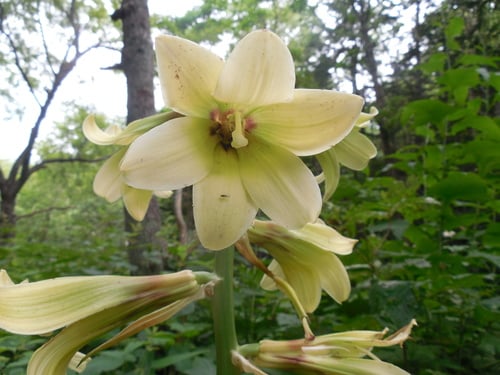
Fritillaria delavayi
Franch.
iNaturalist· cc-by-nc
(c) narido, some rights reserved (CC BY-NC)
iNaturalist· cc-by-nc
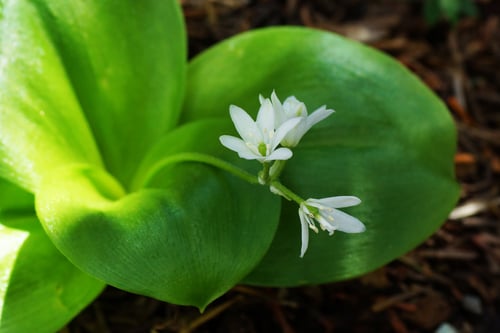
(c) Zhaoqi Leng, some rights reserved (CC BY-NC)
iNaturalist· cc-by-nc
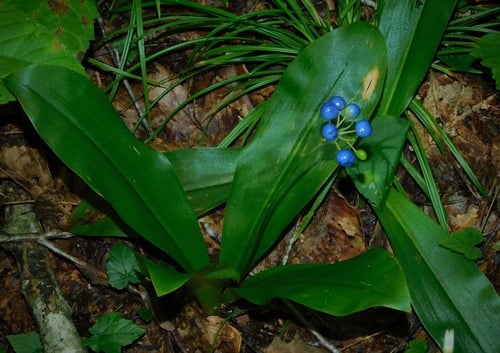
(c) gillianspix, some rights reserved (CC BY-NC)
Description
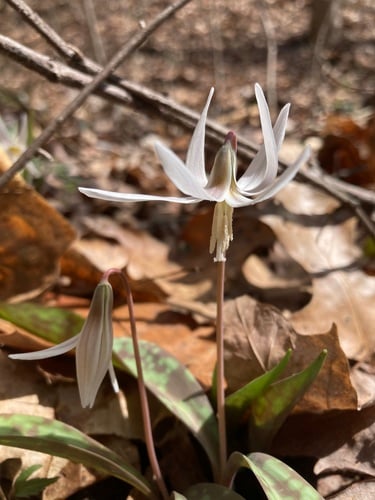
A bulb plant. It has 2-3 scales. They are oval and 1-2 cm across. The stem is 15-35 cm tall. It is often covered with a wax like layer near the base. There are 3-5 leaves. They are closely arranged in the middle of the stem. The leaves are narrowly oval and 2-7 cm long by 1-3 cm wide. The flowering part has 1 flower.
Edible Uses
The bulbs of a few species, such as F. affinis, F. camschatcensis, and F. pudica, are edible if prepared carefully. They were commonly eaten by indigenous peoples of the Pacific Northwest coast of North America. The wild species flowering in areas such as Iran have become important for ecotourism, when in late May people come to the Valley of Roses, near Chelgerd, to see F. imperialis blooming. The area is also rich in F. reuteri and F. gibbosa.
Medicinal Uses
Fritillaria, like other members of the family Liliaceae, contain flavonol glycosides and tri- and diferulic-acid sucrose esters, steroidal alkaloids, saponins and terpenoids that have formed the active ingredients in traditional medicine (see Traditional medicine). Certain species have flowers that emit disagreeable odors that have been referred to as phenolic, putrid, sulfurous, sweaty and skunky. The scent of Fritillaria imperialis has been called "rather nasty", while that of F. agrestis, known commonly as stink bells, is reminiscent of canine feces. On the other hand, F. striata has a sweet fragrance. The "foxy" odor of F. imperialis has been identified as 3-methyl-2-butene-1-thiol (dimethylallyl mercaptan), an alkylthiol. Because of their large genome size, Fritillaria species are an important source for genomic studies of the processes involved in genome size diversity and evolution. They also have important commercial value both in horticulture and traditional medicine. Species of Fritillaria have been used in traditional medicine in China for over 2,000 years, and are one of the most widely used medicines today. The production of medicines from F. cirrhosa is worth US$400 million per annum. Although some are cultivated for this purpose, most are gathered in the wild. In recent years demand has increased leading to over-harvesting of wild populations. In addition to China, Fritillaria products are used medicinally in the Himalayas, including India, Nepal and Pakistan, as well as Japan, Korea and Southeast Asia. To meet the demand additional countries such as Turkey and Burma are involved in the collection. The products are used mainly as antitussives, expectorants, and antihypertensives. The active ingredients are thought to be isosteroidal and steroidal alkaloid compounds. Chinese sources suggest 16 species as source material, but this may be an overestimate due to the large number of synonyms in Chinese. Of these, 15 are in subgenus Fritillaria (both subclades), but one (F. anhuiensis) is in subgenus Liliorhiza. F. imperialis also has a long history of medicinal usage in China and Iran. Fritillaria extracts (fritillaria in English, bulbus fritillariae cirrhosae in Latin) are used in traditional Chinese medicine under the name chuan bei mu (literally "Shell mother from Sichuan", or just beimu). Species such as F. cirrhosa, F. thunbergii and F. verticillata are used in cough remedies. They are listed as chuān bèi (Chinese: 川貝/川贝) or zhè bèi (Chinese: 浙貝/浙贝), respectively, and are often in formulations combined with extracts of loquat (Eriobotrya japonica). Fritillaria verticillata bulbs are also traded as bèi mǔ or, in Kampō, baimo (Chinese/Kanji: 貝母, Katakana: バイモ). In one study fritillaria reduced airway inflammation by suppressing cytokines, histamines, and other compounds of inflammatory response.
Known Hazards
Most fritillaries contain poisonous steroidal alkaloids such as imperialin in the bulbs and some may even be deadly if ingested in quantity.
Distribution
It is a subtropical plant.
Where It Grows
Asia, Bhutan, China, Himalayas,
Synonyms
References (1)
- Yeshi, K. et al, 2017, Taxonomical Identification of Himalayan Edible Medicinal Plants in Bhutan and the Phenolic Contents and Antioxidant Activity of Selected Plants. TBAP 7 (2) 2017 pp 89 - 106