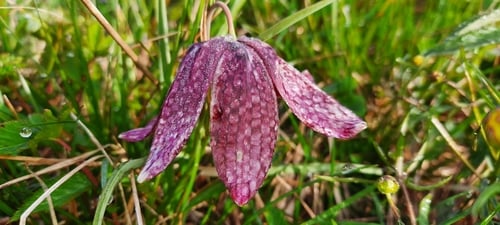
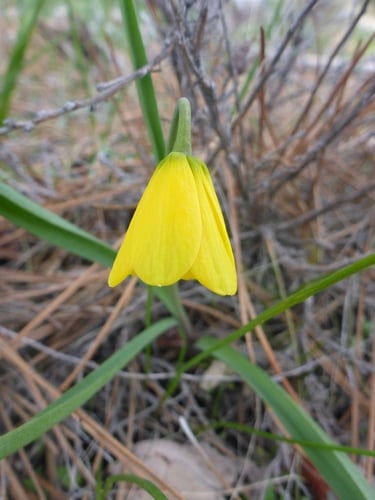
Fritillaria verticillata
Willd.
Baimo
iNaturalist· cc-by-nc
(c) Алексей Эбель, some rights reserved (CC BY-NC), uploaded by Алексей Эбель
iNaturalist· cc-by-nc
(c) Алексей Эбель, some rights reserved (CC BY-NC)
Summary
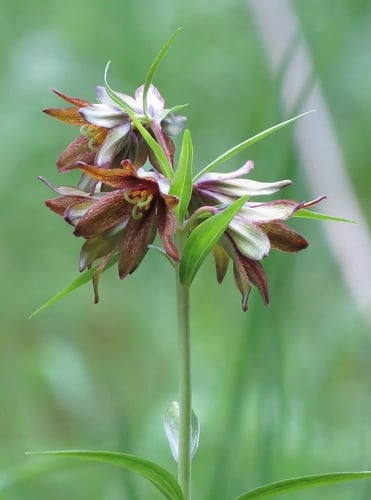
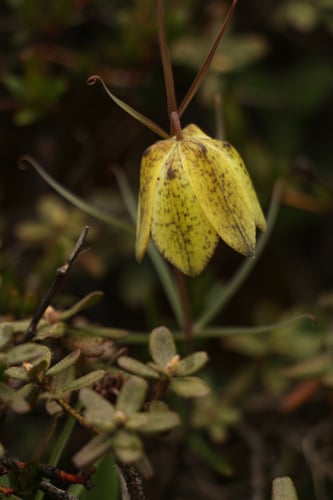
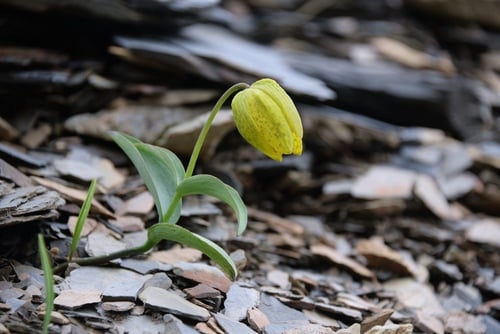
Source: WikipediaFritillaria verticillata is a flowering plant in the lily family Liliaceae, native to Japan, Korea, Mongolia, Xinjiang, Kazakhstan and the Altay region of Siberia. It can grow to 60 cm (23.5 in) tall, usually with one flower at the top, but sometimes with as many as five. The leaves are mostly in whorls, with 4-7 leaves per node, each up to 10 cm long but rarely more than 10 mm across. The flowers are pendent, nodding, bell-shaped, white or pale yellow, sometimes with purple spots. It formerly included the variety Fritillaria verticillata var. thunbergii - now called Fritillaria thunbergii.
Description
A bulb plant. It grows 60 cm high. The leaves are slender and mid green and in rings. There are 2 leaves opposite each other at the base then 4-7 leaves in a ring. The flowers are in loose spikes or up to 15 bell shaped flowers. They are white with faint green lines.
Edible Uses
The bulb, about 2cm in diameter, can be cooked or candied. Young plants can be cooked and used in soups, though harvesting the young plant will greatly reduce the vigour of the bulb and could even kill it. Petals and flower buds are also edible when cooked, and are used in soups.
Traditional Uses
The young plants, petals and flower buds are parboiled and used in soups, and seasoned potherbs. They are also cooked with soy sauce. The bulbs are eaten fried or candied. Caution: Most fritillarias are poisonous if eaten.
Medicinal Uses
The bulbs are antidote, antitussive, astringent, expectorant, galactogogue, and purgative. They contain fritimine, which diminishes excitability of respiratory centres, paralyses voluntary movement, and counters the effects of opium. The bulbs are used internally for coughs, bronchitis, pneumonia, feverish illnesses, and abscesses, and have a folk history of use against breast and lung cancer in China. This remedy should only be used under the supervision of a qualified practitioner, as excessive doses can cause breathing difficulties and heart failure. Bulbs are harvested in winter while dormant and dried for later use.
Distribution
It is a temperate plant. It is native to the mountains of Central Asia. It grows in gravelly meadows between 1,300-2,000 m above sea level. It suits hardiness zones 5-9.
Where It Grows
Asia, Australia, Central Asia*, China, Kazakhstan, Russia, Siberia, Tasmania, Tibet,
Cultivation
Prefers a moist peaty soil in the open garden. Easily grown in a moderately fertile soil in sun or semi-shade. Succeeds in drier soils and is drought tolerant when established. The scaly bulbs are best planted on their sides or surrounded in sand to prevent water collecting in their hollow crowns. Cultivated as a medicinal plant in Japan, the sub-species F. verticillata thunbergii. Baker. is most often used. (this species is now known as F. thunbergii. q.v.). Plants take 3 - 5 years to flower from seed.
Propagation
Seed is best sown as soon as ripe in a cold frame, where it should germinate in spring. Protect from frost. Stored seed should be sown as soon as possible and may take a year or more to germinate. Sow thinly to avoid the need to prick out seedlings. After germination, give occasional liquid feeds to prevent mineral deficiency. When plants die down at the end of their second growing season, divide the small bulbs and plant 2–3 per 8cm deep pot. Grow on for at least another year in light shade in the greenhouse before planting out while dormant. Divide offsets in August — larger bulbs can go directly into permanent positions, while smaller ones are best potted and grown on in a cold frame for a year before autumn planting. Propagation by bulb scales is also possible.
Other Uses
None known.
Other Information
It is a cultivated food plant.
Notes
There are about 100 Fritillaria species.
References (5)
- Facciola, S., 1998, Cornucopia 2: a Source Book of Edible Plants. Kampong Publications, p 143
- Hibbert, M., 2002, The Aussie Plant Finder 2002, Florilegium. p 104
- Lim, T. K., 2015, Edible Medicinal and Non Medicinal Plants. Volume 9, Modified Stems, Roots, Bulbs. Springer p 43
- Plants for a Future database, The Field, Penpol, Lostwithiel, Cornwall, PL22 0NG, UK. http://www.scs.leeds.ac.uk/pfaf/
- Tanaka,