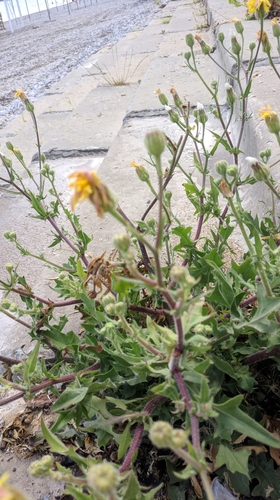
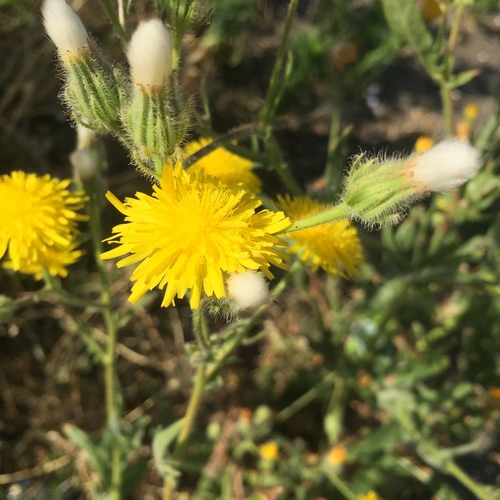
Cosmos sulphureus
Cav.
Yellow cosmos, Sulfur cosmos
iNaturalist· cc-by
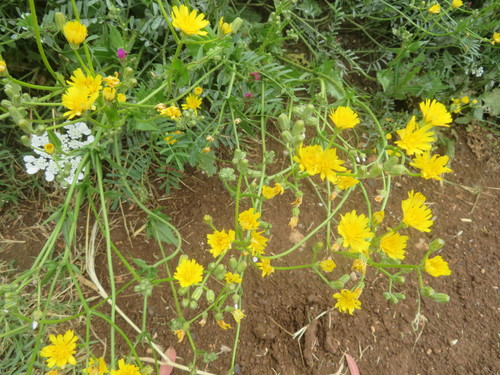
(c) Annika Lindqvist, some rights reserved (CC BY), uploaded by Annika Lindqvist
iNaturalist· cc-by-nc
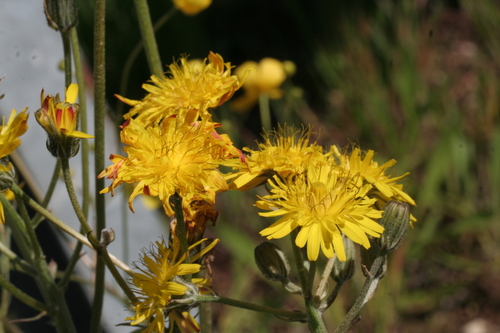
(c) ethan_hagen2004, some rights reserved (CC BY-NC)
iNaturalist· cc-by-nc
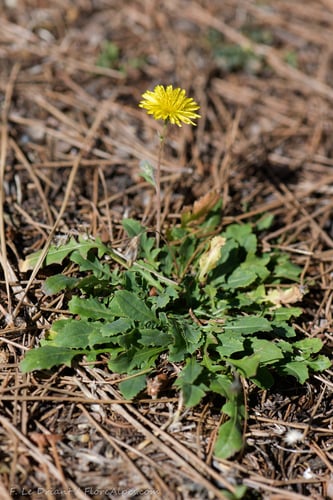
(c) Bodo Nuñez Oberg, some rights reserved (CC BY-NC), uploaded by Bodo Nuñez Oberg
Summary
Source: WikipediaCosmos sulphureus is a species of flowering plant in the sunflower family Asteraceae, also known as sulfur cosmos and yellow cosmos. It is native to Mexico, Central America, and northern South America, and naturalized in other parts of North and South America as well as in Europe, Asia, and Australia. This plant was declared invasive by the United States Southeast Exotic Pest Plant Council in 1996. The flowers of all Cosmos attract birds and butterflies, including the monarch butterfly.
Description
A perennial herb. It grows to 1 m high and spreads to 50 cm across. The stem is erect, slender and very delicate. The leaves are finely divided 2 or 3 times, with fine narrow lobes. The flowers are yellow. They are in open, bowl-shaped flower heads, and these are borne in clusters. These are 3.5-6 cm across.
Edible Uses
The leaves are eaten raw or cooked and used as a spice or flavouring, often rolled in rice paper with meat, fish, or vegetables. The flowers are also edible, and leaves are sold in markets in Indonesia.
Traditional Uses
The leaves are eaten raw or cooked. They are used as a spice or flavouring. They are rolled in rice paper with meat, fish or other vegetables.
This uses section is brief — help expand it
Medicinal Uses
Young shoots are eaten raw or cooked in Indonesia under the name of lalab or gudang. The flowers are a dye, producing an orange-yellow dye, used in pre-Columbian America and later in southern Africa to dye wool. In Thailand, they are consumed in salads or herbal tea with the effect of inhibiting pancreatic lipase. According to a Pakistani team (2017), in rats subjected to a high dose of paracetamol, extract of the plant has a hepatoprotective effect. A Ukrainian publication (2017) attributes to a bread containing 10% dry extract of Cosmos sulphureus a good note for its organoleptic qualities.
Distribution
A tropical plant. It grows best on light well-drained soil. It needs an open sunny position. It is drought and frost resistant. It needs a temperature above 5°C to grow. It Vietnam it grows up to 1,200 m above sea level. In Argentina it grows below 500 m above sea level. It suits hardiness zones 7-11.
Where It Grows
Africa, Argentina, Asia, Australia, Cambodia, Central America, Central Asia, China, Cuba, Dominican Republic, East Africa, Eswatini, Fiji, Haiti, Hawaii, India, Indochina, Indonesia, Korea, Marquesas, Mexico*, Mozambique, Myanmar, Nepal, Niue, North America, Pacific, Papua New Guinea, PNG, Paraguay, Philippines, Rotuma, SE Asia, Slovenia, Southern Africa, South America, Swaziland, Tajikistan, Thailand, USA, Vietnam, West Indies,
Cultivation
It is grown by seeds sown directly into the site where they are to grow.
Propagation
Seed - sow in situ.
Other Uses
The flower heads of this species, plus many other Cosmos, Bidens and Coreopsis species, were major sources of yellow to orange dyes among the pre-Columbian civilizations of Central and South America. In southern Africa, they were adopted as a popular yellow dye by European settlers for domestic textile production and are still used by dyers using natural dyes as a hobby or for textile crafts, to dye wool bright yellow or orange. The flowers should first be boiled for about one hour before adding the mordanted wool to the cooled dye-bath and resuming boiling. Pre-mordanting the fibres with different metallic salts gives various shades of lemon yellow to burnt orange. As a top-dye after a first red dyewood bath (e.g. of Baphia nitida Lodd.), it helps give a scarlet bloom to wool while on indigo-dyed wool, it produces greenish-brown shades. The flower heads of most Cosmos, Bidens, and Coreopsis species contain flavonoid dyes of the chalcone and aurone groups. The specific flavonoids in Cosmos have not been fully elucidated, though the following have been found: luteolin, a group of flavonols having quercetin as their aglycone, and a group of chalcone glycosides. These are all good yellow colorants. The flower heads of about two dozen plants are sufficient to dye 0.5 kg of wool or silk. They should be harvested when they open. They are soaked in water and the mixture is cooked until the flower heads become pale. The dye bath is yellowish in an acid solution (e.g. With vinegar) and reddish in a basic solution (e.g. With ammonia or washing soda). Alum and tartaric acid are often added as a mordant. The textile is simmered in the dye bath until the desired depth of colour is achieved, usually after about one hour.
Other Information
It is not known if they are eaten in Papua New Guinea. The leaves are sold in markets in Indonesia. It is a cultivated food plant.
Notes
There are about 25 Cosmos species.
Synonyms
Also Known As
Kembang goyang, Orange cosmos, Paw-me-tar, Putali phul, Randa meedang, Rumena kozmeja, Sein-chai-kadipa, Sva'y anlu'ek
References (17)
- Ambasta, S.P. (Ed.), 2000, The Useful Plants of India. CSIR India. p 143
- Anderson, E. F., 1993, Plants and people of the Golden Triangle. Dioscorides Press. p 207
- Benvenuti, S. & Mazzoncini, M., 2021, The Biodiversity of Edible Flowers: Discovering New Tastes and New Health Benefits. Frontiers in Plant Science Article 569499.
- Bodkin, F., 1991, Encyclopedia Botanica. Cornstalk publishing, p 289
- Borrell, O.W., 1989, An Annotated Checklist of the Flora of Kairiru Island, New Guinea. Marcellin College, Victoria Australia. p 63
Show all 17 references Hide references
- Brickell, C. (Ed.), 1999, The Royal Horticultural Society A-Z Encyclopedia of Garden Plants. Convent Garden Books. p 306
- Burnie, G. (Ed.), 2003, Annuals and Bulbs. The Gardener's Handbooks. Fog City Press. p 148
- Cundall, P., (ed.), 2004, Gardening Australia: flora: the gardener's bible. ABC Books. p 425
- Icon. 1(3):56, t. 79. 1791
- Martin, F.W. & Ruberte, R.M., 1979, Edible Leaves of the Tropics. Antillian College Press, Mayaguez, Puerto Rico. p 184
- Ochse, J.J. et al, 1931, Vegetables of the Dutch East Indies. Asher reprint. p 127
- Phon, P., 2000, Plants used in Cambodia. © Pauline Dy Phon, Phnom Penh, Cambodia. p 174
- Plants of Haiti Smithsonian Institute http://botany.si.edu
- Seidemann J., 2005, World Spice Plants. Economic Usage, Botany, Taxonomy. Springer. p 118
- Swaziland's Flora Database http://www.sntc.org.sz/flora
- Tanaka, Y. & Van Ke, N., 2007, Edible Wild Plants of Vietnam: The bountiful garden. Orchid books. p 39
- Terra, G.J.A., 1973, Tropical Vegetables. Communication 54e Royal Tropical Institute, Amsterdam, p 41