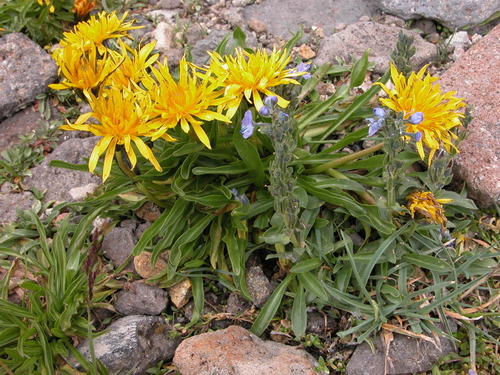
Chamaemelum nobile
(L.) All.
Roman chamomile
iNaturalist· cc-by
(c) Duarte Frade, some rights reserved (CC BY), uploaded by Duarte Frade
iNaturalist· cc-by-nc
(c) georgetelehin, some rights reserved (CC BY-NC)
iNaturalist· cc-by-nc
(c) georgetelehin, some rights reserved (CC BY-NC)
Summary
Source: WikipediaChamaemelum nobile, commonly known as chamomile (also spelled camomile), is a low perennial plant found in dry fields and around gardens and cultivated grounds in Europe, North America, and South America. Its synonym is Anthemis nobilis, with various common names, such as Roman chamomile, English chamomile, garden chamomile, ground apple, low chamomile, mother's daisy or whig plant. C. nobile is one source of the herbal product known as chamomile using dried flowers for flavoring teas or as a fragrance used in aromatherapy. Chamomile has no established medicinal properties.
Description
A herb. It lies along the ground. It is spreading with fine feathery leaves. The flowers occur in single heads on the stems and are daisy like.
This description is brief — help expand it
Edible Uses
Young sprigs are used as a seasoning and can be used to flavour herb beers, along with the whole herb. The fresh or dried flowers are used to make herbal teas, which have a strong aromatic scent and a bitter flavour — this is especially pronounced in the single-flowered form.
Traditional Uses
The flowers are used for herbal teas and for making liqueur.
This uses section is brief — help expand it
Medicinal Uses
Chamomile has a long history of safe and effective use as a household herbal remedy. It is particularly valued for digestive complaints, as a sedative, and as a nervine, and is considered especially suitable for young children. Tea made from the flowers should be prepared in a covered vessel to prevent loss of the essential oils. The flowers are anodyne, anti-inflammatory, antispasmodic, nervine, stomachic, tonic, and vasodilatory. The single-flowered form is medicinally the most potent, but in large doses it can damage the lining of the stomach and bowels; for this reason the double-flowered form is generally preferred, as it contains less of the responsible alkaloid. Flowers are gathered in summer when fully open and either distilled for their essential oil or dried for later use; they should not be stored for more than 12 months. The whole herb can be made into a lotion for external use in treating toothache, earache, and neuralgia. The essential oil is used in aromatherapy, where its keyword is 'Soothing'. The German Commission E Monographs approve Chamaemelum nobile for coughs and bronchitis, fevers and colds, skin inflammations, inflammation of the mouth and pharynx, supporting immunity against infection, and the treatment of wounds and burns.
Known Hazards
Chamomile is likely unsafe for use during pregnancy, and its topical use for skin disorders may cause contact dermatitis. Consuming chamomile tea may adversely affect anticoagulant drugs.
Distribution
It is a Mediterranean climate plant. It grows in sandy and slightly acidic soils. It suits hardiness zones 6-9.
Where It Grows
Africa, Asia, Australia, Britain, Canada, Canary Islands, China, Europe, Ireland, Mediterranean, Mexico, North Africa, North America, Portugal, Spain, Tasmania, USA,
Propagation
Sow seed in March in a cold frame, barely covering it and keeping the compost consistently moist. Once large enough to handle, prick seedlings into individual pots and plant out into permanent positions in summer. Divide plants in spring or autumn — large clumps can go directly into permanent positions, while smaller clumps are better potted up and grown on in a cold frame until rooting well, then planted out in summer or the following spring. Basal cuttings can be taken in spring; harvest shoots when around 5cm long with plenty of underground stem, pot individually, and keep in light shade in a cold frame or greenhouse until rooting well before planting out in summer.
Other Uses
Chamomile works well as a ground cover and attracts beneficial insects, making it a useful companion plant. An infusion of the flowers can be used as a hair shampoo, particularly for fair hair, and as a liquid feed and general plant tonic with activity against a number of plant diseases. It has fungicidal properties and is said to help prevent damping off in seedlings. The flowers are an ingredient of 'QR' herbal compost activator, a dried and powdered herbal mixture added to compost heaps to accelerate bacterial activity and shorten composting time. The whole plant was formerly used as a strewing herb and acts as an insect repellent both when growing and when dried. An essential oil from the whole plant is used as a flavouring and in perfumery. Yellow to gold dyes can be obtained from the flowers. The plant functions as a dynamic accumulator, drawing minerals and nutrients from the soil and storing them in a more bioavailable form suitable for use as fertiliser or mulch improver. The flowers are rich in nectar and pollen and attract a range of pollinators, particularly bees.
Other Information
It is a cultivated plant.
Notes
It is also considered a medicine.
Also Known As
Flower head, Mantzanillea, Manzanilla, Manzanilla amarga, Noble chamamile
References (13)
- Aceituno-Mata, L., et al, 2021, The Persistence of Flavor: Past and Present Use of Wild Food Plants in Sierra Norte de Madrid, Spain. Front. Sustain. Food Syst., 11 January 2021
- Blanco-Salas, J., et al, 2019, Wild Plants Potentially Used in Human Food in the Protected Area “Sierra Grande de Hornachos” of Extremadura (Spain). Sustainability 2019, 11, 456
- Hui, Y. H., Handbook of Food Science, Technology, and Engineering. Volume 2. Table 98:8
- Gonzalez, J. A., et al, 2011, The consumption of wild and semi-domesticated edible plants in the Arribes del Duero (Salamanca-Zamora, Spain): an analysis of traditional knowledge. Genetic. Resour Crop Evolution 58:991-1006
- Irving, M., 2009, The Forager Handbook, A Guide to the Edible Plants of Britain. Ebury Press p 145
Show all 13 references Hide references
- Jackes, D. A., Edible Forest Gardens
- Menendez-Baceta, G., et al, 2012, Wild edible plants traditionally gathered in Gorbeialdea (Biscay, Basque Country) Genetic Resources and Crop Evolution 59:1329-1347
- Pardo-de-Santayana, M., et al, 2005, The gathering and consumption of wild edible plants in the Campoo (Cantabria, Spain). International Journal of Food Sciences and Nutrition. 56(7): 529-542
- Pardo-de-Santayana, M., et al, 2007, Traditional knowledge of wild edible plants used in the northwest of the Iberian Peninsula (Spain and Portugal): a comparative study. Journal of Ethnobiology and Ethnomedicine 2007, 3:27
- Seidemann J., 2005, World Spice Plants. Economic Usage, Botany, Taxonomy. Springer. p 95
- Tardio, J., et al, Ethnobotanical review of wild edible plants in Spain. Botanical J. Linnean Soc. 152 (2006), 27-71
- Wiersema, J. H. & Leon, B., 2013, World Economic Plants. A Standard Reference CRC Press. 2nd Ed. p 166
- World Checklist of Useful Plant Species 2020. Royal Botanic Gardens, Kew